Björn Grabbet, Abdullah Taiem, Răzvan C. Cioc, Pieter C. A. Bruijnincx, Arnaud Thevenon
{"title":"具有不常见反应活性的高应变三环氧化降冰片烯可实现热性能高的聚烯的快速 ROMP","authors":"Björn Grabbet, Abdullah Taiem, Răzvan C. Cioc, Pieter C. A. Bruijnincx, Arnaud Thevenon","doi":"10.1021/acs.macromol.4c02601","DOIUrl":null,"url":null,"abstract":"Bioderived monomers, readily available from biomass via atom- and redox-efficient processes, will need to play a major role in the development of sustainable polymeric materials. Here, we show that a family of tricyclic monomers, efficiently made from biobased furans via Diels–Alder chemistry, allows the production of polyenes with diverse thermo/physical properties through ring opening metathesis polymerization (ROMP). Via small structural variations, we offer insight into the intricacies of monomer design and its implications for polymerization. Notably, the thermostable polyenes all show very similar head-to-tail regioregularities, <i>trans</i>-linkage isomerism distributions, and narrow dispersities. Additionally, the monomers exhibit rare reactivity with ethyl vinyl ether, which can be used as a chain transfer agent, enabling the synthesis of monotelechelic polyenes. The monomers do differ substantially in polymerization rate, spanning two orders of magnitude, in the extent of molecular weight control and in the properties of the resulting amorphous polymers. With glass transition temperatures ranging from 116 to 217 °C and degradation temperatures exceeding 350 °C, these materials are among the highest performing biobased homopolymers reported. We elucidate these variations, demonstrating that the ROMP is profoundly influenced by subtle structural changes in the monomers.","PeriodicalId":51,"journal":{"name":"Macromolecules","volume":"23 1","pages":""},"PeriodicalIF":5.2000,"publicationDate":"2025-04-04","publicationTypes":"Journal Article","fieldsOfStudy":null,"isOpenAccess":false,"openAccessPdf":"","citationCount":"0","resultStr":"{\"title\":\"Highly Strained Tricyclic Oxanorbornenes with Uncommon Reactivity Enable Rapid ROMP for Thermally High-Performing Polyenes\",\"authors\":\"Björn Grabbet, Abdullah Taiem, Răzvan C. Cioc, Pieter C. A. Bruijnincx, Arnaud Thevenon\",\"doi\":\"10.1021/acs.macromol.4c02601\",\"DOIUrl\":null,\"url\":null,\"abstract\":\"Bioderived monomers, readily available from biomass via atom- and redox-efficient processes, will need to play a major role in the development of sustainable polymeric materials. Here, we show that a family of tricyclic monomers, efficiently made from biobased furans via Diels–Alder chemistry, allows the production of polyenes with diverse thermo/physical properties through ring opening metathesis polymerization (ROMP). Via small structural variations, we offer insight into the intricacies of monomer design and its implications for polymerization. Notably, the thermostable polyenes all show very similar head-to-tail regioregularities, <i>trans</i>-linkage isomerism distributions, and narrow dispersities. Additionally, the monomers exhibit rare reactivity with ethyl vinyl ether, which can be used as a chain transfer agent, enabling the synthesis of monotelechelic polyenes. The monomers do differ substantially in polymerization rate, spanning two orders of magnitude, in the extent of molecular weight control and in the properties of the resulting amorphous polymers. With glass transition temperatures ranging from 116 to 217 °C and degradation temperatures exceeding 350 °C, these materials are among the highest performing biobased homopolymers reported. We elucidate these variations, demonstrating that the ROMP is profoundly influenced by subtle structural changes in the monomers.\",\"PeriodicalId\":51,\"journal\":{\"name\":\"Macromolecules\",\"volume\":\"23 1\",\"pages\":\"\"},\"PeriodicalIF\":5.2000,\"publicationDate\":\"2025-04-04\",\"publicationTypes\":\"Journal Article\",\"fieldsOfStudy\":null,\"isOpenAccess\":false,\"openAccessPdf\":\"\",\"citationCount\":\"0\",\"resultStr\":null,\"platform\":\"Semanticscholar\",\"paperid\":null,\"PeriodicalName\":\"Macromolecules\",\"FirstCategoryId\":\"92\",\"ListUrlMain\":\"https://doi.org/10.1021/acs.macromol.4c02601\",\"RegionNum\":1,\"RegionCategory\":\"化学\",\"ArticlePicture\":[],\"TitleCN\":null,\"AbstractTextCN\":null,\"PMCID\":null,\"EPubDate\":\"\",\"PubModel\":\"\",\"JCR\":\"Q1\",\"JCRName\":\"POLYMER SCIENCE\",\"Score\":null,\"Total\":0}","platform":"Semanticscholar","paperid":null,"PeriodicalName":"Macromolecules","FirstCategoryId":"92","ListUrlMain":"https://doi.org/10.1021/acs.macromol.4c02601","RegionNum":1,"RegionCategory":"化学","ArticlePicture":[],"TitleCN":null,"AbstractTextCN":null,"PMCID":null,"EPubDate":"","PubModel":"","JCR":"Q1","JCRName":"POLYMER SCIENCE","Score":null,"Total":0}
Highly Strained Tricyclic Oxanorbornenes with Uncommon Reactivity Enable Rapid ROMP for Thermally High-Performing Polyenes
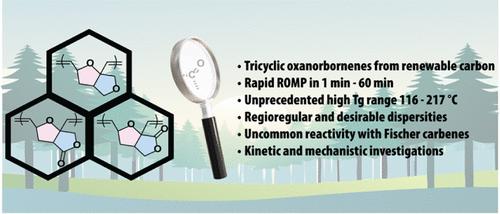
Bioderived monomers, readily available from biomass via atom- and redox-efficient processes, will need to play a major role in the development of sustainable polymeric materials. Here, we show that a family of tricyclic monomers, efficiently made from biobased furans via Diels–Alder chemistry, allows the production of polyenes with diverse thermo/physical properties through ring opening metathesis polymerization (ROMP). Via small structural variations, we offer insight into the intricacies of monomer design and its implications for polymerization. Notably, the thermostable polyenes all show very similar head-to-tail regioregularities, trans-linkage isomerism distributions, and narrow dispersities. Additionally, the monomers exhibit rare reactivity with ethyl vinyl ether, which can be used as a chain transfer agent, enabling the synthesis of monotelechelic polyenes. The monomers do differ substantially in polymerization rate, spanning two orders of magnitude, in the extent of molecular weight control and in the properties of the resulting amorphous polymers. With glass transition temperatures ranging from 116 to 217 °C and degradation temperatures exceeding 350 °C, these materials are among the highest performing biobased homopolymers reported. We elucidate these variations, demonstrating that the ROMP is profoundly influenced by subtle structural changes in the monomers.
期刊介绍:
Macromolecules publishes original, fundamental, and impactful research on all aspects of polymer science. Topics of interest include synthesis (e.g., controlled polymerizations, polymerization catalysis, post polymerization modification, new monomer structures and polymer architectures, and polymerization mechanisms/kinetics analysis); phase behavior, thermodynamics, dynamic, and ordering/disordering phenomena (e.g., self-assembly, gelation, crystallization, solution/melt/solid-state characteristics); structure and properties (e.g., mechanical and rheological properties, surface/interfacial characteristics, electronic and transport properties); new state of the art characterization (e.g., spectroscopy, scattering, microscopy, rheology), simulation (e.g., Monte Carlo, molecular dynamics, multi-scale/coarse-grained modeling), and theoretical methods. Renewable/sustainable polymers, polymer networks, responsive polymers, electro-, magneto- and opto-active macromolecules, inorganic polymers, charge-transporting polymers (ion-containing, semiconducting, and conducting), nanostructured polymers, and polymer composites are also of interest. Typical papers published in Macromolecules showcase important and innovative concepts, experimental methods/observations, and theoretical/computational approaches that demonstrate a fundamental advance in the understanding of polymers.




 京公网安备 11010802042870号
京ICP备2023020795号-1
京公网安备 11010802042870号
京ICP备2023020795号-1

 分享
分享
 求助内容:
求助内容: 应助结果提醒方式:
 扫码关注我们
