Rozalia A. Dodean, Yuexin Li, Xiaowei Zhang, Diana Caridha, Michael S. Madejczyk, Xiannu Jin, William E. Dennis, Ravi Chetree, Karl Kudyba, Sharon McEnearney, Patricia J. Lee, Cameron Blount, Jesse DeLuca, Chau Vuong, Kristina Pannone, Hieu T. Dinh, Kennedy Mdaki, Susan Leed, Monica L. Martin, Brandon S. Pybus, Sovitj Pou, Rolf W. Winter, Katherine M. Liebman, Rachel Williams, Amrendra Kumar, Anongruk Chim-Ong, Liwang Cui, Stephen Orena, Jackson Assimwe, Innocent Tibagambirwa, Oswald Byaruhanga, Patrick Angutoko, Jennifer Legac, Oriana Kreutzfeld, Philip J. Rosenthal, Roland A. Cooper, Aaron Nilsen, Michael K. Riscoe, Alison Roth, Papireddy Kancharla, Jane X. Kelly
{"title":"具有根治潜力的新一代抗疟疾吖啶酮类药物的研制","authors":"Rozalia A. Dodean, Yuexin Li, Xiaowei Zhang, Diana Caridha, Michael S. Madejczyk, Xiannu Jin, William E. Dennis, Ravi Chetree, Karl Kudyba, Sharon McEnearney, Patricia J. Lee, Cameron Blount, Jesse DeLuca, Chau Vuong, Kristina Pannone, Hieu T. Dinh, Kennedy Mdaki, Susan Leed, Monica L. Martin, Brandon S. Pybus, Sovitj Pou, Rolf W. Winter, Katherine M. Liebman, Rachel Williams, Amrendra Kumar, Anongruk Chim-Ong, Liwang Cui, Stephen Orena, Jackson Assimwe, Innocent Tibagambirwa, Oswald Byaruhanga, Patrick Angutoko, Jennifer Legac, Oriana Kreutzfeld, Philip J. Rosenthal, Roland A. Cooper, Aaron Nilsen, Michael K. Riscoe, Alison Roth, Papireddy Kancharla, Jane X. Kelly","doi":"10.1021/acs.jmedchem.5c00419","DOIUrl":null,"url":null,"abstract":"Building from our previous lead compound T111 (<b>1</b>) possessing activity against both <i>Plasmodium falciparum</i> asexual blood-stage (ABS) and <i>Plasmodium berghei</i> liver-stage (LS) parasites, next-generation antimalarial acridones were systematically designed and synthesized. A large number of newly generated acridones displayed excellent antimalarial activities against both ABS and LS parasites, with feasible safety and metabolic profiles. In a high-throughput hypnozoitocidal assay using <i>Plasmodium cynomolgi</i>, a number of these acridones significantly inhibited schizont and hypnozoite formation in both prophylactic and radical cure-dosing modes. Notably, newer generation acridones substantially mitigated cross-resistance with atovaquone. Representative compound <b>28</b> (T229) provided full LS protection and a sustained blood-stage cure for murine <i>P. berghei</i> infection dosed at both 10 and 40 mg/kg/day orally. Furthermore, compound <b>28</b> demonstrated a low risk of both genotoxicity and cardiotoxicity and was highly effective against ART-resistant parasites. This study demonstrated the first and robust antirelapse LS activity from a novel acridone family.","PeriodicalId":46,"journal":{"name":"Journal of Medicinal Chemistry","volume":"22 1","pages":""},"PeriodicalIF":7.3000,"publicationDate":"2025-04-03","publicationTypes":"Journal Article","fieldsOfStudy":null,"isOpenAccess":false,"openAccessPdf":"","citationCount":"0","resultStr":"{\"title\":\"Development of Next-Generation Antimalarial Acridones with Radical Cure Potential\",\"authors\":\"Rozalia A. Dodean, Yuexin Li, Xiaowei Zhang, Diana Caridha, Michael S. Madejczyk, Xiannu Jin, William E. Dennis, Ravi Chetree, Karl Kudyba, Sharon McEnearney, Patricia J. Lee, Cameron Blount, Jesse DeLuca, Chau Vuong, Kristina Pannone, Hieu T. Dinh, Kennedy Mdaki, Susan Leed, Monica L. Martin, Brandon S. Pybus, Sovitj Pou, Rolf W. Winter, Katherine M. Liebman, Rachel Williams, Amrendra Kumar, Anongruk Chim-Ong, Liwang Cui, Stephen Orena, Jackson Assimwe, Innocent Tibagambirwa, Oswald Byaruhanga, Patrick Angutoko, Jennifer Legac, Oriana Kreutzfeld, Philip J. Rosenthal, Roland A. Cooper, Aaron Nilsen, Michael K. Riscoe, Alison Roth, Papireddy Kancharla, Jane X. Kelly\",\"doi\":\"10.1021/acs.jmedchem.5c00419\",\"DOIUrl\":null,\"url\":null,\"abstract\":\"Building from our previous lead compound T111 (<b>1</b>) possessing activity against both <i>Plasmodium falciparum</i> asexual blood-stage (ABS) and <i>Plasmodium berghei</i> liver-stage (LS) parasites, next-generation antimalarial acridones were systematically designed and synthesized. A large number of newly generated acridones displayed excellent antimalarial activities against both ABS and LS parasites, with feasible safety and metabolic profiles. In a high-throughput hypnozoitocidal assay using <i>Plasmodium cynomolgi</i>, a number of these acridones significantly inhibited schizont and hypnozoite formation in both prophylactic and radical cure-dosing modes. Notably, newer generation acridones substantially mitigated cross-resistance with atovaquone. Representative compound <b>28</b> (T229) provided full LS protection and a sustained blood-stage cure for murine <i>P. berghei</i> infection dosed at both 10 and 40 mg/kg/day orally. Furthermore, compound <b>28</b> demonstrated a low risk of both genotoxicity and cardiotoxicity and was highly effective against ART-resistant parasites. This study demonstrated the first and robust antirelapse LS activity from a novel acridone family.\",\"PeriodicalId\":46,\"journal\":{\"name\":\"Journal of Medicinal Chemistry\",\"volume\":\"22 1\",\"pages\":\"\"},\"PeriodicalIF\":7.3000,\"publicationDate\":\"2025-04-03\",\"publicationTypes\":\"Journal Article\",\"fieldsOfStudy\":null,\"isOpenAccess\":false,\"openAccessPdf\":\"\",\"citationCount\":\"0\",\"resultStr\":null,\"platform\":\"Semanticscholar\",\"paperid\":null,\"PeriodicalName\":\"Journal of Medicinal Chemistry\",\"FirstCategoryId\":\"3\",\"ListUrlMain\":\"https://doi.org/10.1021/acs.jmedchem.5c00419\",\"RegionNum\":1,\"RegionCategory\":\"医学\",\"ArticlePicture\":[],\"TitleCN\":null,\"AbstractTextCN\":null,\"PMCID\":null,\"EPubDate\":\"\",\"PubModel\":\"\",\"JCR\":\"Q1\",\"JCRName\":\"CHEMISTRY, MEDICINAL\",\"Score\":null,\"Total\":0}","platform":"Semanticscholar","paperid":null,"PeriodicalName":"Journal of Medicinal Chemistry","FirstCategoryId":"3","ListUrlMain":"https://doi.org/10.1021/acs.jmedchem.5c00419","RegionNum":1,"RegionCategory":"医学","ArticlePicture":[],"TitleCN":null,"AbstractTextCN":null,"PMCID":null,"EPubDate":"","PubModel":"","JCR":"Q1","JCRName":"CHEMISTRY, MEDICINAL","Score":null,"Total":0}
引用次数: 0
摘要
我们以前的先导化合物 T111(1)对恶性疟原虫无性血液期(ABS)和伯格氏疟原虫肝脏期(LS)寄生虫都具有活性,在此基础上,我们系统地设计和合成了下一代抗疟吖啶酮。大量新生成的吖啶酮类化合物对 ABS 和 LS 寄生虫都显示出了极佳的抗疟活性,并且具有良好的安全性和代谢特性。在一项使用疟原虫进行的高通量低佐虫杀灭试验中,这些吖啶酮在预防性用药和根治性用药模式下都能显著抑制裂头蚴和低佐虫的形成。值得注意的是,新一代吖啶酮大大减轻了与阿托伐醌的交叉耐药性。具有代表性的化合物 28(T229)为小鼠伯格氏疟原虫感染提供了全面的 LS 保护,并以 10 毫克/千克/天和 40 毫克/千克/天的口服剂量实现了持续的血期治愈。此外,化合物 28 的遗传毒性和心脏毒性风险都很低,而且对抗病毒疗法耐药寄生虫非常有效。这项研究首次证明了新型吖啶酮家族具有强大的抗复发性寄生虫活性。
Development of Next-Generation Antimalarial Acridones with Radical Cure Potential
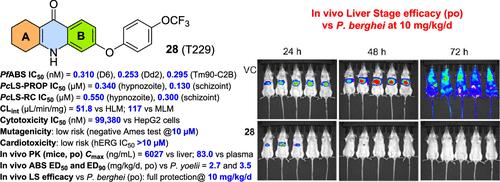
Building from our previous lead compound T111 (1) possessing activity against both Plasmodium falciparum asexual blood-stage (ABS) and Plasmodium berghei liver-stage (LS) parasites, next-generation antimalarial acridones were systematically designed and synthesized. A large number of newly generated acridones displayed excellent antimalarial activities against both ABS and LS parasites, with feasible safety and metabolic profiles. In a high-throughput hypnozoitocidal assay using Plasmodium cynomolgi, a number of these acridones significantly inhibited schizont and hypnozoite formation in both prophylactic and radical cure-dosing modes. Notably, newer generation acridones substantially mitigated cross-resistance with atovaquone. Representative compound 28 (T229) provided full LS protection and a sustained blood-stage cure for murine P. berghei infection dosed at both 10 and 40 mg/kg/day orally. Furthermore, compound 28 demonstrated a low risk of both genotoxicity and cardiotoxicity and was highly effective against ART-resistant parasites. This study demonstrated the first and robust antirelapse LS activity from a novel acridone family.
期刊介绍:
The Journal of Medicinal Chemistry is a prestigious biweekly peer-reviewed publication that focuses on the multifaceted field of medicinal chemistry. Since its inception in 1959 as the Journal of Medicinal and Pharmaceutical Chemistry, it has evolved to become a cornerstone in the dissemination of research findings related to the design, synthesis, and development of therapeutic agents.
The Journal of Medicinal Chemistry is recognized for its significant impact in the scientific community, as evidenced by its 2022 impact factor of 7.3. This metric reflects the journal's influence and the importance of its content in shaping the future of drug discovery and development. The journal serves as a vital resource for chemists, pharmacologists, and other researchers interested in the molecular mechanisms of drug action and the optimization of therapeutic compounds.




 京公网安备 11010802042870号
京ICP备2023020795号-1
京公网安备 11010802042870号
京ICP备2023020795号-1

 分享
分享
 求助内容:
求助内容: 应助结果提醒方式:
 扫码关注我们
