{"title":"全球50岁以上细胞学异常女性宫颈人乳头瘤病毒(HPV)负担:系统回顾和荟萃分析","authors":"Vanesa Osmani, Michael Rossiter, Lucy Hörner, Theoneste Nkurunziza, Sophia Rank, Luana Fiengo Tanaka, Stefanie J Klug","doi":"10.1136/bmjgh-2024-017309","DOIUrl":null,"url":null,"abstract":"<p><strong>Introduction: </strong>More than half of global cervical cancer cases occur among women older than 50. However, global estimates regarding the human papillomavirus (HPV) prevalence among this population are lacking, especially for women with abnormal cytology. Therefore, we conducted a systematic review and meta-analysis to estimate the worldwide HPV prevalence in women aged 50 and older with abnormal cytology.</p><p><strong>Methods: </strong>We searched PubMed, Scopus and Web of Science for quantitative studies reporting any or high-risk (HR)-HPV prevalence for women 50 years and older with abnormal cytology (atypical squamous cells of undetermined significance and higher). We extracted data on world region, subregion, cervical lesion type, recruitment setting, HPV test, year of study conduct and HPV prevalence from the included studies. We assessed the risk of bias of the included studies using a modified Newcastle-Ottawa scale. We estimated the pooled prevalence and 95% CIs of any-HPV and HR-HPV using random-effects models, considering the world regions. Additionally, we estimated the prevalence by HPV type, lesion type and age groups.</p><p><strong>Results: </strong>Overall, 113 studies met the inclusion criteria, of which 104 were included in the meta-analysis. Among women aged 50 and older with abnormal cytology, the estimated global pooled prevalence of any-HPV from 53 studies, including 14 585 women, was 54.5% (95%CI, 46.0 to 62.8%), and the HR-HPV prevalence from 85 studies, covering 33 672 women, was 43.0% (95%CI, 36.6 to 49.5%). There was a higher HR-HPV prevalence among women with high-grade lesions and women living in the African continent. No major differences in HR-HPV prevalence between the age groups of women over 50 years were found. The most common single HPV types worldwide were 16 and 52, with pooled prevalence estimates of 12.0% (95%CI, 8.0% to 17.7%) and 8.4% (95%CI, 4.4% to 15.4%), respectively.</p><p><strong>Conclusion: </strong>Our findings highlight the relevance of targeted screening interventions among women 50 years and older. To achieve the elimination of cervical cancer, age-inclusive screening strategies should be considered.</p><p><strong>Prospero registration number: </strong>CRD42021241365.</p>","PeriodicalId":9137,"journal":{"name":"BMJ Global Health","volume":"10 4","pages":""},"PeriodicalIF":5.8000,"publicationDate":"2025-04-02","publicationTypes":"Journal Article","fieldsOfStudy":null,"isOpenAccess":false,"openAccessPdf":"https://www.ncbi.nlm.nih.gov/pmc/articles/PMC11966958/pdf/","citationCount":"0","resultStr":"{\"title\":\"Worldwide burden of cervical human papillomavirus (HPV) in women over 50 years with abnormal cytology: a systematic review and meta-analysis.\",\"authors\":\"Vanesa Osmani, Michael Rossiter, Lucy Hörner, Theoneste Nkurunziza, Sophia Rank, Luana Fiengo Tanaka, Stefanie J Klug\",\"doi\":\"10.1136/bmjgh-2024-017309\",\"DOIUrl\":null,\"url\":null,\"abstract\":\"<p><strong>Introduction: </strong>More than half of global cervical cancer cases occur among women older than 50. However, global estimates regarding the human papillomavirus (HPV) prevalence among this population are lacking, especially for women with abnormal cytology. Therefore, we conducted a systematic review and meta-analysis to estimate the worldwide HPV prevalence in women aged 50 and older with abnormal cytology.</p><p><strong>Methods: </strong>We searched PubMed, Scopus and Web of Science for quantitative studies reporting any or high-risk (HR)-HPV prevalence for women 50 years and older with abnormal cytology (atypical squamous cells of undetermined significance and higher). We extracted data on world region, subregion, cervical lesion type, recruitment setting, HPV test, year of study conduct and HPV prevalence from the included studies. We assessed the risk of bias of the included studies using a modified Newcastle-Ottawa scale. We estimated the pooled prevalence and 95% CIs of any-HPV and HR-HPV using random-effects models, considering the world regions. Additionally, we estimated the prevalence by HPV type, lesion type and age groups.</p><p><strong>Results: </strong>Overall, 113 studies met the inclusion criteria, of which 104 were included in the meta-analysis. Among women aged 50 and older with abnormal cytology, the estimated global pooled prevalence of any-HPV from 53 studies, including 14 585 women, was 54.5% (95%CI, 46.0 to 62.8%), and the HR-HPV prevalence from 85 studies, covering 33 672 women, was 43.0% (95%CI, 36.6 to 49.5%). There was a higher HR-HPV prevalence among women with high-grade lesions and women living in the African continent. No major differences in HR-HPV prevalence between the age groups of women over 50 years were found. The most common single HPV types worldwide were 16 and 52, with pooled prevalence estimates of 12.0% (95%CI, 8.0% to 17.7%) and 8.4% (95%CI, 4.4% to 15.4%), respectively.</p><p><strong>Conclusion: </strong>Our findings highlight the relevance of targeted screening interventions among women 50 years and older. To achieve the elimination of cervical cancer, age-inclusive screening strategies should be considered.</p><p><strong>Prospero registration number: </strong>CRD42021241365.</p>\",\"PeriodicalId\":9137,\"journal\":{\"name\":\"BMJ Global Health\",\"volume\":\"10 4\",\"pages\":\"\"},\"PeriodicalIF\":5.8000,\"publicationDate\":\"2025-04-02\",\"publicationTypes\":\"Journal Article\",\"fieldsOfStudy\":null,\"isOpenAccess\":false,\"openAccessPdf\":\"https://www.ncbi.nlm.nih.gov/pmc/articles/PMC11966958/pdf/\",\"citationCount\":\"0\",\"resultStr\":null,\"platform\":\"Semanticscholar\",\"paperid\":null,\"PeriodicalName\":\"BMJ Global Health\",\"FirstCategoryId\":\"3\",\"ListUrlMain\":\"https://doi.org/10.1136/bmjgh-2024-017309\",\"RegionNum\":2,\"RegionCategory\":\"医学\",\"ArticlePicture\":[],\"TitleCN\":null,\"AbstractTextCN\":null,\"PMCID\":null,\"EPubDate\":\"\",\"PubModel\":\"\",\"JCR\":\"Q1\",\"JCRName\":\"PUBLIC, ENVIRONMENTAL & OCCUPATIONAL HEALTH\",\"Score\":null,\"Total\":0}","platform":"Semanticscholar","paperid":null,"PeriodicalName":"BMJ Global Health","FirstCategoryId":"3","ListUrlMain":"https://doi.org/10.1136/bmjgh-2024-017309","RegionNum":2,"RegionCategory":"医学","ArticlePicture":[],"TitleCN":null,"AbstractTextCN":null,"PMCID":null,"EPubDate":"","PubModel":"","JCR":"Q1","JCRName":"PUBLIC, ENVIRONMENTAL & OCCUPATIONAL HEALTH","Score":null,"Total":0}
Worldwide burden of cervical human papillomavirus (HPV) in women over 50 years with abnormal cytology: a systematic review and meta-analysis.
Introduction: More than half of global cervical cancer cases occur among women older than 50. However, global estimates regarding the human papillomavirus (HPV) prevalence among this population are lacking, especially for women with abnormal cytology. Therefore, we conducted a systematic review and meta-analysis to estimate the worldwide HPV prevalence in women aged 50 and older with abnormal cytology.
Methods: We searched PubMed, Scopus and Web of Science for quantitative studies reporting any or high-risk (HR)-HPV prevalence for women 50 years and older with abnormal cytology (atypical squamous cells of undetermined significance and higher). We extracted data on world region, subregion, cervical lesion type, recruitment setting, HPV test, year of study conduct and HPV prevalence from the included studies. We assessed the risk of bias of the included studies using a modified Newcastle-Ottawa scale. We estimated the pooled prevalence and 95% CIs of any-HPV and HR-HPV using random-effects models, considering the world regions. Additionally, we estimated the prevalence by HPV type, lesion type and age groups.
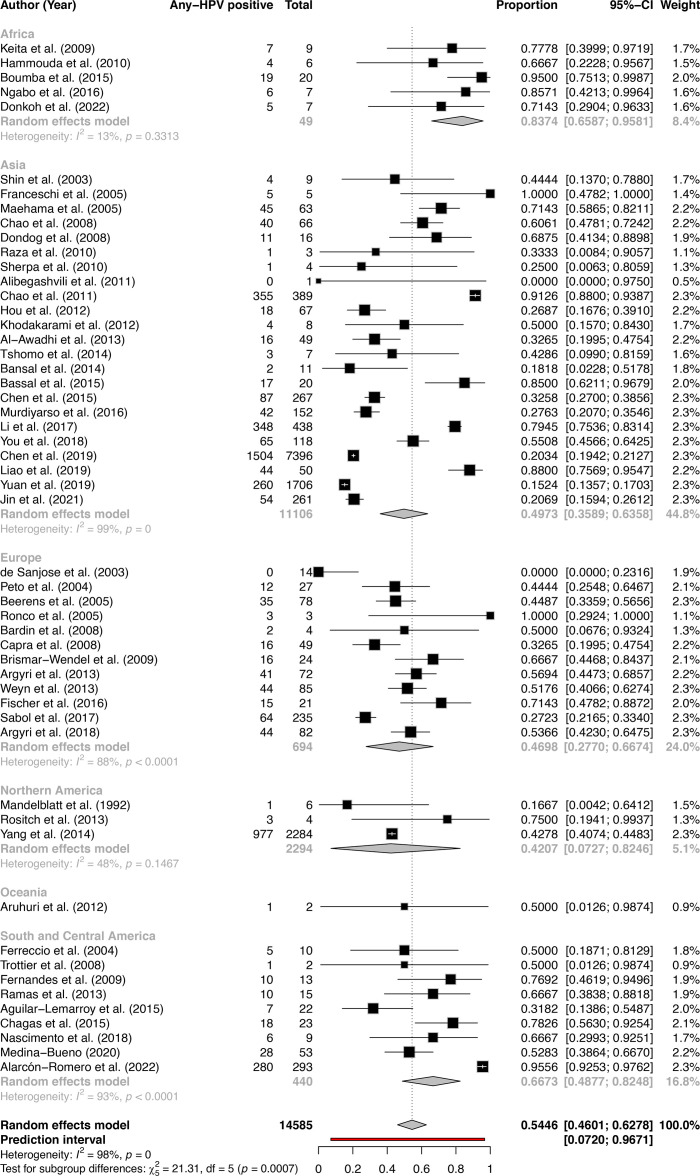
Results: Overall, 113 studies met the inclusion criteria, of which 104 were included in the meta-analysis. Among women aged 50 and older with abnormal cytology, the estimated global pooled prevalence of any-HPV from 53 studies, including 14 585 women, was 54.5% (95%CI, 46.0 to 62.8%), and the HR-HPV prevalence from 85 studies, covering 33 672 women, was 43.0% (95%CI, 36.6 to 49.5%). There was a higher HR-HPV prevalence among women with high-grade lesions and women living in the African continent. No major differences in HR-HPV prevalence between the age groups of women over 50 years were found. The most common single HPV types worldwide were 16 and 52, with pooled prevalence estimates of 12.0% (95%CI, 8.0% to 17.7%) and 8.4% (95%CI, 4.4% to 15.4%), respectively.
Conclusion: Our findings highlight the relevance of targeted screening interventions among women 50 years and older. To achieve the elimination of cervical cancer, age-inclusive screening strategies should be considered.
期刊介绍:
BMJ Global Health is an online Open Access journal from BMJ that focuses on publishing high-quality peer-reviewed content pertinent to individuals engaged in global health, including policy makers, funders, researchers, clinicians, and frontline healthcare workers. The journal encompasses all facets of global health, with a special emphasis on submissions addressing underfunded areas such as non-communicable diseases (NCDs). It welcomes research across all study phases and designs, from study protocols to phase I trials to meta-analyses, including small or specialized studies. The journal also encourages opinionated discussions on controversial topics.






 京公网安备 11010802042870号
京ICP备2023020795号-1
京公网安备 11010802042870号
京ICP备2023020795号-1

 分享
分享
 求助内容:
求助内容: 应助结果提醒方式:
 扫码关注我们
