Jiaqi Yang, Ziyun Ye, Qilu Xue, Dandan Li, Minghui Liang, Guoqian Li, Huanhuan Liu, Langlang Yi, Bo Hu, Pengju Yin, Guanqun Ge, Klyuyev Dmitriy, Alexandre Maciuk, Bruno Figadere
{"title":"基于扭曲混合微流控芯片和多修饰纳米探针的动态液体集成单细胞SERS平台用于癌细胞的无标记检测","authors":"Jiaqi Yang, Ziyun Ye, Qilu Xue, Dandan Li, Minghui Liang, Guoqian Li, Huanhuan Liu, Langlang Yi, Bo Hu, Pengju Yin, Guanqun Ge, Klyuyev Dmitriy, Alexandre Maciuk, Bruno Figadere","doi":"10.1021/acs.analchem.4c06051","DOIUrl":null,"url":null,"abstract":"Surface-enhanced Raman scattering (SERS) has emerged as a potent spectroscopic technique for the detection of single cells. However, it is difficult to achieve label-free detection at the single-cell level in dynamic liquids because nanoprobe aggregation in biological fluids and the low combination of nanoprobes and cells reduce the sensitivity of SERS detection. Herein, a dynamic liquid integrated single-cell SERS (DLISC-SERS) platform is developed for the label-free detection of single cancer cells. DLISC-SERS consists of three components, including a twisted mixing microfluidic chip to achieve an efficient combination of nanoprobes and cells, a commercial coaxial needle to accomplish 3D dynamic liquid focusing by annular sheath flow, and a quartz capillary to offer a SERS detection area with low noise. The mixing intensity of the twisted mixing microfluidic chip is almost 3.67-fold higher than that of straight mixing. The multifunctionally modified nanoprobe, Ag NSs@PEG@3COOH, can be stably dispersed in biological fluids for at least 30 min. The segment weighting similarity-based KNN model can classify single-cell spectra with sensitivity, specificity, and accuracy up to 100, 99.4, and 99.5%, respectively. The accuracy of the model for three-way classification is 95.2%. The DLISC-SERS platform is a powerful tool for detecting cancer cells at the single-cell level.","PeriodicalId":27,"journal":{"name":"Analytical Chemistry","volume":"73 1","pages":""},"PeriodicalIF":6.7000,"publicationDate":"2025-04-04","publicationTypes":"Journal Article","fieldsOfStudy":null,"isOpenAccess":false,"openAccessPdf":"","citationCount":"0","resultStr":"{\"title\":\"Dynamic Liquid Integrated Single-Cell SERS Platform Based on the Twisted Mixing Microfluidic Chip and Multi-Modified Nanoprobe for the Label-Free Detection of Cancer Cells\",\"authors\":\"Jiaqi Yang, Ziyun Ye, Qilu Xue, Dandan Li, Minghui Liang, Guoqian Li, Huanhuan Liu, Langlang Yi, Bo Hu, Pengju Yin, Guanqun Ge, Klyuyev Dmitriy, Alexandre Maciuk, Bruno Figadere\",\"doi\":\"10.1021/acs.analchem.4c06051\",\"DOIUrl\":null,\"url\":null,\"abstract\":\"Surface-enhanced Raman scattering (SERS) has emerged as a potent spectroscopic technique for the detection of single cells. However, it is difficult to achieve label-free detection at the single-cell level in dynamic liquids because nanoprobe aggregation in biological fluids and the low combination of nanoprobes and cells reduce the sensitivity of SERS detection. Herein, a dynamic liquid integrated single-cell SERS (DLISC-SERS) platform is developed for the label-free detection of single cancer cells. DLISC-SERS consists of three components, including a twisted mixing microfluidic chip to achieve an efficient combination of nanoprobes and cells, a commercial coaxial needle to accomplish 3D dynamic liquid focusing by annular sheath flow, and a quartz capillary to offer a SERS detection area with low noise. The mixing intensity of the twisted mixing microfluidic chip is almost 3.67-fold higher than that of straight mixing. The multifunctionally modified nanoprobe, Ag NSs@PEG@3COOH, can be stably dispersed in biological fluids for at least 30 min. The segment weighting similarity-based KNN model can classify single-cell spectra with sensitivity, specificity, and accuracy up to 100, 99.4, and 99.5%, respectively. The accuracy of the model for three-way classification is 95.2%. The DLISC-SERS platform is a powerful tool for detecting cancer cells at the single-cell level.\",\"PeriodicalId\":27,\"journal\":{\"name\":\"Analytical Chemistry\",\"volume\":\"73 1\",\"pages\":\"\"},\"PeriodicalIF\":6.7000,\"publicationDate\":\"2025-04-04\",\"publicationTypes\":\"Journal Article\",\"fieldsOfStudy\":null,\"isOpenAccess\":false,\"openAccessPdf\":\"\",\"citationCount\":\"0\",\"resultStr\":null,\"platform\":\"Semanticscholar\",\"paperid\":null,\"PeriodicalName\":\"Analytical Chemistry\",\"FirstCategoryId\":\"92\",\"ListUrlMain\":\"https://doi.org/10.1021/acs.analchem.4c06051\",\"RegionNum\":1,\"RegionCategory\":\"化学\",\"ArticlePicture\":[],\"TitleCN\":null,\"AbstractTextCN\":null,\"PMCID\":null,\"EPubDate\":\"\",\"PubModel\":\"\",\"JCR\":\"Q1\",\"JCRName\":\"CHEMISTRY, ANALYTICAL\",\"Score\":null,\"Total\":0}","platform":"Semanticscholar","paperid":null,"PeriodicalName":"Analytical Chemistry","FirstCategoryId":"92","ListUrlMain":"https://doi.org/10.1021/acs.analchem.4c06051","RegionNum":1,"RegionCategory":"化学","ArticlePicture":[],"TitleCN":null,"AbstractTextCN":null,"PMCID":null,"EPubDate":"","PubModel":"","JCR":"Q1","JCRName":"CHEMISTRY, ANALYTICAL","Score":null,"Total":0}
Dynamic Liquid Integrated Single-Cell SERS Platform Based on the Twisted Mixing Microfluidic Chip and Multi-Modified Nanoprobe for the Label-Free Detection of Cancer Cells
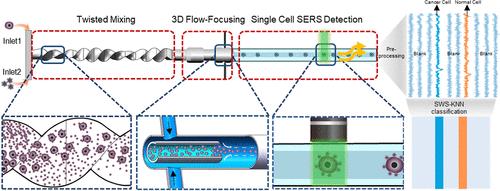
Surface-enhanced Raman scattering (SERS) has emerged as a potent spectroscopic technique for the detection of single cells. However, it is difficult to achieve label-free detection at the single-cell level in dynamic liquids because nanoprobe aggregation in biological fluids and the low combination of nanoprobes and cells reduce the sensitivity of SERS detection. Herein, a dynamic liquid integrated single-cell SERS (DLISC-SERS) platform is developed for the label-free detection of single cancer cells. DLISC-SERS consists of three components, including a twisted mixing microfluidic chip to achieve an efficient combination of nanoprobes and cells, a commercial coaxial needle to accomplish 3D dynamic liquid focusing by annular sheath flow, and a quartz capillary to offer a SERS detection area with low noise. The mixing intensity of the twisted mixing microfluidic chip is almost 3.67-fold higher than that of straight mixing. The multifunctionally modified nanoprobe, Ag NSs@PEG@3COOH, can be stably dispersed in biological fluids for at least 30 min. The segment weighting similarity-based KNN model can classify single-cell spectra with sensitivity, specificity, and accuracy up to 100, 99.4, and 99.5%, respectively. The accuracy of the model for three-way classification is 95.2%. The DLISC-SERS platform is a powerful tool for detecting cancer cells at the single-cell level.
期刊介绍:
Analytical Chemistry, a peer-reviewed research journal, focuses on disseminating new and original knowledge across all branches of analytical chemistry. Fundamental articles may explore general principles of chemical measurement science and need not directly address existing or potential analytical methodology. They can be entirely theoretical or report experimental results. Contributions may cover various phases of analytical operations, including sampling, bioanalysis, electrochemistry, mass spectrometry, microscale and nanoscale systems, environmental analysis, separations, spectroscopy, chemical reactions and selectivity, instrumentation, imaging, surface analysis, and data processing. Papers discussing known analytical methods should present a significant, original application of the method, a notable improvement, or results on an important analyte.




 京公网安备 11010802042870号
京ICP备2023020795号-1
京公网安备 11010802042870号
京ICP备2023020795号-1

 分享
分享
 求助内容:
求助内容: 应助结果提醒方式:
 扫码关注我们
