Jin Wang, Xin Wang, Xuesong Li, Xiangmei Li, Hongtao Lei and Juewen Liu
{"title":"具有低纳米摩尔亲和力的三价镧系离子的DNA适体","authors":"Jin Wang, Xin Wang, Xuesong Li, Xiangmei Li, Hongtao Lei and Juewen Liu","doi":"10.1039/D5QI00391A","DOIUrl":null,"url":null,"abstract":"<p >Lanthanides are extremely important for a variety of technological applications. In this work, DNA aptamers were selected using the library-immobilization method (capture-SELEX) with Tb<small><sup>3+</sup></small> and Ce<small><sup>3+</sup></small> as target metal ions. The Tb<small><sup>3+</sup></small> selection yielded a new sequence named Tb-1 that has a <em>K</em><small><sub>d</sub></small> of 26.9 nM for La<small><sup>3+</sup></small>, 3.9 nM for Tb<small><sup>3+</sup></small>, and 2.3 nM for Lu<small><sup>3+</sup></small> as determined by a DNA strand displacement assay. Non-lanthanide metal ions did not induce a fluorescence enhancement. Therefore, it is a general lanthanide binding aptamer. Another aptamer Tb-4 (<em>K</em><small><sub>d</sub></small> 290 nM) has some sequence similarity to a previously reported aptamer selected using Gd<small><sup>3+</sup></small> (<em>K</em><small><sub>d</sub></small> 1.5 μM), as determined by a thioflavin T fluorescence assay. Compared to a previously reported aptamer named Sc-1, Tb-1 has faster exchange with EDTA for lanthanide binding, suggesting that Tb-1 is an outer-sphere ligand. By comparing different aptamers, we have gained fundamental insights into aptamer binding to lanthanide ions. Finally, using the strand displacement reaction, a detection limit of 0.5 nM Tb<small><sup>3+</sup></small> was achieved in Lake Ontario water.</p>","PeriodicalId":79,"journal":{"name":"Inorganic Chemistry Frontiers","volume":" 14","pages":" 4494-4502"},"PeriodicalIF":6.2000,"publicationDate":"2025-04-07","publicationTypes":"Journal Article","fieldsOfStudy":null,"isOpenAccess":false,"openAccessPdf":"https://pubs.rsc.org/en/content/articlepdf/2025/qi/d5qi00391a?page=search","citationCount":"0","resultStr":"{\"title\":\"A DNA aptamer for trivalent lanthanide ions with low nanomolar affinity†\",\"authors\":\"Jin Wang, Xin Wang, Xuesong Li, Xiangmei Li, Hongtao Lei and Juewen Liu\",\"doi\":\"10.1039/D5QI00391A\",\"DOIUrl\":null,\"url\":null,\"abstract\":\"<p >Lanthanides are extremely important for a variety of technological applications. In this work, DNA aptamers were selected using the library-immobilization method (capture-SELEX) with Tb<small><sup>3+</sup></small> and Ce<small><sup>3+</sup></small> as target metal ions. The Tb<small><sup>3+</sup></small> selection yielded a new sequence named Tb-1 that has a <em>K</em><small><sub>d</sub></small> of 26.9 nM for La<small><sup>3+</sup></small>, 3.9 nM for Tb<small><sup>3+</sup></small>, and 2.3 nM for Lu<small><sup>3+</sup></small> as determined by a DNA strand displacement assay. Non-lanthanide metal ions did not induce a fluorescence enhancement. Therefore, it is a general lanthanide binding aptamer. Another aptamer Tb-4 (<em>K</em><small><sub>d</sub></small> 290 nM) has some sequence similarity to a previously reported aptamer selected using Gd<small><sup>3+</sup></small> (<em>K</em><small><sub>d</sub></small> 1.5 μM), as determined by a thioflavin T fluorescence assay. Compared to a previously reported aptamer named Sc-1, Tb-1 has faster exchange with EDTA for lanthanide binding, suggesting that Tb-1 is an outer-sphere ligand. By comparing different aptamers, we have gained fundamental insights into aptamer binding to lanthanide ions. Finally, using the strand displacement reaction, a detection limit of 0.5 nM Tb<small><sup>3+</sup></small> was achieved in Lake Ontario water.</p>\",\"PeriodicalId\":79,\"journal\":{\"name\":\"Inorganic Chemistry Frontiers\",\"volume\":\" 14\",\"pages\":\" 4494-4502\"},\"PeriodicalIF\":6.2000,\"publicationDate\":\"2025-04-07\",\"publicationTypes\":\"Journal Article\",\"fieldsOfStudy\":null,\"isOpenAccess\":false,\"openAccessPdf\":\"https://pubs.rsc.org/en/content/articlepdf/2025/qi/d5qi00391a?page=search\",\"citationCount\":\"0\",\"resultStr\":null,\"platform\":\"Semanticscholar\",\"paperid\":null,\"PeriodicalName\":\"Inorganic Chemistry Frontiers\",\"FirstCategoryId\":\"92\",\"ListUrlMain\":\"https://pubs.rsc.org/en/content/articlelanding/2025/qi/d5qi00391a\",\"RegionNum\":1,\"RegionCategory\":\"化学\",\"ArticlePicture\":[],\"TitleCN\":null,\"AbstractTextCN\":null,\"PMCID\":null,\"EPubDate\":\"\",\"PubModel\":\"\",\"JCR\":\"Q1\",\"JCRName\":\"CHEMISTRY, INORGANIC & NUCLEAR\",\"Score\":null,\"Total\":0}","platform":"Semanticscholar","paperid":null,"PeriodicalName":"Inorganic Chemistry Frontiers","FirstCategoryId":"92","ListUrlMain":"https://pubs.rsc.org/en/content/articlelanding/2025/qi/d5qi00391a","RegionNum":1,"RegionCategory":"化学","ArticlePicture":[],"TitleCN":null,"AbstractTextCN":null,"PMCID":null,"EPubDate":"","PubModel":"","JCR":"Q1","JCRName":"CHEMISTRY, INORGANIC & NUCLEAR","Score":null,"Total":0}
A DNA aptamer for trivalent lanthanide ions with low nanomolar affinity†
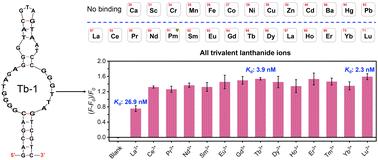
Lanthanides are extremely important for a variety of technological applications. In this work, DNA aptamers were selected using the library-immobilization method (capture-SELEX) with Tb3+ and Ce3+ as target metal ions. The Tb3+ selection yielded a new sequence named Tb-1 that has a Kd of 26.9 nM for La3+, 3.9 nM for Tb3+, and 2.3 nM for Lu3+ as determined by a DNA strand displacement assay. Non-lanthanide metal ions did not induce a fluorescence enhancement. Therefore, it is a general lanthanide binding aptamer. Another aptamer Tb-4 (Kd 290 nM) has some sequence similarity to a previously reported aptamer selected using Gd3+ (Kd 1.5 μM), as determined by a thioflavin T fluorescence assay. Compared to a previously reported aptamer named Sc-1, Tb-1 has faster exchange with EDTA for lanthanide binding, suggesting that Tb-1 is an outer-sphere ligand. By comparing different aptamers, we have gained fundamental insights into aptamer binding to lanthanide ions. Finally, using the strand displacement reaction, a detection limit of 0.5 nM Tb3+ was achieved in Lake Ontario water.





 京公网安备 11010802042870号
京ICP备2023020795号-1
京公网安备 11010802042870号
京ICP备2023020795号-1

 分享
分享
 求助内容:
求助内容: 应助结果提醒方式:
 扫码关注我们
