{"title":"一步制备高效杂化超级电容器性能的ni掺杂MIL-53(Fe)金属有机骨架","authors":"Kabir O. Otun and N. Mketo","doi":"10.1039/D4NJ05343E","DOIUrl":null,"url":null,"abstract":"<p >Metal–organic frameworks (MOFs) with dual metal sites are considered promising electrode materials for electrochemical energy storage applications owing to their unique structural and compositional advantages. Using a simple one-step solvothermal technique, nickel ions were incorporated into MIL-53(Fe) framework to design a nickel-doped iron-based MOF (MIL-53(Fe)-Ni), which was eventually used as an efficient electrode to improve supercapacitor performance. Owing to its distinct hexagonal pyramid-like structure and the synergistic effect of bimetallic ions, the MIL-53(Fe)-Ni-2 electrode material demonstrates a high specific capacity of 408.1 C g<small><sup>−1</sup></small> at 1 A g<small><sup>−1</sup></small> and remarkable cycling stability (80.9% capacity retention over 5000 cycles at 10 A g<small><sup>−1</sup></small>) in a half-cell system configuration. For practical applications, a full cell comprising a capacitive-type AC and a battery-type MIL-53(Fe)-Ni-2 was assembled to form an asymmetric supercapacitor device (ASC). The MIL-53(Fe)-Ni-2//AC ASC device resulted in a specific energy of 32.63 W h kg<small><sup>−1</sup></small> at 1142 W kg<small><sup>−1</sup></small> and capacity retention and coulombic efficiency of 72.5 and 99.3% respectively, which further led credence to the good stability of MIL-53(Fe)-Ni-2. This work provides insight into the effect of metal doping on modifying the properties of MOFs and demonstrating their great potential in supercapacitor research.</p>","PeriodicalId":95,"journal":{"name":"New Journal of Chemistry","volume":" 15","pages":" 6409-6420"},"PeriodicalIF":2.6000,"publicationDate":"2025-03-26","publicationTypes":"Journal Article","fieldsOfStudy":null,"isOpenAccess":false,"openAccessPdf":"","citationCount":"0","resultStr":"{\"title\":\"Facile one-step preparation of Ni-doped MIL-53(Fe) metal–organic frameworks for efficient hybrid supercapacitor performance†\",\"authors\":\"Kabir O. Otun and N. Mketo\",\"doi\":\"10.1039/D4NJ05343E\",\"DOIUrl\":null,\"url\":null,\"abstract\":\"<p >Metal–organic frameworks (MOFs) with dual metal sites are considered promising electrode materials for electrochemical energy storage applications owing to their unique structural and compositional advantages. Using a simple one-step solvothermal technique, nickel ions were incorporated into MIL-53(Fe) framework to design a nickel-doped iron-based MOF (MIL-53(Fe)-Ni), which was eventually used as an efficient electrode to improve supercapacitor performance. Owing to its distinct hexagonal pyramid-like structure and the synergistic effect of bimetallic ions, the MIL-53(Fe)-Ni-2 electrode material demonstrates a high specific capacity of 408.1 C g<small><sup>−1</sup></small> at 1 A g<small><sup>−1</sup></small> and remarkable cycling stability (80.9% capacity retention over 5000 cycles at 10 A g<small><sup>−1</sup></small>) in a half-cell system configuration. For practical applications, a full cell comprising a capacitive-type AC and a battery-type MIL-53(Fe)-Ni-2 was assembled to form an asymmetric supercapacitor device (ASC). The MIL-53(Fe)-Ni-2//AC ASC device resulted in a specific energy of 32.63 W h kg<small><sup>−1</sup></small> at 1142 W kg<small><sup>−1</sup></small> and capacity retention and coulombic efficiency of 72.5 and 99.3% respectively, which further led credence to the good stability of MIL-53(Fe)-Ni-2. This work provides insight into the effect of metal doping on modifying the properties of MOFs and demonstrating their great potential in supercapacitor research.</p>\",\"PeriodicalId\":95,\"journal\":{\"name\":\"New Journal of Chemistry\",\"volume\":\" 15\",\"pages\":\" 6409-6420\"},\"PeriodicalIF\":2.6000,\"publicationDate\":\"2025-03-26\",\"publicationTypes\":\"Journal Article\",\"fieldsOfStudy\":null,\"isOpenAccess\":false,\"openAccessPdf\":\"\",\"citationCount\":\"0\",\"resultStr\":null,\"platform\":\"Semanticscholar\",\"paperid\":null,\"PeriodicalName\":\"New Journal of Chemistry\",\"FirstCategoryId\":\"92\",\"ListUrlMain\":\"https://pubs.rsc.org/en/content/articlelanding/2025/nj/d4nj05343e\",\"RegionNum\":3,\"RegionCategory\":\"化学\",\"ArticlePicture\":[],\"TitleCN\":null,\"AbstractTextCN\":null,\"PMCID\":null,\"EPubDate\":\"\",\"PubModel\":\"\",\"JCR\":\"Q2\",\"JCRName\":\"CHEMISTRY, MULTIDISCIPLINARY\",\"Score\":null,\"Total\":0}","platform":"Semanticscholar","paperid":null,"PeriodicalName":"New Journal of Chemistry","FirstCategoryId":"92","ListUrlMain":"https://pubs.rsc.org/en/content/articlelanding/2025/nj/d4nj05343e","RegionNum":3,"RegionCategory":"化学","ArticlePicture":[],"TitleCN":null,"AbstractTextCN":null,"PMCID":null,"EPubDate":"","PubModel":"","JCR":"Q2","JCRName":"CHEMISTRY, MULTIDISCIPLINARY","Score":null,"Total":0}
引用次数: 0
摘要
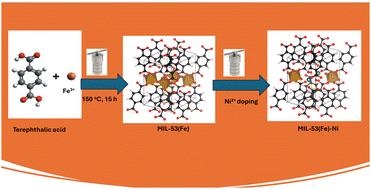
具有双金属位的金属有机框架(mof)由于其独特的结构和组成优势,被认为是电化学储能应用的极具前景的电极材料。采用简单的一步溶剂热技术,将镍离子掺入MIL-53(Fe)框架中,设计了掺杂镍的铁基MIL-53(Fe)-Ni,该MIL-53(Fe)-Ni最终用作提高超级电容器性能的高效电极。MIL-53(Fe)-Ni-2电极材料由于其独特的六方锥体结构和双金属离子的协同作用,在1 ag−1条件下具有408.1 C g−1的高比容量,在10 ag−1条件下具有良好的循环稳定性(在5000次循环中保持80.9%的容量)。在实际应用中,我们组装了一个由电容型交流电和电池型MIL-53(Fe)-Ni-2组成的完整电池,形成了一个不对称超级电容器装置(ASC)。MIL-53(Fe)-Ni-2//AC ASC装置在1142 W kg - 1时的比能为32.63 W h kg - 1,容量保持率和库仑效率分别为72.5%和99.3%,进一步证明了MIL-53(Fe)-Ni-2具有良好的稳定性。本研究揭示了金属掺杂对MOFs性能的影响,并展示了其在超级电容器研究中的巨大潜力。
Facile one-step preparation of Ni-doped MIL-53(Fe) metal–organic frameworks for efficient hybrid supercapacitor performance†
Metal–organic frameworks (MOFs) with dual metal sites are considered promising electrode materials for electrochemical energy storage applications owing to their unique structural and compositional advantages. Using a simple one-step solvothermal technique, nickel ions were incorporated into MIL-53(Fe) framework to design a nickel-doped iron-based MOF (MIL-53(Fe)-Ni), which was eventually used as an efficient electrode to improve supercapacitor performance. Owing to its distinct hexagonal pyramid-like structure and the synergistic effect of bimetallic ions, the MIL-53(Fe)-Ni-2 electrode material demonstrates a high specific capacity of 408.1 C g−1 at 1 A g−1 and remarkable cycling stability (80.9% capacity retention over 5000 cycles at 10 A g−1) in a half-cell system configuration. For practical applications, a full cell comprising a capacitive-type AC and a battery-type MIL-53(Fe)-Ni-2 was assembled to form an asymmetric supercapacitor device (ASC). The MIL-53(Fe)-Ni-2//AC ASC device resulted in a specific energy of 32.63 W h kg−1 at 1142 W kg−1 and capacity retention and coulombic efficiency of 72.5 and 99.3% respectively, which further led credence to the good stability of MIL-53(Fe)-Ni-2. This work provides insight into the effect of metal doping on modifying the properties of MOFs and demonstrating their great potential in supercapacitor research.




 京公网安备 11010802042870号
京ICP备2023020795号-1
京公网安备 11010802042870号
京ICP备2023020795号-1

 分享
分享
 求助内容:
求助内容: 应助结果提醒方式:
 扫码关注我们
