Mona Hosseini-Sarvari, Melika Rahimi and Saeede Saki
{"title":"以硫酸g-C3N4为光催化剂,溶剂和光控制选择性光氧化糠醛制备高附加值化学品","authors":"Mona Hosseini-Sarvari, Melika Rahimi and Saeede Saki","doi":"10.1039/D5NJ00534E","DOIUrl":null,"url":null,"abstract":"<p >Furfural is a compound derived from renewable lignocellulosic biomass. Furfural's highly functionalized molecular structure enables its conversion into fossil fuel alternatives and valuable chemicals. The selective oxidation of furfural into high-value-added chemicals is a pivotal process in sustainable chemical synthesis. This study explores a tunable approach to the photo-oxidation of furfural using sulfated graphitic carbon nitride (g-C<small><sub>3</sub></small>N<small><sub>4</sub></small>) as a photocatalyst, with reaction selectivity modulated by solvent choice and light wavelength. Sulfuric acid modification of g-C<small><sub>3</sub></small>N<small><sub>4</sub></small> enhances its photocatalytic performance by increasing surface acidity and optimizing its electronic properties, improving light absorption and charge separation. Our results reveal that the choice of solvent plays a critical role in dictating the reaction pathway, enabling the selective production of key chemicals such as furan, maleic acid, and succinic acid. Furthermore, the wavelength of light irradiation provides an additional level of control, allowing fine-tuning of product selectivity under identical conditions. This dual modulation highlights the dynamic interplay between the reaction environment and photocatalytic activity. The findings present sulfated g-C<small><sub>3</sub></small>N<small><sub>4</sub></small> as an efficient and versatile photocatalyst for the green transformation of biomass-derived furfural, with potential implications for industrial applications in renewable chemical production. This study underscores the importance of combining material modification with reaction environment engineering to achieve high-efficiency catalytic processes.</p>","PeriodicalId":95,"journal":{"name":"New Journal of Chemistry","volume":" 15","pages":" 6484-6494"},"PeriodicalIF":2.6000,"publicationDate":"2025-03-21","publicationTypes":"Journal Article","fieldsOfStudy":null,"isOpenAccess":false,"openAccessPdf":"","citationCount":"0","resultStr":"{\"title\":\"Solvent and light-controlled selective photo-oxidation of furfural into high value-added chemicals using sulfated g-C3N4 as photocatalyst†\",\"authors\":\"Mona Hosseini-Sarvari, Melika Rahimi and Saeede Saki\",\"doi\":\"10.1039/D5NJ00534E\",\"DOIUrl\":null,\"url\":null,\"abstract\":\"<p >Furfural is a compound derived from renewable lignocellulosic biomass. Furfural's highly functionalized molecular structure enables its conversion into fossil fuel alternatives and valuable chemicals. The selective oxidation of furfural into high-value-added chemicals is a pivotal process in sustainable chemical synthesis. This study explores a tunable approach to the photo-oxidation of furfural using sulfated graphitic carbon nitride (g-C<small><sub>3</sub></small>N<small><sub>4</sub></small>) as a photocatalyst, with reaction selectivity modulated by solvent choice and light wavelength. Sulfuric acid modification of g-C<small><sub>3</sub></small>N<small><sub>4</sub></small> enhances its photocatalytic performance by increasing surface acidity and optimizing its electronic properties, improving light absorption and charge separation. Our results reveal that the choice of solvent plays a critical role in dictating the reaction pathway, enabling the selective production of key chemicals such as furan, maleic acid, and succinic acid. Furthermore, the wavelength of light irradiation provides an additional level of control, allowing fine-tuning of product selectivity under identical conditions. This dual modulation highlights the dynamic interplay between the reaction environment and photocatalytic activity. The findings present sulfated g-C<small><sub>3</sub></small>N<small><sub>4</sub></small> as an efficient and versatile photocatalyst for the green transformation of biomass-derived furfural, with potential implications for industrial applications in renewable chemical production. This study underscores the importance of combining material modification with reaction environment engineering to achieve high-efficiency catalytic processes.</p>\",\"PeriodicalId\":95,\"journal\":{\"name\":\"New Journal of Chemistry\",\"volume\":\" 15\",\"pages\":\" 6484-6494\"},\"PeriodicalIF\":2.6000,\"publicationDate\":\"2025-03-21\",\"publicationTypes\":\"Journal Article\",\"fieldsOfStudy\":null,\"isOpenAccess\":false,\"openAccessPdf\":\"\",\"citationCount\":\"0\",\"resultStr\":null,\"platform\":\"Semanticscholar\",\"paperid\":null,\"PeriodicalName\":\"New Journal of Chemistry\",\"FirstCategoryId\":\"92\",\"ListUrlMain\":\"https://pubs.rsc.org/en/content/articlelanding/2025/nj/d5nj00534e\",\"RegionNum\":3,\"RegionCategory\":\"化学\",\"ArticlePicture\":[],\"TitleCN\":null,\"AbstractTextCN\":null,\"PMCID\":null,\"EPubDate\":\"\",\"PubModel\":\"\",\"JCR\":\"Q2\",\"JCRName\":\"CHEMISTRY, MULTIDISCIPLINARY\",\"Score\":null,\"Total\":0}","platform":"Semanticscholar","paperid":null,"PeriodicalName":"New Journal of Chemistry","FirstCategoryId":"92","ListUrlMain":"https://pubs.rsc.org/en/content/articlelanding/2025/nj/d5nj00534e","RegionNum":3,"RegionCategory":"化学","ArticlePicture":[],"TitleCN":null,"AbstractTextCN":null,"PMCID":null,"EPubDate":"","PubModel":"","JCR":"Q2","JCRName":"CHEMISTRY, MULTIDISCIPLINARY","Score":null,"Total":0}
Solvent and light-controlled selective photo-oxidation of furfural into high value-added chemicals using sulfated g-C3N4 as photocatalyst†
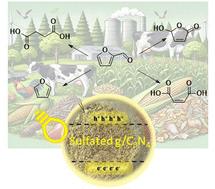
Furfural is a compound derived from renewable lignocellulosic biomass. Furfural's highly functionalized molecular structure enables its conversion into fossil fuel alternatives and valuable chemicals. The selective oxidation of furfural into high-value-added chemicals is a pivotal process in sustainable chemical synthesis. This study explores a tunable approach to the photo-oxidation of furfural using sulfated graphitic carbon nitride (g-C3N4) as a photocatalyst, with reaction selectivity modulated by solvent choice and light wavelength. Sulfuric acid modification of g-C3N4 enhances its photocatalytic performance by increasing surface acidity and optimizing its electronic properties, improving light absorption and charge separation. Our results reveal that the choice of solvent plays a critical role in dictating the reaction pathway, enabling the selective production of key chemicals such as furan, maleic acid, and succinic acid. Furthermore, the wavelength of light irradiation provides an additional level of control, allowing fine-tuning of product selectivity under identical conditions. This dual modulation highlights the dynamic interplay between the reaction environment and photocatalytic activity. The findings present sulfated g-C3N4 as an efficient and versatile photocatalyst for the green transformation of biomass-derived furfural, with potential implications for industrial applications in renewable chemical production. This study underscores the importance of combining material modification with reaction environment engineering to achieve high-efficiency catalytic processes.




 京公网安备 11010802042870号
京ICP备2023020795号-1
京公网安备 11010802042870号
京ICP备2023020795号-1

 分享
分享
 求助内容:
求助内容: 应助结果提醒方式:
 扫码关注我们
