Yunfan Zhou, Min Guo, Yuanliang Li, Huangying Tan, Xu Chen and Wensheng Yang
{"title":"基于石墨烯量子点的胰腺神经内分泌肿瘤生物标志物嗜铬粒蛋白B的电化学发光免疫传感器。","authors":"Yunfan Zhou, Min Guo, Yuanliang Li, Huangying Tan, Xu Chen and Wensheng Yang","doi":"10.1039/D5AY00060B","DOIUrl":null,"url":null,"abstract":"<p >Neuroendocrine tumor (NET) is a rare and heterogeneous tumor with an increasing incidence, which is often misdiagnosed and frequently presents with distant metastases at the time of diagnosis. Chromogranin B (CgB) is not influenced by other diseases or drug factors, such as proton pump inhibitors (PPIs), and is therefore expected to serve as a complementary biomarker to improve the early diagnosis of NET. However, the detection sensitivity of CgB urgently requires improvement. In this study, a highly sensitive ECL immunosensor was designed for the detection of CgB. Graphdiyne quantum dots (GDY QDs), synthesized <em>via</em> the hydrothermal treatment of graphdiyne (GDY) nanosheets, exhibited good biocompatibility and a high electrochemiluminescence (ECL) quantum yield (<em>Φ</em><small><sub>ECL</sub></small> = 218.5%) when using K<small><sub>2</sub></small>S<small><sub>2</sub></small>O<small><sub>8</sub></small> as a co-reactant. With remarkable conductivity and a large surface area, Au NPs effectively loaded a high amount of GDY QDs, thereby enhancing the ECL response. Therefore, the developed ECL immunosensor showed exceptional analytical performance for CgB detection, demonstrating excellent linearity over a range of 10 fg mL<small><sup>−1</sup></small> to 100 ng mL<small><sup>−1</sup></small>, with a limit of detection as low as 1.84 fg mL<small><sup>−1</sup></small> (S/N = 3). Moreover, this immunosensor could detect CgB levels in clinical serum and functioned synergistically with enzyme-linked immunosorbent assay (ELISA). This work expands the application of GDY QDs in ECL biosensors while also providing a highly sensitive detection method for CgB.</p>","PeriodicalId":64,"journal":{"name":"Analytical Methods","volume":" 16","pages":" 3249-3257"},"PeriodicalIF":2.6000,"publicationDate":"2025-04-07","publicationTypes":"Journal Article","fieldsOfStudy":null,"isOpenAccess":false,"openAccessPdf":"","citationCount":"0","resultStr":"{\"title\":\"Electrochemiluminescence immunosensor for the sensitive detection of the pancreatic neuroendocrine tumor biomarker chromogranin B based on graphdiyne quantum dots†\",\"authors\":\"Yunfan Zhou, Min Guo, Yuanliang Li, Huangying Tan, Xu Chen and Wensheng Yang\",\"doi\":\"10.1039/D5AY00060B\",\"DOIUrl\":null,\"url\":null,\"abstract\":\"<p >Neuroendocrine tumor (NET) is a rare and heterogeneous tumor with an increasing incidence, which is often misdiagnosed and frequently presents with distant metastases at the time of diagnosis. Chromogranin B (CgB) is not influenced by other diseases or drug factors, such as proton pump inhibitors (PPIs), and is therefore expected to serve as a complementary biomarker to improve the early diagnosis of NET. However, the detection sensitivity of CgB urgently requires improvement. In this study, a highly sensitive ECL immunosensor was designed for the detection of CgB. Graphdiyne quantum dots (GDY QDs), synthesized <em>via</em> the hydrothermal treatment of graphdiyne (GDY) nanosheets, exhibited good biocompatibility and a high electrochemiluminescence (ECL) quantum yield (<em>Φ</em><small><sub>ECL</sub></small> = 218.5%) when using K<small><sub>2</sub></small>S<small><sub>2</sub></small>O<small><sub>8</sub></small> as a co-reactant. With remarkable conductivity and a large surface area, Au NPs effectively loaded a high amount of GDY QDs, thereby enhancing the ECL response. Therefore, the developed ECL immunosensor showed exceptional analytical performance for CgB detection, demonstrating excellent linearity over a range of 10 fg mL<small><sup>−1</sup></small> to 100 ng mL<small><sup>−1</sup></small>, with a limit of detection as low as 1.84 fg mL<small><sup>−1</sup></small> (S/N = 3). Moreover, this immunosensor could detect CgB levels in clinical serum and functioned synergistically with enzyme-linked immunosorbent assay (ELISA). This work expands the application of GDY QDs in ECL biosensors while also providing a highly sensitive detection method for CgB.</p>\",\"PeriodicalId\":64,\"journal\":{\"name\":\"Analytical Methods\",\"volume\":\" 16\",\"pages\":\" 3249-3257\"},\"PeriodicalIF\":2.6000,\"publicationDate\":\"2025-04-07\",\"publicationTypes\":\"Journal Article\",\"fieldsOfStudy\":null,\"isOpenAccess\":false,\"openAccessPdf\":\"\",\"citationCount\":\"0\",\"resultStr\":null,\"platform\":\"Semanticscholar\",\"paperid\":null,\"PeriodicalName\":\"Analytical Methods\",\"FirstCategoryId\":\"92\",\"ListUrlMain\":\"https://pubs.rsc.org/en/content/articlelanding/2025/ay/d5ay00060b\",\"RegionNum\":3,\"RegionCategory\":\"化学\",\"ArticlePicture\":[],\"TitleCN\":null,\"AbstractTextCN\":null,\"PMCID\":null,\"EPubDate\":\"\",\"PubModel\":\"\",\"JCR\":\"Q2\",\"JCRName\":\"CHEMISTRY, ANALYTICAL\",\"Score\":null,\"Total\":0}","platform":"Semanticscholar","paperid":null,"PeriodicalName":"Analytical Methods","FirstCategoryId":"92","ListUrlMain":"https://pubs.rsc.org/en/content/articlelanding/2025/ay/d5ay00060b","RegionNum":3,"RegionCategory":"化学","ArticlePicture":[],"TitleCN":null,"AbstractTextCN":null,"PMCID":null,"EPubDate":"","PubModel":"","JCR":"Q2","JCRName":"CHEMISTRY, ANALYTICAL","Score":null,"Total":0}
Electrochemiluminescence immunosensor for the sensitive detection of the pancreatic neuroendocrine tumor biomarker chromogranin B based on graphdiyne quantum dots†
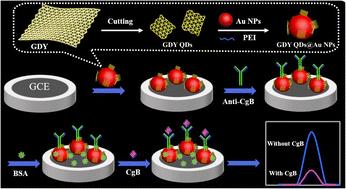
Neuroendocrine tumor (NET) is a rare and heterogeneous tumor with an increasing incidence, which is often misdiagnosed and frequently presents with distant metastases at the time of diagnosis. Chromogranin B (CgB) is not influenced by other diseases or drug factors, such as proton pump inhibitors (PPIs), and is therefore expected to serve as a complementary biomarker to improve the early diagnosis of NET. However, the detection sensitivity of CgB urgently requires improvement. In this study, a highly sensitive ECL immunosensor was designed for the detection of CgB. Graphdiyne quantum dots (GDY QDs), synthesized via the hydrothermal treatment of graphdiyne (GDY) nanosheets, exhibited good biocompatibility and a high electrochemiluminescence (ECL) quantum yield (ΦECL = 218.5%) when using K2S2O8 as a co-reactant. With remarkable conductivity and a large surface area, Au NPs effectively loaded a high amount of GDY QDs, thereby enhancing the ECL response. Therefore, the developed ECL immunosensor showed exceptional analytical performance for CgB detection, demonstrating excellent linearity over a range of 10 fg mL−1 to 100 ng mL−1, with a limit of detection as low as 1.84 fg mL−1 (S/N = 3). Moreover, this immunosensor could detect CgB levels in clinical serum and functioned synergistically with enzyme-linked immunosorbent assay (ELISA). This work expands the application of GDY QDs in ECL biosensors while also providing a highly sensitive detection method for CgB.




 京公网安备 11010802042870号
京ICP备2023020795号-1
京公网安备 11010802042870号
京ICP备2023020795号-1

 分享
分享
 求助内容:
求助内容: 应助结果提醒方式:
 扫码关注我们
