Denise Di Lena, Edoardo Sisti, Erik Brass, Erica Belforte, Bruna Marini, Alessandro Porchetta, Laura Squarcia, Eleonora Da Pozzo, Alessandro Bertucci, Rudy Ippodrino
{"title":"利用基于TNF-α的多表位DNA纳米开关快速、单步监测单克隆抗体的生物利用度","authors":"Denise Di Lena, Edoardo Sisti, Erik Brass, Erica Belforte, Bruna Marini, Alessandro Porchetta, Laura Squarcia, Eleonora Da Pozzo, Alessandro Bertucci, Rudy Ippodrino","doi":"10.1021/acs.analchem.5c01239","DOIUrl":null,"url":null,"abstract":"Therapeutic drug monitoring (TDM) is increasingly valuable for tailoring personalized therapy, particularly in managing chronic inflammatory diseases where overtreatment can cause significant side effects. Monoclonal antibodies (mAbs), a primary therapeutic approach for these conditions, face challenges from antidrug antibodies (ADAs), which can reduce mAb bioavailability and efficacy. To address these issues, we utilized Tumor Necrosis Factor α (TNF-α) as a binding moiety in a fluorescence-based programmable nanosensor within the NanoHYBRID (NH) platform developed by Ulisse Biomed S.p.A. By directly conjugating TNF-α to DNA probes, we developed a rapid, homogeneous, affinity-based assay capable of detecting multiple mAbs targeting distinct epitopes on the same protein. This NH platform effectively detected therapeutic concentrations of clinically relevant mAbs, such as Infliximab, Adalimumab, and Golimumab, in blood serum samples in a one-step process, bypassing the need for time-intensive washing steps. Moreover, the NH sensor exhibited heightened sensitivity to the presence of ADA, which impacted drug quantification, indicating its utility for monitoring bioavailable mAb levels. Compared to ELISA, the NH platform demonstrated superior sensitivity to ADAs, suggesting its potential as a highly specific, modular solution for TDM. This modular design allows the NH platform to create multiepitope nanosensors capable of measuring bioavailable mAbs in a single step.","PeriodicalId":27,"journal":{"name":"Analytical Chemistry","volume":"37 1","pages":""},"PeriodicalIF":6.7000,"publicationDate":"2025-04-08","publicationTypes":"Journal Article","fieldsOfStudy":null,"isOpenAccess":false,"openAccessPdf":"","citationCount":"0","resultStr":"{\"title\":\"Rapid, Single-Step Monitoring of Monoclonal Antibody Bioavailability by Using a TNF-α-Based Multiepitope DNA Nanoswitch\",\"authors\":\"Denise Di Lena, Edoardo Sisti, Erik Brass, Erica Belforte, Bruna Marini, Alessandro Porchetta, Laura Squarcia, Eleonora Da Pozzo, Alessandro Bertucci, Rudy Ippodrino\",\"doi\":\"10.1021/acs.analchem.5c01239\",\"DOIUrl\":null,\"url\":null,\"abstract\":\"Therapeutic drug monitoring (TDM) is increasingly valuable for tailoring personalized therapy, particularly in managing chronic inflammatory diseases where overtreatment can cause significant side effects. Monoclonal antibodies (mAbs), a primary therapeutic approach for these conditions, face challenges from antidrug antibodies (ADAs), which can reduce mAb bioavailability and efficacy. To address these issues, we utilized Tumor Necrosis Factor α (TNF-α) as a binding moiety in a fluorescence-based programmable nanosensor within the NanoHYBRID (NH) platform developed by Ulisse Biomed S.p.A. By directly conjugating TNF-α to DNA probes, we developed a rapid, homogeneous, affinity-based assay capable of detecting multiple mAbs targeting distinct epitopes on the same protein. This NH platform effectively detected therapeutic concentrations of clinically relevant mAbs, such as Infliximab, Adalimumab, and Golimumab, in blood serum samples in a one-step process, bypassing the need for time-intensive washing steps. Moreover, the NH sensor exhibited heightened sensitivity to the presence of ADA, which impacted drug quantification, indicating its utility for monitoring bioavailable mAb levels. Compared to ELISA, the NH platform demonstrated superior sensitivity to ADAs, suggesting its potential as a highly specific, modular solution for TDM. This modular design allows the NH platform to create multiepitope nanosensors capable of measuring bioavailable mAbs in a single step.\",\"PeriodicalId\":27,\"journal\":{\"name\":\"Analytical Chemistry\",\"volume\":\"37 1\",\"pages\":\"\"},\"PeriodicalIF\":6.7000,\"publicationDate\":\"2025-04-08\",\"publicationTypes\":\"Journal Article\",\"fieldsOfStudy\":null,\"isOpenAccess\":false,\"openAccessPdf\":\"\",\"citationCount\":\"0\",\"resultStr\":null,\"platform\":\"Semanticscholar\",\"paperid\":null,\"PeriodicalName\":\"Analytical Chemistry\",\"FirstCategoryId\":\"92\",\"ListUrlMain\":\"https://doi.org/10.1021/acs.analchem.5c01239\",\"RegionNum\":1,\"RegionCategory\":\"化学\",\"ArticlePicture\":[],\"TitleCN\":null,\"AbstractTextCN\":null,\"PMCID\":null,\"EPubDate\":\"\",\"PubModel\":\"\",\"JCR\":\"Q1\",\"JCRName\":\"CHEMISTRY, ANALYTICAL\",\"Score\":null,\"Total\":0}","platform":"Semanticscholar","paperid":null,"PeriodicalName":"Analytical Chemistry","FirstCategoryId":"92","ListUrlMain":"https://doi.org/10.1021/acs.analchem.5c01239","RegionNum":1,"RegionCategory":"化学","ArticlePicture":[],"TitleCN":null,"AbstractTextCN":null,"PMCID":null,"EPubDate":"","PubModel":"","JCR":"Q1","JCRName":"CHEMISTRY, ANALYTICAL","Score":null,"Total":0}
引用次数: 0
摘要
治疗药物监测(TDM)在定制个性化疗法方面的价值与日俱增,尤其是在治疗慢性炎症性疾病方面,过度治疗可能会导致严重的副作用。单克隆抗体(mAbs)是治疗这些疾病的主要方法,但它面临着抗药抗体(ADAs)的挑战,因为抗药抗体会降低 mAb 的生物利用度和疗效。为了解决这些问题,我们利用肿瘤坏死因子α(TNF-α)作为Ulisse Biomed S.p.A.公司开发的NanoHYBRID(NH)平台中基于荧光的可编程纳米传感器的结合分子。通过直接将TNF-α与DNA探针结合,我们开发出了一种快速、均质、基于亲和力的检测方法,能够检测针对同一蛋白质上不同表位的多种mAb。这种 NH 平台可有效检测血清样本中临床相关 mAbs(如英夫利昔单抗、阿达木单抗和戈利木单抗)的治疗浓度,一步到位,无需耗时的洗涤步骤。此外,NH 传感器对影响药物定量的 ADA 的存在表现出更高的灵敏度,这表明它可用于监测生物可利用的 mAb 水平。与酶联免疫吸附法相比,NH 平台对 ADA 的灵敏度更高,这表明它有潜力成为 TDM 的高特异性模块化解决方案。这种模块化设计使 NH 平台能够创建多位点纳米传感器,只需一个步骤就能测量生物可利用的 mAb。
Rapid, Single-Step Monitoring of Monoclonal Antibody Bioavailability by Using a TNF-α-Based Multiepitope DNA Nanoswitch
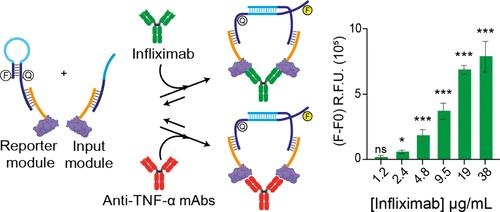
Therapeutic drug monitoring (TDM) is increasingly valuable for tailoring personalized therapy, particularly in managing chronic inflammatory diseases where overtreatment can cause significant side effects. Monoclonal antibodies (mAbs), a primary therapeutic approach for these conditions, face challenges from antidrug antibodies (ADAs), which can reduce mAb bioavailability and efficacy. To address these issues, we utilized Tumor Necrosis Factor α (TNF-α) as a binding moiety in a fluorescence-based programmable nanosensor within the NanoHYBRID (NH) platform developed by Ulisse Biomed S.p.A. By directly conjugating TNF-α to DNA probes, we developed a rapid, homogeneous, affinity-based assay capable of detecting multiple mAbs targeting distinct epitopes on the same protein. This NH platform effectively detected therapeutic concentrations of clinically relevant mAbs, such as Infliximab, Adalimumab, and Golimumab, in blood serum samples in a one-step process, bypassing the need for time-intensive washing steps. Moreover, the NH sensor exhibited heightened sensitivity to the presence of ADA, which impacted drug quantification, indicating its utility for monitoring bioavailable mAb levels. Compared to ELISA, the NH platform demonstrated superior sensitivity to ADAs, suggesting its potential as a highly specific, modular solution for TDM. This modular design allows the NH platform to create multiepitope nanosensors capable of measuring bioavailable mAbs in a single step.
期刊介绍:
Analytical Chemistry, a peer-reviewed research journal, focuses on disseminating new and original knowledge across all branches of analytical chemistry. Fundamental articles may explore general principles of chemical measurement science and need not directly address existing or potential analytical methodology. They can be entirely theoretical or report experimental results. Contributions may cover various phases of analytical operations, including sampling, bioanalysis, electrochemistry, mass spectrometry, microscale and nanoscale systems, environmental analysis, separations, spectroscopy, chemical reactions and selectivity, instrumentation, imaging, surface analysis, and data processing. Papers discussing known analytical methods should present a significant, original application of the method, a notable improvement, or results on an important analyte.




 京公网安备 11010802042870号
京ICP备2023020795号-1
京公网安备 11010802042870号
京ICP备2023020795号-1

 分享
分享
 求助内容:
求助内容: 应助结果提醒方式:
 扫码关注我们
