Olfactory preference in chemical host plant recognition by male and female click beetles and its implications for pest management
BACKGROUND
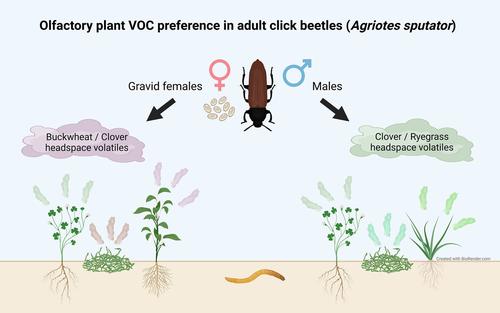
Plants emit volatile organic compounds (VOCs), which serve as critical cues for herbivorous insects to locate hosts for feeding and oviposition. Understanding how adults identify host plants is essential to develop pest management strategies, particularly for hemiedaphic insects like click beetles, the larvae of which are significant soil-dwelling pests. To investigate click beetle attraction towards plant VOCs and their relevance for oviposition, we tested the attractiveness of constitutive VOCs (emitted by intact plants) and damage-induced VOCs (released by chopped plants) from 11 plant species to male and female Agriotes sputator beetles.
RESULTS
Agriotes sputator beetles exhibit plant species-specific olfactory preferences, which are influenced by beetle sex and female maturity and differ between constitutive and damage-induced VOCs. Female beetles showed the greatest attraction to buckwheat VOCs, especially during their main oviposition period, whereas males were more attracted to clover and ryegrass. EAG recordings show strong female antennal responses to ryegrass, carrot, maize, wild carrot, barley, and buckwheat VOCs, while male antennae responded significantly only to peas. Antennae from female beetles show overall stronger responses to constitutive VOCs than those of males (P = 0.02).
期刊介绍:
Pest Management Science is the international journal of research and development in crop protection and pest control. Since its launch in 1970, the journal has become the premier forum for papers on the discovery, application, and impact on the environment of products and strategies designed for pest management.
Published for SCI by John Wiley & Sons Ltd.





 京公网安备 11010802042870号
京ICP备2023020795号-1
京公网安备 11010802042870号
京ICP备2023020795号-1

 分享
分享
 求助内容:
求助内容: 应助结果提醒方式:
 扫码关注我们
