{"title":"粘性推进弹性丝的优化设计。","authors":"Mariia Dvoriashyna and Eric Lauga","doi":"10.1039/D4SM01388C","DOIUrl":null,"url":null,"abstract":"<p >The propulsion of many eukaryotic cells is generated by flagella, flexible slender filaments that are actively oscillating in space and time. The dynamics of these biological appendages have inspired the design of many types of artificial microswimmers. The magnitude of the filament's viscous propulsion depends on the time-varying shape of the filament, and that shape depends in turn on the spatial distribution of the bending rigidity of the filament. In this work, we rigorously determine the relationship between the mechanical (bending) properties of the filament and the viscous thrust it produces using mathematical optimisation. Specifically, by considering a model system (a slender elastic filament with an oscillating slope at its base), we derive the optimal bending rigidity function along the filament that maximises the time-averaged thrust produced by the actuated filament. Instead of prescribing a specific functional form, we use functional optimisation and adjoint-based variational calculus to formally establish the link between the distribution of bending rigidity and propulsion. The optimal rigidities are found to be stiff near the base, and soft near the distal end, with a spatial distribution that depends critically on the constraints used in the optimisation procedure. These findings may guide the optimal design of future artificial swimmers.</p>","PeriodicalId":103,"journal":{"name":"Soft Matter","volume":" 18","pages":" 3503-3514"},"PeriodicalIF":2.8000,"publicationDate":"2025-04-08","publicationTypes":"Journal Article","fieldsOfStudy":null,"isOpenAccess":false,"openAccessPdf":"https://pubs.rsc.org/en/content/articlepdf/2025/sm/d4sm01388c?page=search","citationCount":"0","resultStr":"{\"title\":\"Designing optimal elastic filaments for viscous propulsion\",\"authors\":\"Mariia Dvoriashyna and Eric Lauga\",\"doi\":\"10.1039/D4SM01388C\",\"DOIUrl\":null,\"url\":null,\"abstract\":\"<p >The propulsion of many eukaryotic cells is generated by flagella, flexible slender filaments that are actively oscillating in space and time. The dynamics of these biological appendages have inspired the design of many types of artificial microswimmers. The magnitude of the filament's viscous propulsion depends on the time-varying shape of the filament, and that shape depends in turn on the spatial distribution of the bending rigidity of the filament. In this work, we rigorously determine the relationship between the mechanical (bending) properties of the filament and the viscous thrust it produces using mathematical optimisation. Specifically, by considering a model system (a slender elastic filament with an oscillating slope at its base), we derive the optimal bending rigidity function along the filament that maximises the time-averaged thrust produced by the actuated filament. Instead of prescribing a specific functional form, we use functional optimisation and adjoint-based variational calculus to formally establish the link between the distribution of bending rigidity and propulsion. The optimal rigidities are found to be stiff near the base, and soft near the distal end, with a spatial distribution that depends critically on the constraints used in the optimisation procedure. These findings may guide the optimal design of future artificial swimmers.</p>\",\"PeriodicalId\":103,\"journal\":{\"name\":\"Soft Matter\",\"volume\":\" 18\",\"pages\":\" 3503-3514\"},\"PeriodicalIF\":2.8000,\"publicationDate\":\"2025-04-08\",\"publicationTypes\":\"Journal Article\",\"fieldsOfStudy\":null,\"isOpenAccess\":false,\"openAccessPdf\":\"https://pubs.rsc.org/en/content/articlepdf/2025/sm/d4sm01388c?page=search\",\"citationCount\":\"0\",\"resultStr\":null,\"platform\":\"Semanticscholar\",\"paperid\":null,\"PeriodicalName\":\"Soft Matter\",\"FirstCategoryId\":\"92\",\"ListUrlMain\":\"https://pubs.rsc.org/en/content/articlelanding/2025/sm/d4sm01388c\",\"RegionNum\":3,\"RegionCategory\":\"化学\",\"ArticlePicture\":[],\"TitleCN\":null,\"AbstractTextCN\":null,\"PMCID\":null,\"EPubDate\":\"\",\"PubModel\":\"\",\"JCR\":\"Q3\",\"JCRName\":\"CHEMISTRY, PHYSICAL\",\"Score\":null,\"Total\":0}","platform":"Semanticscholar","paperid":null,"PeriodicalName":"Soft Matter","FirstCategoryId":"92","ListUrlMain":"https://pubs.rsc.org/en/content/articlelanding/2025/sm/d4sm01388c","RegionNum":3,"RegionCategory":"化学","ArticlePicture":[],"TitleCN":null,"AbstractTextCN":null,"PMCID":null,"EPubDate":"","PubModel":"","JCR":"Q3","JCRName":"CHEMISTRY, PHYSICAL","Score":null,"Total":0}
Designing optimal elastic filaments for viscous propulsion
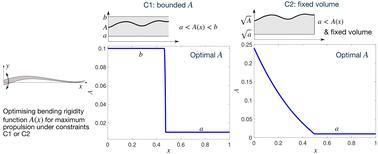
The propulsion of many eukaryotic cells is generated by flagella, flexible slender filaments that are actively oscillating in space and time. The dynamics of these biological appendages have inspired the design of many types of artificial microswimmers. The magnitude of the filament's viscous propulsion depends on the time-varying shape of the filament, and that shape depends in turn on the spatial distribution of the bending rigidity of the filament. In this work, we rigorously determine the relationship between the mechanical (bending) properties of the filament and the viscous thrust it produces using mathematical optimisation. Specifically, by considering a model system (a slender elastic filament with an oscillating slope at its base), we derive the optimal bending rigidity function along the filament that maximises the time-averaged thrust produced by the actuated filament. Instead of prescribing a specific functional form, we use functional optimisation and adjoint-based variational calculus to formally establish the link between the distribution of bending rigidity and propulsion. The optimal rigidities are found to be stiff near the base, and soft near the distal end, with a spatial distribution that depends critically on the constraints used in the optimisation procedure. These findings may guide the optimal design of future artificial swimmers.
期刊介绍:
Soft Matter is an international journal published by the Royal Society of Chemistry using Engineering-Materials Science: A Synthesis as its research focus. It publishes original research articles, review articles, and synthesis articles related to this field, reporting the latest discoveries in the relevant theoretical, practical, and applied disciplines in a timely manner, and aims to promote the rapid exchange of scientific information in this subject area. The journal is an open access journal. The journal is an open access journal and has not been placed on the alert list in the last three years.



 京公网安备 11010802042870号
京ICP备2023020795号-1
京公网安备 11010802042870号
京ICP备2023020795号-1

 分享
分享
 求助内容:
求助内容: 应助结果提醒方式:
 扫码关注我们
