{"title":"华北地区3 ~ 6岁学龄前儿童远视储备:北京远视储备研究。","authors":"Jianing Pu, Yuxin Fang, Zhen Zhou, Wei Chen, Jianping Hu, Shanshan Jin, Xinli Liu, Lihua Wang, Jingjing Feng, Huan Tong, Shanshan Xing, Ya Xing Wang, Yonghong Jiao","doi":"10.1186/s12886-025-04008-9","DOIUrl":null,"url":null,"abstract":"<p><strong>Clinical relevance: </strong>In recent years, the concept of hyperopia reserve, defined as a physiological hyperopic refractive status preceding emmetropia and myopia, has gained increasing attention. and raised awareness about myopia. This concept has become of interest to both parents and practitioners.</p><p><strong>Background: </strong>To report the distribution of refractive errors and ocular biometry in a large scale of preschool children in Beijing, in North China. The distribution of hyperopia reserve and its associated factors were also further investigated.</p><p><strong>Methods: </strong>This study presents baseline data from Beijing Hyperopia Reserve Research (BHRR), which enrolled 2109 preschool children from 22 randomly selected kindergartens. Cycloplegic refraction was performed for all children. Hyperopia reserve was defined as a spherical equivalent refractive error (SER) greater than zero. Parents completed a questionnaire about the severity of refractive status (normal; mild myopia <-3D; moderate myopia ≥-3D and ≤-6D; high myopia >-6D) and their children's indoor and outdoor activity times.</p><p><strong>Results: </strong>The mean SER was + 1.11 ± 0.97D, and the mean axial length was 22.25 + 0.73 mm in all preschool children. The overall prevalence of myopia was 3.7%, with age-specific rates of 2.8%, 3.8%, 3.8%, and 5.2%, respectively. A total of 1932 children (91.6%) had hyperopia reserve, yet only 24.1% of children had age-adjusted normal hyperopia reserve. Regression analysis showed that maintaining hyperopia reserve was associated with sex (boy as reference, OR = 1.7, P = 0.005), mild myopic group parents (Father: OR = 1.7, P = 0.003; Mother: OR = 2.2, P < 0.001), increased outdoor activity time (OR = 1.3, P = 0.031) and reduced study time (OR = 0.8, P = 0.025).</p><p><strong>Conclusions: </strong>The present study provided a comprehensive database on the refractive status and ocular biometry of preschool children aged 3-6 years in Beijing, North China. Although most children maintained hyperopia reserve, the majority had age-adjusted hyperopia reserve deficiencies. Early intervention, particularly for children with parents exhibiting severe myopia may be warranted.</p>","PeriodicalId":9058,"journal":{"name":"BMC Ophthalmology","volume":"25 1","pages":"175"},"PeriodicalIF":1.7000,"publicationDate":"2025-04-07","publicationTypes":"Journal Article","fieldsOfStudy":null,"isOpenAccess":false,"openAccessPdf":"https://www.ncbi.nlm.nih.gov/pmc/articles/PMC11974099/pdf/","citationCount":"0","resultStr":"{\"title\":\"The hyperopia reserve in 3- to 6- years-old preschool children in North China: the Beijing hyperopia reserve research.\",\"authors\":\"Jianing Pu, Yuxin Fang, Zhen Zhou, Wei Chen, Jianping Hu, Shanshan Jin, Xinli Liu, Lihua Wang, Jingjing Feng, Huan Tong, Shanshan Xing, Ya Xing Wang, Yonghong Jiao\",\"doi\":\"10.1186/s12886-025-04008-9\",\"DOIUrl\":null,\"url\":null,\"abstract\":\"<p><strong>Clinical relevance: </strong>In recent years, the concept of hyperopia reserve, defined as a physiological hyperopic refractive status preceding emmetropia and myopia, has gained increasing attention. and raised awareness about myopia. This concept has become of interest to both parents and practitioners.</p><p><strong>Background: </strong>To report the distribution of refractive errors and ocular biometry in a large scale of preschool children in Beijing, in North China. The distribution of hyperopia reserve and its associated factors were also further investigated.</p><p><strong>Methods: </strong>This study presents baseline data from Beijing Hyperopia Reserve Research (BHRR), which enrolled 2109 preschool children from 22 randomly selected kindergartens. Cycloplegic refraction was performed for all children. Hyperopia reserve was defined as a spherical equivalent refractive error (SER) greater than zero. Parents completed a questionnaire about the severity of refractive status (normal; mild myopia <-3D; moderate myopia ≥-3D and ≤-6D; high myopia >-6D) and their children's indoor and outdoor activity times.</p><p><strong>Results: </strong>The mean SER was + 1.11 ± 0.97D, and the mean axial length was 22.25 + 0.73 mm in all preschool children. The overall prevalence of myopia was 3.7%, with age-specific rates of 2.8%, 3.8%, 3.8%, and 5.2%, respectively. A total of 1932 children (91.6%) had hyperopia reserve, yet only 24.1% of children had age-adjusted normal hyperopia reserve. Regression analysis showed that maintaining hyperopia reserve was associated with sex (boy as reference, OR = 1.7, P = 0.005), mild myopic group parents (Father: OR = 1.7, P = 0.003; Mother: OR = 2.2, P < 0.001), increased outdoor activity time (OR = 1.3, P = 0.031) and reduced study time (OR = 0.8, P = 0.025).</p><p><strong>Conclusions: </strong>The present study provided a comprehensive database on the refractive status and ocular biometry of preschool children aged 3-6 years in Beijing, North China. Although most children maintained hyperopia reserve, the majority had age-adjusted hyperopia reserve deficiencies. Early intervention, particularly for children with parents exhibiting severe myopia may be warranted.</p>\",\"PeriodicalId\":9058,\"journal\":{\"name\":\"BMC Ophthalmology\",\"volume\":\"25 1\",\"pages\":\"175\"},\"PeriodicalIF\":1.7000,\"publicationDate\":\"2025-04-07\",\"publicationTypes\":\"Journal Article\",\"fieldsOfStudy\":null,\"isOpenAccess\":false,\"openAccessPdf\":\"https://www.ncbi.nlm.nih.gov/pmc/articles/PMC11974099/pdf/\",\"citationCount\":\"0\",\"resultStr\":null,\"platform\":\"Semanticscholar\",\"paperid\":null,\"PeriodicalName\":\"BMC Ophthalmology\",\"FirstCategoryId\":\"3\",\"ListUrlMain\":\"https://doi.org/10.1186/s12886-025-04008-9\",\"RegionNum\":4,\"RegionCategory\":\"医学\",\"ArticlePicture\":[],\"TitleCN\":null,\"AbstractTextCN\":null,\"PMCID\":null,\"EPubDate\":\"\",\"PubModel\":\"\",\"JCR\":\"Q3\",\"JCRName\":\"OPHTHALMOLOGY\",\"Score\":null,\"Total\":0}","platform":"Semanticscholar","paperid":null,"PeriodicalName":"BMC Ophthalmology","FirstCategoryId":"3","ListUrlMain":"https://doi.org/10.1186/s12886-025-04008-9","RegionNum":4,"RegionCategory":"医学","ArticlePicture":[],"TitleCN":null,"AbstractTextCN":null,"PMCID":null,"EPubDate":"","PubModel":"","JCR":"Q3","JCRName":"OPHTHALMOLOGY","Score":null,"Total":0}
引用次数: 0
摘要
临床意义:近年来,远视储备的概念越来越受到关注,它被定义为在远视和近视之前的一种生理性远视屈光状态。并提高了人们对近视的认识。这一概念引起了家长和从业者的兴趣。背景:报道北京地区大范围学龄前儿童屈光不正及眼部生物测量的分布情况。进一步探讨远视储备的分布及其相关因素。方法:本研究采用北京市远视保护研究中心(BHRR)的基线数据,随机抽取22所幼儿园的2109名学龄前儿童。所有患儿均行睫状体麻痹屈光检查。远视储备定义为球面等效屈光误差(SER)大于零。家长填写了一份关于屈光状态严重程度的问卷(正常;轻度近视-6D)和孩子的室内和室外活动时间。结果:学龄前儿童平均SER为+ 1.11±0.97D,平均轴长为22.25 + 0.73 mm。总体近视患病率为3.7%,各年龄段近视患病率分别为2.8%、3.8%、3.8%和5.2%。1932例儿童(91.6%)存在远视储备,而年龄调整后正常远视储备的儿童仅占24.1%。回归分析显示,远视储备维持与性别(男孩为参照,OR = 1.7, P = 0.005)、轻度近视组父母(父亲:OR = 1.7, P = 0.003;结论:本研究为北京地区3 ~ 6岁学龄前儿童屈光状态及眼部生物测量提供了较为全面的数据库。虽然大多数儿童保持远视储备,但大多数儿童存在年龄调整的远视储备缺陷。早期干预,特别是对于父母表现出严重近视的儿童,可能是有必要的。
The hyperopia reserve in 3- to 6- years-old preschool children in North China: the Beijing hyperopia reserve research.
Clinical relevance: In recent years, the concept of hyperopia reserve, defined as a physiological hyperopic refractive status preceding emmetropia and myopia, has gained increasing attention. and raised awareness about myopia. This concept has become of interest to both parents and practitioners.
Background: To report the distribution of refractive errors and ocular biometry in a large scale of preschool children in Beijing, in North China. The distribution of hyperopia reserve and its associated factors were also further investigated.
Methods: This study presents baseline data from Beijing Hyperopia Reserve Research (BHRR), which enrolled 2109 preschool children from 22 randomly selected kindergartens. Cycloplegic refraction was performed for all children. Hyperopia reserve was defined as a spherical equivalent refractive error (SER) greater than zero. Parents completed a questionnaire about the severity of refractive status (normal; mild myopia <-3D; moderate myopia ≥-3D and ≤-6D; high myopia >-6D) and their children's indoor and outdoor activity times.
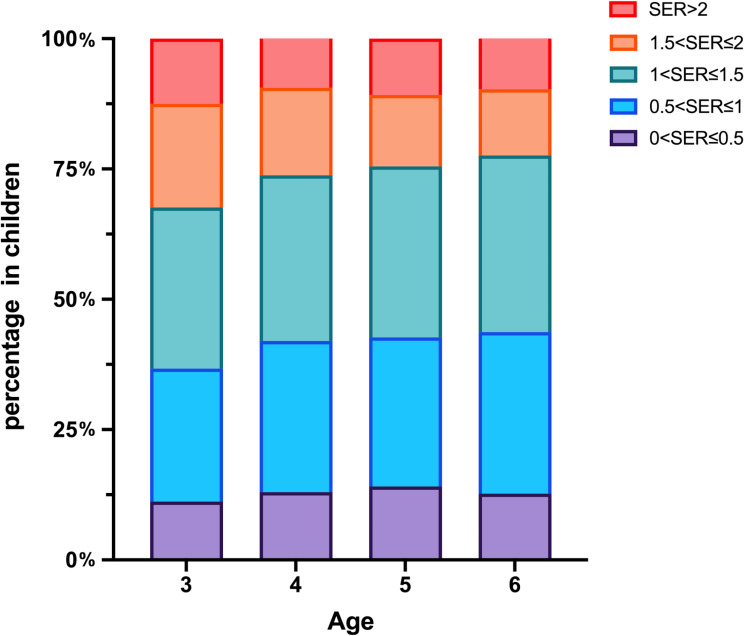
Results: The mean SER was + 1.11 ± 0.97D, and the mean axial length was 22.25 + 0.73 mm in all preschool children. The overall prevalence of myopia was 3.7%, with age-specific rates of 2.8%, 3.8%, 3.8%, and 5.2%, respectively. A total of 1932 children (91.6%) had hyperopia reserve, yet only 24.1% of children had age-adjusted normal hyperopia reserve. Regression analysis showed that maintaining hyperopia reserve was associated with sex (boy as reference, OR = 1.7, P = 0.005), mild myopic group parents (Father: OR = 1.7, P = 0.003; Mother: OR = 2.2, P < 0.001), increased outdoor activity time (OR = 1.3, P = 0.031) and reduced study time (OR = 0.8, P = 0.025).
Conclusions: The present study provided a comprehensive database on the refractive status and ocular biometry of preschool children aged 3-6 years in Beijing, North China. Although most children maintained hyperopia reserve, the majority had age-adjusted hyperopia reserve deficiencies. Early intervention, particularly for children with parents exhibiting severe myopia may be warranted.
期刊介绍:
BMC Ophthalmology is an open access, peer-reviewed journal that considers articles on all aspects of the prevention, diagnosis and management of eye disorders, as well as related molecular genetics, pathophysiology, and epidemiology.





 京公网安备 11010802042870号
京ICP备2023020795号-1
京公网安备 11010802042870号
京ICP备2023020795号-1

 分享
分享
 求助内容:
求助内容: 应助结果提醒方式:
 扫码关注我们
