{"title":"受教育程度与慢性疼痛的关系:一项中介孟德尔随机化研究。","authors":"Hanqi Wang, Mingjuan Liu, Hongbo Li, Shijie Xu","doi":"10.2147/JPR.S515921","DOIUrl":null,"url":null,"abstract":"<p><strong>Background: </strong>The underlying association between educational attainment (EA) and chronic pain (CP) risk is not clear. This study aimed to investigate the causal relationship of EA with CP using Mendelian randomization (MR).</p><p><strong>Methods: </strong>Single nucleotide polymorphisms (SNPs) for EA were selected from the Social Science Genetic Association Consortium (SSGAC). Inverse-variance weighted (IVW), weighted median, penalized weighted median, maximum likelihood (ML), and MR-Egger methods were used to estimate causal effects. Two sample MR analyses were undertaken to assess whether EA has a causal effect on CP. We also performed mediation analyses to estimate the mediation effects.</p><p><strong>Results: </strong>A genetically predicted higher EA was associated with a decreased risk of multisite chronic pain (MCP) (odds ratio [OR] = 0.772, 95% confidence interval [CI] 0.732-0.816 per one standard deviation of longer education, P < 0.05), and the Genome-wide association studies (GWAS) data for chronic widespread pain (CWP) supported the result mentioned above. Potential mediators included body mass index (BMI) (OR = 1.176, 95% CI 1.091-1.267, P < 0.05), smoking (OR = 1.054, 95% CI 1.028-1.081, P < 0.05), and depression (OR = 1.201, 95% CI 1.147-1.258, P < 0.05) have all been proven to be causally associated with MCP. The proportions of the effects of genetically predicted EA mediated through genetically predicted BMI, smoking, and depression were 17.1%, 23.6%, and 9.2%, respectively.</p><p><strong>Conclusion: </strong>Genetically predicted higher educational attainment reduces multisite chronic pain risk, partially mediated by body mass index (17.1%), smoking (23.6%), and depression (9.2%), highlighting education's protective role and its potential in chronic pain prevention strategies.</p>","PeriodicalId":16661,"journal":{"name":"Journal of Pain Research","volume":"18 ","pages":"1793-1804"},"PeriodicalIF":2.5000,"publicationDate":"2025-04-03","publicationTypes":"Journal Article","fieldsOfStudy":null,"isOpenAccess":false,"openAccessPdf":"https://www.ncbi.nlm.nih.gov/pmc/articles/PMC11974555/pdf/","citationCount":"0","resultStr":"{\"title\":\"Association Between Educational Attainment and Chronic Pain: A Mediation Mendelian Randomization Study.\",\"authors\":\"Hanqi Wang, Mingjuan Liu, Hongbo Li, Shijie Xu\",\"doi\":\"10.2147/JPR.S515921\",\"DOIUrl\":null,\"url\":null,\"abstract\":\"<p><strong>Background: </strong>The underlying association between educational attainment (EA) and chronic pain (CP) risk is not clear. This study aimed to investigate the causal relationship of EA with CP using Mendelian randomization (MR).</p><p><strong>Methods: </strong>Single nucleotide polymorphisms (SNPs) for EA were selected from the Social Science Genetic Association Consortium (SSGAC). Inverse-variance weighted (IVW), weighted median, penalized weighted median, maximum likelihood (ML), and MR-Egger methods were used to estimate causal effects. Two sample MR analyses were undertaken to assess whether EA has a causal effect on CP. We also performed mediation analyses to estimate the mediation effects.</p><p><strong>Results: </strong>A genetically predicted higher EA was associated with a decreased risk of multisite chronic pain (MCP) (odds ratio [OR] = 0.772, 95% confidence interval [CI] 0.732-0.816 per one standard deviation of longer education, P < 0.05), and the Genome-wide association studies (GWAS) data for chronic widespread pain (CWP) supported the result mentioned above. Potential mediators included body mass index (BMI) (OR = 1.176, 95% CI 1.091-1.267, P < 0.05), smoking (OR = 1.054, 95% CI 1.028-1.081, P < 0.05), and depression (OR = 1.201, 95% CI 1.147-1.258, P < 0.05) have all been proven to be causally associated with MCP. The proportions of the effects of genetically predicted EA mediated through genetically predicted BMI, smoking, and depression were 17.1%, 23.6%, and 9.2%, respectively.</p><p><strong>Conclusion: </strong>Genetically predicted higher educational attainment reduces multisite chronic pain risk, partially mediated by body mass index (17.1%), smoking (23.6%), and depression (9.2%), highlighting education's protective role and its potential in chronic pain prevention strategies.</p>\",\"PeriodicalId\":16661,\"journal\":{\"name\":\"Journal of Pain Research\",\"volume\":\"18 \",\"pages\":\"1793-1804\"},\"PeriodicalIF\":2.5000,\"publicationDate\":\"2025-04-03\",\"publicationTypes\":\"Journal Article\",\"fieldsOfStudy\":null,\"isOpenAccess\":false,\"openAccessPdf\":\"https://www.ncbi.nlm.nih.gov/pmc/articles/PMC11974555/pdf/\",\"citationCount\":\"0\",\"resultStr\":null,\"platform\":\"Semanticscholar\",\"paperid\":null,\"PeriodicalName\":\"Journal of Pain Research\",\"FirstCategoryId\":\"3\",\"ListUrlMain\":\"https://doi.org/10.2147/JPR.S515921\",\"RegionNum\":3,\"RegionCategory\":\"医学\",\"ArticlePicture\":[],\"TitleCN\":null,\"AbstractTextCN\":null,\"PMCID\":null,\"EPubDate\":\"2025/1/1 0:00:00\",\"PubModel\":\"eCollection\",\"JCR\":\"Q2\",\"JCRName\":\"CLINICAL NEUROLOGY\",\"Score\":null,\"Total\":0}","platform":"Semanticscholar","paperid":null,"PeriodicalName":"Journal of Pain Research","FirstCategoryId":"3","ListUrlMain":"https://doi.org/10.2147/JPR.S515921","RegionNum":3,"RegionCategory":"医学","ArticlePicture":[],"TitleCN":null,"AbstractTextCN":null,"PMCID":null,"EPubDate":"2025/1/1 0:00:00","PubModel":"eCollection","JCR":"Q2","JCRName":"CLINICAL NEUROLOGY","Score":null,"Total":0}
引用次数: 0
摘要
背景:受教育程度(EA)与慢性疼痛(CP)风险之间的潜在关联尚不清楚。本研究旨在利用孟德尔随机化(MR)研究EA与CP的因果关系。方法:从社会科学遗传协会联盟(SSGAC)中筛选EA的单核苷酸多态性(snp)。使用反方差加权(IVW)、加权中位数、惩罚加权中位数、最大似然(ML)和MR-Egger方法来估计因果效应。我们进行了两个样本MR分析,以评估EA是否对CP有因果影响。我们还进行了中介分析,以估计中介效应。结果:基因预测较高的EA与多部位慢性疼痛(MCP)风险降低相关(优势比[OR] = 0.772, 95%可信区间[CI] 0.732-0.816,每一个教育时间较长的标准差,P < 0.05),慢性广泛性疼痛(CWP)的全基因组关联研究(GWAS)数据支持上述结果。潜在的介质包括身体质量指数(BMI) (OR = 1.176, 95% CI 1.091-1.267, P < 0.05)、吸烟(OR = 1.054, 95% CI 1.028-1.081, P < 0.05)和抑郁(OR = 1.201, 95% CI 1.147-1.258, P < 0.05)均被证明与MCP有因果关系。通过基因预测BMI、吸烟和抑郁介导的基因预测EA的影响比例分别为17.1%、23.6%和9.2%。结论:基因预测较高的受教育程度可降低多部位慢性疼痛风险,部分介导因素包括体重指数(17.1%)、吸烟(23.6%)和抑郁(9.2%),突出了教育的保护作用及其在慢性疼痛预防策略中的潜力。
Association Between Educational Attainment and Chronic Pain: A Mediation Mendelian Randomization Study.
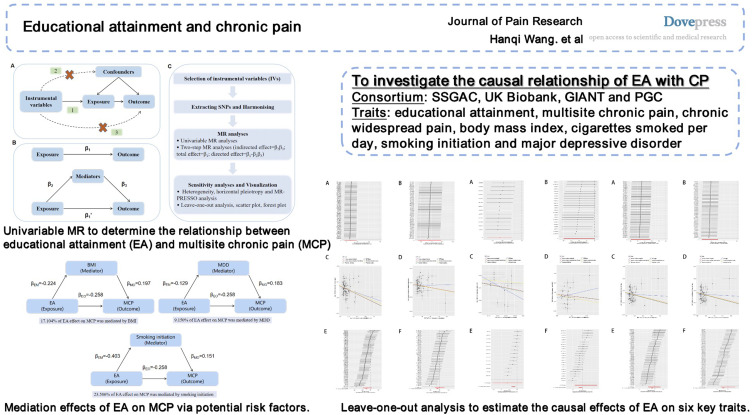
Background: The underlying association between educational attainment (EA) and chronic pain (CP) risk is not clear. This study aimed to investigate the causal relationship of EA with CP using Mendelian randomization (MR).
Methods: Single nucleotide polymorphisms (SNPs) for EA were selected from the Social Science Genetic Association Consortium (SSGAC). Inverse-variance weighted (IVW), weighted median, penalized weighted median, maximum likelihood (ML), and MR-Egger methods were used to estimate causal effects. Two sample MR analyses were undertaken to assess whether EA has a causal effect on CP. We also performed mediation analyses to estimate the mediation effects.
Results: A genetically predicted higher EA was associated with a decreased risk of multisite chronic pain (MCP) (odds ratio [OR] = 0.772, 95% confidence interval [CI] 0.732-0.816 per one standard deviation of longer education, P < 0.05), and the Genome-wide association studies (GWAS) data for chronic widespread pain (CWP) supported the result mentioned above. Potential mediators included body mass index (BMI) (OR = 1.176, 95% CI 1.091-1.267, P < 0.05), smoking (OR = 1.054, 95% CI 1.028-1.081, P < 0.05), and depression (OR = 1.201, 95% CI 1.147-1.258, P < 0.05) have all been proven to be causally associated with MCP. The proportions of the effects of genetically predicted EA mediated through genetically predicted BMI, smoking, and depression were 17.1%, 23.6%, and 9.2%, respectively.
Conclusion: Genetically predicted higher educational attainment reduces multisite chronic pain risk, partially mediated by body mass index (17.1%), smoking (23.6%), and depression (9.2%), highlighting education's protective role and its potential in chronic pain prevention strategies.
期刊介绍:
Journal of Pain Research is an international, peer-reviewed, open access journal that welcomes laboratory and clinical findings in the fields of pain research and the prevention and management of pain. Original research, reviews, symposium reports, hypothesis formation and commentaries are all considered for publication. Additionally, the journal now welcomes the submission of pain-policy-related editorials and commentaries, particularly in regard to ethical, regulatory, forensic, and other legal issues in pain medicine, and to the education of pain practitioners and researchers.






 京公网安备 11010802042870号
京ICP备2023020795号-1
京公网安备 11010802042870号
京ICP备2023020795号-1

 分享
分享
 求助内容:
求助内容: 应助结果提醒方式:
 扫码关注我们
