{"title":"1995年至2023年气候因素对印度高、高、中、低流行邦疟疾发生的影响。","authors":"Muniaraj Mayilsamy, Rajagopal Parthasarathy, Rajamannar Veeramanoharan, Paramasivan Rajaiah","doi":"10.1186/s12936-025-05326-5","DOIUrl":null,"url":null,"abstract":"<p><strong>Background: </strong>Malaria has been surging in India for the past 3 years after reaching the recorded low in 2021. Among the possible reasons for this unexpected surge of cases, such as insufficient surveillance, slow and aggregated data reporting, endemic pockets in the tribal, dense forest areas where control programmes are difficult to reach, the role of climate change due to global warming has gained less attention. Similar to the diverse climatic conditions that prevail in different regions of India, the malaria distribution is also highly variable. Therefore, the impact of the annual average of climatic factors on the annual parasite index (API) in hyper-, high-, moderate-, and low-endemic states was analysed.</p><p><strong>Methods: </strong>The annual malaria data provided by the National Center for Vector Borne Diseases Control, and meteorological data provided by the India Meteorological Department, Pune, and Statista, were used to make temporal trend analysis, scatter plot analysis, clustered scatter plot analysis, and Spearman & Pearson correlation coefficient to determine the impact of climatic factors on the occurrence of malaria in hyper, high, moderate and low endemic States in India.</p><p><strong>Results: </strong>While the increasing annual temperature and rainfall negatively influenced the annual parasite index in high, moderate, and low endemic states, both had no influence on API in malaria hyperendemic states. Although minimum and maximum annual rainfall was found to be detrimental to the increase of API in low and moderate endemic states, moderate annual rainfall of high and hyperendemic states was favourable for increasing API. The increasing annual relative humidity negatively influenced the API in high and moderate endemic states and had a positive influence on the API in low endemic states. The humidity did not have any influence over the API in the hyperendemic state. Statistical analysis showed that, except in Mizoram, the annual mean temperature negatively influenced the API in all other states. The annual rainfall and average humidity were shown to be negatively associated with API only in Odisha.</p><p><strong>Conclusion: </strong>The present study revealed the relationships between annual climatic factors such as temperature, rainfall, and humidity with API in malaria hyper-, high-, moderate- and low endemic states in India.</p>","PeriodicalId":18317,"journal":{"name":"Malaria Journal","volume":"24 1","pages":"113"},"PeriodicalIF":3.0000,"publicationDate":"2025-04-07","publicationTypes":"Journal Article","fieldsOfStudy":null,"isOpenAccess":false,"openAccessPdf":"https://www.ncbi.nlm.nih.gov/pmc/articles/PMC11978134/pdf/","citationCount":"0","resultStr":"{\"title\":\"Impact of climatic factors on the occurrence of malaria in hyper, high, moderate and low endemic States in India from 1995 to 2023.\",\"authors\":\"Muniaraj Mayilsamy, Rajagopal Parthasarathy, Rajamannar Veeramanoharan, Paramasivan Rajaiah\",\"doi\":\"10.1186/s12936-025-05326-5\",\"DOIUrl\":null,\"url\":null,\"abstract\":\"<p><strong>Background: </strong>Malaria has been surging in India for the past 3 years after reaching the recorded low in 2021. Among the possible reasons for this unexpected surge of cases, such as insufficient surveillance, slow and aggregated data reporting, endemic pockets in the tribal, dense forest areas where control programmes are difficult to reach, the role of climate change due to global warming has gained less attention. Similar to the diverse climatic conditions that prevail in different regions of India, the malaria distribution is also highly variable. Therefore, the impact of the annual average of climatic factors on the annual parasite index (API) in hyper-, high-, moderate-, and low-endemic states was analysed.</p><p><strong>Methods: </strong>The annual malaria data provided by the National Center for Vector Borne Diseases Control, and meteorological data provided by the India Meteorological Department, Pune, and Statista, were used to make temporal trend analysis, scatter plot analysis, clustered scatter plot analysis, and Spearman & Pearson correlation coefficient to determine the impact of climatic factors on the occurrence of malaria in hyper, high, moderate and low endemic States in India.</p><p><strong>Results: </strong>While the increasing annual temperature and rainfall negatively influenced the annual parasite index in high, moderate, and low endemic states, both had no influence on API in malaria hyperendemic states. Although minimum and maximum annual rainfall was found to be detrimental to the increase of API in low and moderate endemic states, moderate annual rainfall of high and hyperendemic states was favourable for increasing API. The increasing annual relative humidity negatively influenced the API in high and moderate endemic states and had a positive influence on the API in low endemic states. The humidity did not have any influence over the API in the hyperendemic state. Statistical analysis showed that, except in Mizoram, the annual mean temperature negatively influenced the API in all other states. The annual rainfall and average humidity were shown to be negatively associated with API only in Odisha.</p><p><strong>Conclusion: </strong>The present study revealed the relationships between annual climatic factors such as temperature, rainfall, and humidity with API in malaria hyper-, high-, moderate- and low endemic states in India.</p>\",\"PeriodicalId\":18317,\"journal\":{\"name\":\"Malaria Journal\",\"volume\":\"24 1\",\"pages\":\"113\"},\"PeriodicalIF\":3.0000,\"publicationDate\":\"2025-04-07\",\"publicationTypes\":\"Journal Article\",\"fieldsOfStudy\":null,\"isOpenAccess\":false,\"openAccessPdf\":\"https://www.ncbi.nlm.nih.gov/pmc/articles/PMC11978134/pdf/\",\"citationCount\":\"0\",\"resultStr\":null,\"platform\":\"Semanticscholar\",\"paperid\":null,\"PeriodicalName\":\"Malaria Journal\",\"FirstCategoryId\":\"3\",\"ListUrlMain\":\"https://doi.org/10.1186/s12936-025-05326-5\",\"RegionNum\":3,\"RegionCategory\":\"医学\",\"ArticlePicture\":[],\"TitleCN\":null,\"AbstractTextCN\":null,\"PMCID\":null,\"EPubDate\":\"\",\"PubModel\":\"\",\"JCR\":\"Q3\",\"JCRName\":\"INFECTIOUS DISEASES\",\"Score\":null,\"Total\":0}","platform":"Semanticscholar","paperid":null,"PeriodicalName":"Malaria Journal","FirstCategoryId":"3","ListUrlMain":"https://doi.org/10.1186/s12936-025-05326-5","RegionNum":3,"RegionCategory":"医学","ArticlePicture":[],"TitleCN":null,"AbstractTextCN":null,"PMCID":null,"EPubDate":"","PubModel":"","JCR":"Q3","JCRName":"INFECTIOUS DISEASES","Score":null,"Total":0}
Impact of climatic factors on the occurrence of malaria in hyper, high, moderate and low endemic States in India from 1995 to 2023.
Background: Malaria has been surging in India for the past 3 years after reaching the recorded low in 2021. Among the possible reasons for this unexpected surge of cases, such as insufficient surveillance, slow and aggregated data reporting, endemic pockets in the tribal, dense forest areas where control programmes are difficult to reach, the role of climate change due to global warming has gained less attention. Similar to the diverse climatic conditions that prevail in different regions of India, the malaria distribution is also highly variable. Therefore, the impact of the annual average of climatic factors on the annual parasite index (API) in hyper-, high-, moderate-, and low-endemic states was analysed.
Methods: The annual malaria data provided by the National Center for Vector Borne Diseases Control, and meteorological data provided by the India Meteorological Department, Pune, and Statista, were used to make temporal trend analysis, scatter plot analysis, clustered scatter plot analysis, and Spearman & Pearson correlation coefficient to determine the impact of climatic factors on the occurrence of malaria in hyper, high, moderate and low endemic States in India.
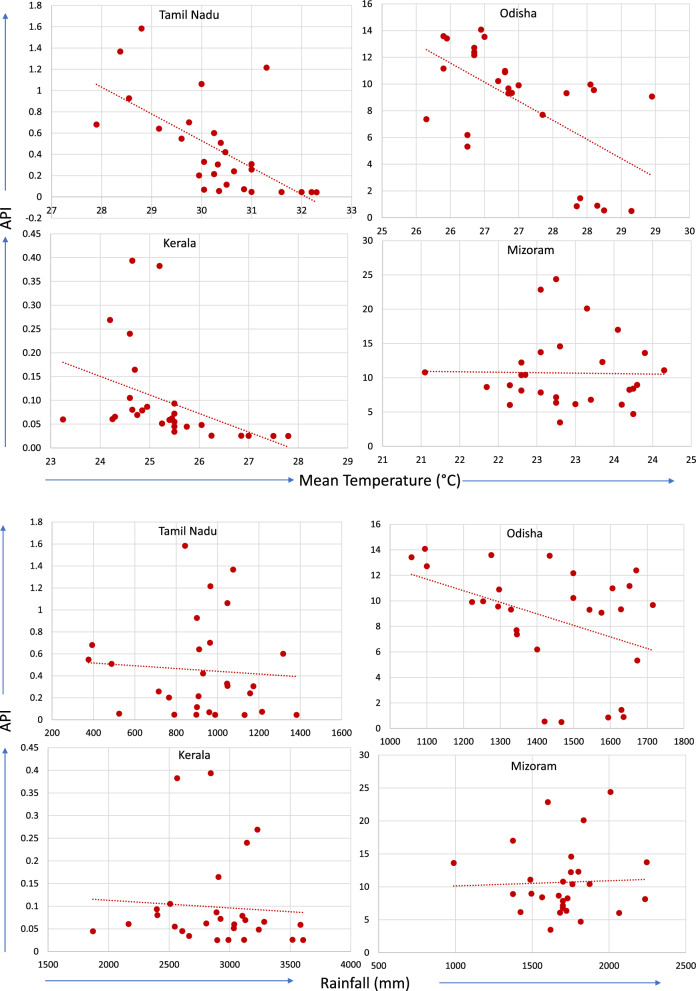
Results: While the increasing annual temperature and rainfall negatively influenced the annual parasite index in high, moderate, and low endemic states, both had no influence on API in malaria hyperendemic states. Although minimum and maximum annual rainfall was found to be detrimental to the increase of API in low and moderate endemic states, moderate annual rainfall of high and hyperendemic states was favourable for increasing API. The increasing annual relative humidity negatively influenced the API in high and moderate endemic states and had a positive influence on the API in low endemic states. The humidity did not have any influence over the API in the hyperendemic state. Statistical analysis showed that, except in Mizoram, the annual mean temperature negatively influenced the API in all other states. The annual rainfall and average humidity were shown to be negatively associated with API only in Odisha.
Conclusion: The present study revealed the relationships between annual climatic factors such as temperature, rainfall, and humidity with API in malaria hyper-, high-, moderate- and low endemic states in India.
期刊介绍:
Malaria Journal is aimed at the scientific community interested in malaria in its broadest sense. It is the only journal that publishes exclusively articles on malaria and, as such, it aims to bring together knowledge from the different specialities involved in this very broad discipline, from the bench to the bedside and to the field.






 京公网安备 11010802042870号
京ICP备2023020795号-1
京公网安备 11010802042870号
京ICP备2023020795号-1

 分享
分享
 求助内容:
求助内容: 应助结果提醒方式:
 扫码关注我们
