Development of bio-nano-herbicide using Eucalyptus citriodora essential oil against a notorious weed Echinochloa crus-galli
BACKGROUND
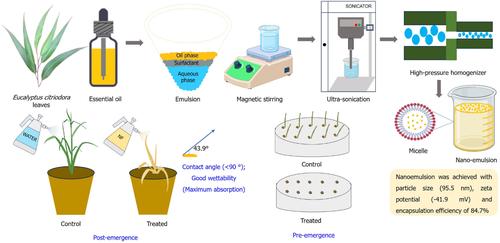
Weeds are a menace in agriculture causing crop yield reductions to the tune of 40–50%. To overcome the problems of weeds, herbicides have been used excessively to the extent that they have caused resistance in weeds, in addition to the environmental hazards. Nano-herbicides are intended to exploit botanicals to develop novel bio-nano-herbicide formulations. Bio-nano herbicide was developed using Eucalyptus citriodora essential oil combined high-energy approaches such as ultra-sonication and high-pressure homogenization. The formulation has hydrodynamic and physical sizes of 95.5 and 32.3–57.7 nm, respectively. The product was tested for their pre-emergence and post-emergence herbicidal activity against Echinochloa crus-galli.
RESULTS
Increased concentration of bio-nano-herbicide inhibited the pre-emergence of weed seeds. Treated weed seeds registered lower dehydrogenase (0.80 to 0.32), alpha-amylase (1.349 to 0.101 mg maltose), catalase (3.87 to 3.52 μmol H₂O₂ min−1 g−1 protein), peroxidase (3.96 to 3.61 U mg−1 protein min−1) and super oxide dismutase (0.94 to 0.56 U mg−1 protein min−1) activities than control. Further, foliar spray of 1% nanoemulsion recorded significantly lower total chlorophyll content (1.62 mg g−1 fresh weight), than the crude oil (2.58 mg g−1). The antioxidant enzyme activities increased immediately after the first spray and the weeds wilted after the second spray.
期刊介绍:
Pest Management Science is the international journal of research and development in crop protection and pest control. Since its launch in 1970, the journal has become the premier forum for papers on the discovery, application, and impact on the environment of products and strategies designed for pest management.
Published for SCI by John Wiley & Sons Ltd.




 京公网安备 11010802042870号
京ICP备2023020795号-1
京公网安备 11010802042870号
京ICP备2023020795号-1

 分享
分享
 求助内容:
求助内容: 应助结果提醒方式:
 扫码关注我们
