Indirect plant defense may provide economically important pest suppression in sorghum
BACKGROUND
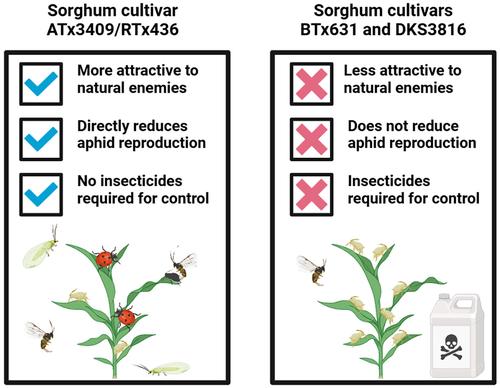
A promising strategy to optimize biological control of insect pests is selecting crop varieties with indirect defense traits. Indirect plant defenses recruit natural enemies to kill pests and include chemical attractants like herbivore-induced plant volatiles. In prior laboratory assays, we found sorghum (Sorghum bicolor L.) cultivar ATx3409/RTx436 infested with sorghum aphid (Melanaphis sorghi Theobald) was attractive to natural enemies and emitted more chemical attractants than two other cultivars. In this field study, we manually infested 9-week-old sorghum plants with aphids and quantified differences in natural enemy and aphid densities among cultivars throughout the growing season. We also used field cages to control access of natural enemies to plants and estimate their effects on aphid suppression.
RESULTS
We found strong evidence that indirect plant defenses confer economically relevant control of aphid pest populations and that laboratory assays can accurately predict natural enemy recruitment in the field. In 2022, there were three times more lady beetles (Coleoptera: Coccinellidae), lacewings (Neuroptera: Chrysopidae and Hemerobiidae), hover flies (Diptera: Syrphidae), and parasitoids (Hymenoptera: Braconidae and Aphelinidae) per aphid on ATx3409/RTx436 than on the other two cultivars. In the field cage experiment, natural enemies reduced aphid densities by up to 83% one week after aphid infestation. ATx3409/RTx436 was the only cultivar to remain below the economic threshold throughout the growing season, indicating that this cultivar would not require any pesticide applications to control aphids. In 2023, there were similar abundances of natural enemies and aphid densities across cultivars, the latter of which remained near zero throughout the growing season, likely due to extremely hot temperatures and drought that may have contributed to aphid mortality.
期刊介绍:
Pest Management Science is the international journal of research and development in crop protection and pest control. Since its launch in 1970, the journal has become the premier forum for papers on the discovery, application, and impact on the environment of products and strategies designed for pest management.
Published for SCI by John Wiley & Sons Ltd.





 京公网安备 11010802042870号
京ICP备2023020795号-1
京公网安备 11010802042870号
京ICP备2023020795号-1

 分享
分享
 求助内容:
求助内容: 应助结果提醒方式:
 扫码关注我们
