{"title":"孟德尔随机化研究:免疫细胞与社交恐惧症、特定恐惧症和广场恐惧症风险之间的因果关系。","authors":"Jun-Neng Wang, Dong-Hu Yu, Zhi-Yu Li, Ling-Yue Kong, Nan-Hao Li, You-Xian Wu, Tian-Qing Wang, Ze-Fen Wang, Zhi-Qiang Li","doi":"10.1186/s12888-025-06794-4","DOIUrl":null,"url":null,"abstract":"<p><strong>Background: </strong>Although phobia is a common psychiatric disorder, the underlying biological mechanisms have not been fully elucidated. Complex immune-brain interactions that affect neural development, survival, and function may have causal and therapeutic implications in psychiatric illnesses. In this study, the relationships between immune cell traits and phobia were analysed using Mendelian randomization to explore the biological mechanisms.</p><p><strong>Methods: </strong>Based on publicly-available genetic data, a two-sample MR analysis was used to determine the causal relationship between 731 immune cell traits and the risk of developing phobias. Sensitivity analyses were conducted to verify the robustness, heterogeneity, and horizontal pleiotropy of the results.</p><p><strong>Results: </strong>After forward and reverse analyses, false discovery rate (FDR) corrections were performed. No significant associations between phobias and immune cell traits were identified. After adjusting the FDR threshold, social phobia affected two immune cell traits: CD39 on granulocytes (β = 9.0347, 95% confidence interval (CI) = 4.4802-13.5891, P = 0.0001, FDR = 0.0738), and CD11c on granulocytes (β = 7.7976, 95% CI = 3.4616-12.1336, P = 0.0004, FDR = 0.1547). Three immune cell traits affected the risk of specific phobias: CD4 + CD8dim T cell %leukocyte (odds ratio (OR) = 0.9985, 95% CI = 0.9976-0.9993, P = 0.0006, FDR = 0.1373), CD45 on CD33 + HLA DR + CD14dim (OR = 0.9977, 95% CI = 0.9964-0.9990, P = 0.0004, FDR = 0.1373), and CD8 on CD28 + CD45RA + CD8br (OR = 0.9990, 95% CI = 0.9985-0.9996, P = 0.0003, FDR = 0.1373). Two immune cell traits affected the risk of agoraphobia: CD3 on CD39 + resting regulatory T cells (Tregs) (OR = 1.0010, 95 CI%=1.0005-1.0015, P = 0.0001, FDR = 0.0596) and HLA DR on CD33br HLA DR + CD14dim (OR = 0.9993, 95 CI%=0.9990-0.9997, P = 0.0002, FDR = 0.0596).</p><p><strong>Conclusions: </strong>Immune cell traits closely related to phobias were screened out through genomics, which provides a reference for the subsequent research on the immune system-phobia interaction.</p>","PeriodicalId":9029,"journal":{"name":"BMC Psychiatry","volume":"25 1","pages":"350"},"PeriodicalIF":3.4000,"publicationDate":"2025-04-08","publicationTypes":"Journal Article","fieldsOfStudy":null,"isOpenAccess":false,"openAccessPdf":"https://www.ncbi.nlm.nih.gov/pmc/articles/PMC11980060/pdf/","citationCount":"0","resultStr":"{\"title\":\"A Mendelian randomization study: causal relationship between immune cells and the risks of social phobia, specific phobia, and agoraphobia.\",\"authors\":\"Jun-Neng Wang, Dong-Hu Yu, Zhi-Yu Li, Ling-Yue Kong, Nan-Hao Li, You-Xian Wu, Tian-Qing Wang, Ze-Fen Wang, Zhi-Qiang Li\",\"doi\":\"10.1186/s12888-025-06794-4\",\"DOIUrl\":null,\"url\":null,\"abstract\":\"<p><strong>Background: </strong>Although phobia is a common psychiatric disorder, the underlying biological mechanisms have not been fully elucidated. Complex immune-brain interactions that affect neural development, survival, and function may have causal and therapeutic implications in psychiatric illnesses. In this study, the relationships between immune cell traits and phobia were analysed using Mendelian randomization to explore the biological mechanisms.</p><p><strong>Methods: </strong>Based on publicly-available genetic data, a two-sample MR analysis was used to determine the causal relationship between 731 immune cell traits and the risk of developing phobias. Sensitivity analyses were conducted to verify the robustness, heterogeneity, and horizontal pleiotropy of the results.</p><p><strong>Results: </strong>After forward and reverse analyses, false discovery rate (FDR) corrections were performed. No significant associations between phobias and immune cell traits were identified. After adjusting the FDR threshold, social phobia affected two immune cell traits: CD39 on granulocytes (β = 9.0347, 95% confidence interval (CI) = 4.4802-13.5891, P = 0.0001, FDR = 0.0738), and CD11c on granulocytes (β = 7.7976, 95% CI = 3.4616-12.1336, P = 0.0004, FDR = 0.1547). Three immune cell traits affected the risk of specific phobias: CD4 + CD8dim T cell %leukocyte (odds ratio (OR) = 0.9985, 95% CI = 0.9976-0.9993, P = 0.0006, FDR = 0.1373), CD45 on CD33 + HLA DR + CD14dim (OR = 0.9977, 95% CI = 0.9964-0.9990, P = 0.0004, FDR = 0.1373), and CD8 on CD28 + CD45RA + CD8br (OR = 0.9990, 95% CI = 0.9985-0.9996, P = 0.0003, FDR = 0.1373). Two immune cell traits affected the risk of agoraphobia: CD3 on CD39 + resting regulatory T cells (Tregs) (OR = 1.0010, 95 CI%=1.0005-1.0015, P = 0.0001, FDR = 0.0596) and HLA DR on CD33br HLA DR + CD14dim (OR = 0.9993, 95 CI%=0.9990-0.9997, P = 0.0002, FDR = 0.0596).</p><p><strong>Conclusions: </strong>Immune cell traits closely related to phobias were screened out through genomics, which provides a reference for the subsequent research on the immune system-phobia interaction.</p>\",\"PeriodicalId\":9029,\"journal\":{\"name\":\"BMC Psychiatry\",\"volume\":\"25 1\",\"pages\":\"350\"},\"PeriodicalIF\":3.4000,\"publicationDate\":\"2025-04-08\",\"publicationTypes\":\"Journal Article\",\"fieldsOfStudy\":null,\"isOpenAccess\":false,\"openAccessPdf\":\"https://www.ncbi.nlm.nih.gov/pmc/articles/PMC11980060/pdf/\",\"citationCount\":\"0\",\"resultStr\":null,\"platform\":\"Semanticscholar\",\"paperid\":null,\"PeriodicalName\":\"BMC Psychiatry\",\"FirstCategoryId\":\"3\",\"ListUrlMain\":\"https://doi.org/10.1186/s12888-025-06794-4\",\"RegionNum\":2,\"RegionCategory\":\"医学\",\"ArticlePicture\":[],\"TitleCN\":null,\"AbstractTextCN\":null,\"PMCID\":null,\"EPubDate\":\"\",\"PubModel\":\"\",\"JCR\":\"Q2\",\"JCRName\":\"PSYCHIATRY\",\"Score\":null,\"Total\":0}","platform":"Semanticscholar","paperid":null,"PeriodicalName":"BMC Psychiatry","FirstCategoryId":"3","ListUrlMain":"https://doi.org/10.1186/s12888-025-06794-4","RegionNum":2,"RegionCategory":"医学","ArticlePicture":[],"TitleCN":null,"AbstractTextCN":null,"PMCID":null,"EPubDate":"","PubModel":"","JCR":"Q2","JCRName":"PSYCHIATRY","Score":null,"Total":0}
引用次数: 0
摘要
背景:虽然恐惧症是一种常见的精神疾病,但其潜在的生物学机制尚未完全阐明。影响神经发育、生存和功能的复杂免疫-脑相互作用可能在精神疾病中具有因果关系和治疗意义。本研究采用孟德尔随机化方法分析免疫细胞特征与恐惧症的关系,探讨其生物学机制。方法:基于公开的遗传数据,采用双样本MR分析来确定731种免疫细胞特征与发生恐惧症风险之间的因果关系。进行敏感性分析以验证结果的稳健性、异质性和水平多效性。结果:经过正向和反向分析,进行了错误发现率(FDR)修正。没有发现恐惧症和免疫细胞特征之间的显著关联。调整FDR阈值后,社交恐惧症影响两种免疫细胞特征:粒细胞CD39 (β = 9.0347, 95%可信区间(CI) = 4.4802-13.5891, P = 0.0001, FDR = 0.0738)和粒细胞CD11c (β = 7.7976, 95% CI = 3.4616-12.1336, P = 0.0004, FDR = 0.1547)。三个免疫细胞特征影响特定恐惧症的风险:CD4 + T细胞CD8dim %白细胞(优势比(或)= 0.9985,95% CI -0.9993 = 0.9976, P = 0.0006,罗斯福= 0.1373),在CD33 CD45 + HLA DR + CD14dim (OR = 0.9977, 95% CI -0.9990 = 0.9964, P = 0.0004,罗斯福= 0.1373),和CD8 CD28 + CD45RA + CD8br (OR = 0.9990, 95% CI -0.9996 = 0.9985, P = 0.0003,罗斯福= 0.1373)。两种免疫细胞特征影响恐地风险:CD3作用于CD39 +静息调节性T细胞(Tregs) (OR = 1.0010, 95 CI%=1.0005-1.0015, P = 0.0001, FDR = 0.0596)和HLA DR作用于CD33br HLA DR + CD14dim (OR = 0.9993, 95 CI%=0.9990-0.9997, P = 0.0002, FDR = 0.0596)。结论:通过基因组学筛选出与恐惧症密切相关的免疫细胞特征,为后续免疫系统-恐惧症相互作用的研究提供参考。
A Mendelian randomization study: causal relationship between immune cells and the risks of social phobia, specific phobia, and agoraphobia.
Background: Although phobia is a common psychiatric disorder, the underlying biological mechanisms have not been fully elucidated. Complex immune-brain interactions that affect neural development, survival, and function may have causal and therapeutic implications in psychiatric illnesses. In this study, the relationships between immune cell traits and phobia were analysed using Mendelian randomization to explore the biological mechanisms.
Methods: Based on publicly-available genetic data, a two-sample MR analysis was used to determine the causal relationship between 731 immune cell traits and the risk of developing phobias. Sensitivity analyses were conducted to verify the robustness, heterogeneity, and horizontal pleiotropy of the results.
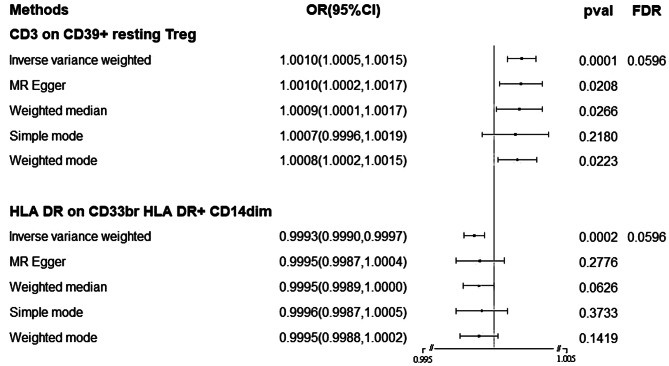
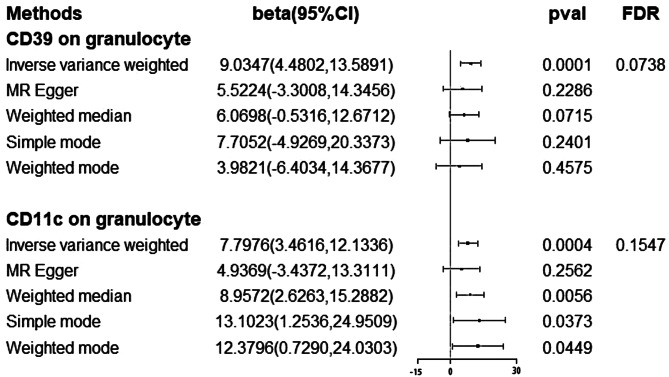
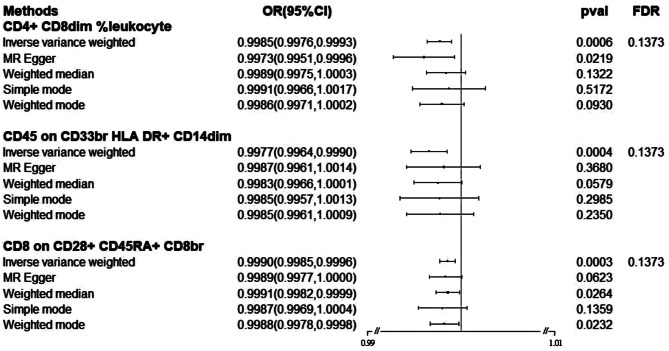
Results: After forward and reverse analyses, false discovery rate (FDR) corrections were performed. No significant associations between phobias and immune cell traits were identified. After adjusting the FDR threshold, social phobia affected two immune cell traits: CD39 on granulocytes (β = 9.0347, 95% confidence interval (CI) = 4.4802-13.5891, P = 0.0001, FDR = 0.0738), and CD11c on granulocytes (β = 7.7976, 95% CI = 3.4616-12.1336, P = 0.0004, FDR = 0.1547). Three immune cell traits affected the risk of specific phobias: CD4 + CD8dim T cell %leukocyte (odds ratio (OR) = 0.9985, 95% CI = 0.9976-0.9993, P = 0.0006, FDR = 0.1373), CD45 on CD33 + HLA DR + CD14dim (OR = 0.9977, 95% CI = 0.9964-0.9990, P = 0.0004, FDR = 0.1373), and CD8 on CD28 + CD45RA + CD8br (OR = 0.9990, 95% CI = 0.9985-0.9996, P = 0.0003, FDR = 0.1373). Two immune cell traits affected the risk of agoraphobia: CD3 on CD39 + resting regulatory T cells (Tregs) (OR = 1.0010, 95 CI%=1.0005-1.0015, P = 0.0001, FDR = 0.0596) and HLA DR on CD33br HLA DR + CD14dim (OR = 0.9993, 95 CI%=0.9990-0.9997, P = 0.0002, FDR = 0.0596).
Conclusions: Immune cell traits closely related to phobias were screened out through genomics, which provides a reference for the subsequent research on the immune system-phobia interaction.
期刊介绍:
BMC Psychiatry is an open access, peer-reviewed journal that considers articles on all aspects of the prevention, diagnosis and management of psychiatric disorders, as well as related molecular genetics, pathophysiology, and epidemiology.




 京公网安备 11010802042870号
京ICP备2023020795号-1
京公网安备 11010802042870号
京ICP备2023020795号-1

 分享
分享
 求助内容:
求助内容: 应助结果提醒方式:
 扫码关注我们
