{"title":"推拿疗法与手工物理疗法治疗膝骨关节炎的比较疗效:一项随机对照试验。","authors":"Peihong Ma, Luping Liu, Sina Li, Meiling Cai, Siyu Han, Zhiwen Weng, Qianji Chen, Yixuan Gao, Lingyun Zhang, Guiyun Wu, Xiaoming Yang, Yang Zhang, Duoduo Li, Changxin Liu, Ya'nan Sun, Shiyan Yan, Xiyou Wang, Changhe Yu","doi":"10.1186/s12906-025-04850-w","DOIUrl":null,"url":null,"abstract":"<p><strong>Background: </strong>Tuina therapy (Tuina) is commonly utilized for managing knee osteoarthritis (KOA), yet the available evidence is limited. This study aimed to evaluate the effectiveness of Tuina compared to widely accepted manual physical therapy (mPT) for patients with KOA.</p><p><strong>Methods: </strong>Between Oct 2019 and Oct 2021, patients with KOA (Kellgren-Lawrence score II or III) were randomly assigned in a 1:1 ratio to receive Tuina or mPT, with eight 20-min sessions over 3 weeks. Assessments were performed at baseline, week 4, 8, and 16. The primary outcome was the change of total Western Ontario and McMaster University Osteoarthritis Index (WOMAC) from baseline to week 4. Secondary outcomes included WOMAC subscales, knee pain measures, performance-based tests, quality-of-life measures, and safety assessments. Patients, evaluators, and statisticians were blinded to treatment group assignment. All main analyses were by intention-to-treat.</p><p><strong>Results: </strong>Of the 140 patients allocated to Tuina or mPT, 127 completed the treatment. There was significant intervention × time interaction observed in the WOMAC-total (F(2, 266) = 3.87, P = 0.02), there was no statistically significant between groups at week 4 (between-group difference: -1.00, 95%CI: -5.33 to 3.33, P = 0.79, Bonferroni correction). By week 8, Tuina showed significantly consistent improvement compared to mPT (between-group difference: -4.33, 95%CI: -8.34 to -0.31, P = 0.03, Bonferroni correction), whereas there were no statistically significant differences between groups at week 16 (between-group difference: 0.74, 95%CI: -3.67 to 5.15, P = 0.37, Bonferroni correction). Most secondary outcomes showed no significant between-group differences, except for the Timed Up and Go Test Time favoring mPT (0.94, 95%CI: 0.03 to 1.85, P = 0.04). No serious adverse events occurred. One patient in the mPT group took the medication and no patients received other therapies for KOA.</p><p><strong>Conclusions: </strong>Tuina produced beneficial effectiveness similar to mPT in treating KOA.</p><p><strong>Trial registration: </strong>NCT03966248, Registered on 29/05/2019, ClinicalTrials.gov.</p>","PeriodicalId":9128,"journal":{"name":"BMC Complementary Medicine and Therapies","volume":"25 1","pages":"128"},"PeriodicalIF":4.4000,"publicationDate":"2025-04-08","publicationTypes":"Journal Article","fieldsOfStudy":null,"isOpenAccess":false,"openAccessPdf":"https://www.ncbi.nlm.nih.gov/pmc/articles/PMC11980076/pdf/","citationCount":"0","resultStr":"{\"title\":\"Comparative effectiveness of Tuina therapy versus manual physical therapy for knee osteoarthritis: a randomized controlled trial.\",\"authors\":\"Peihong Ma, Luping Liu, Sina Li, Meiling Cai, Siyu Han, Zhiwen Weng, Qianji Chen, Yixuan Gao, Lingyun Zhang, Guiyun Wu, Xiaoming Yang, Yang Zhang, Duoduo Li, Changxin Liu, Ya'nan Sun, Shiyan Yan, Xiyou Wang, Changhe Yu\",\"doi\":\"10.1186/s12906-025-04850-w\",\"DOIUrl\":null,\"url\":null,\"abstract\":\"<p><strong>Background: </strong>Tuina therapy (Tuina) is commonly utilized for managing knee osteoarthritis (KOA), yet the available evidence is limited. This study aimed to evaluate the effectiveness of Tuina compared to widely accepted manual physical therapy (mPT) for patients with KOA.</p><p><strong>Methods: </strong>Between Oct 2019 and Oct 2021, patients with KOA (Kellgren-Lawrence score II or III) were randomly assigned in a 1:1 ratio to receive Tuina or mPT, with eight 20-min sessions over 3 weeks. Assessments were performed at baseline, week 4, 8, and 16. The primary outcome was the change of total Western Ontario and McMaster University Osteoarthritis Index (WOMAC) from baseline to week 4. Secondary outcomes included WOMAC subscales, knee pain measures, performance-based tests, quality-of-life measures, and safety assessments. Patients, evaluators, and statisticians were blinded to treatment group assignment. All main analyses were by intention-to-treat.</p><p><strong>Results: </strong>Of the 140 patients allocated to Tuina or mPT, 127 completed the treatment. There was significant intervention × time interaction observed in the WOMAC-total (F(2, 266) = 3.87, P = 0.02), there was no statistically significant between groups at week 4 (between-group difference: -1.00, 95%CI: -5.33 to 3.33, P = 0.79, Bonferroni correction). By week 8, Tuina showed significantly consistent improvement compared to mPT (between-group difference: -4.33, 95%CI: -8.34 to -0.31, P = 0.03, Bonferroni correction), whereas there were no statistically significant differences between groups at week 16 (between-group difference: 0.74, 95%CI: -3.67 to 5.15, P = 0.37, Bonferroni correction). Most secondary outcomes showed no significant between-group differences, except for the Timed Up and Go Test Time favoring mPT (0.94, 95%CI: 0.03 to 1.85, P = 0.04). No serious adverse events occurred. One patient in the mPT group took the medication and no patients received other therapies for KOA.</p><p><strong>Conclusions: </strong>Tuina produced beneficial effectiveness similar to mPT in treating KOA.</p><p><strong>Trial registration: </strong>NCT03966248, Registered on 29/05/2019, ClinicalTrials.gov.</p>\",\"PeriodicalId\":9128,\"journal\":{\"name\":\"BMC Complementary Medicine and Therapies\",\"volume\":\"25 1\",\"pages\":\"128\"},\"PeriodicalIF\":4.4000,\"publicationDate\":\"2025-04-08\",\"publicationTypes\":\"Journal Article\",\"fieldsOfStudy\":null,\"isOpenAccess\":false,\"openAccessPdf\":\"https://www.ncbi.nlm.nih.gov/pmc/articles/PMC11980076/pdf/\",\"citationCount\":\"0\",\"resultStr\":null,\"platform\":\"Semanticscholar\",\"paperid\":null,\"PeriodicalName\":\"BMC Complementary Medicine and Therapies\",\"FirstCategoryId\":\"3\",\"ListUrlMain\":\"https://doi.org/10.1186/s12906-025-04850-w\",\"RegionNum\":2,\"RegionCategory\":\"医学\",\"ArticlePicture\":[],\"TitleCN\":null,\"AbstractTextCN\":null,\"PMCID\":null,\"EPubDate\":\"\",\"PubModel\":\"\",\"JCR\":\"Q1\",\"JCRName\":\"INTEGRATIVE & COMPLEMENTARY MEDICINE\",\"Score\":null,\"Total\":0}","platform":"Semanticscholar","paperid":null,"PeriodicalName":"BMC Complementary Medicine and Therapies","FirstCategoryId":"3","ListUrlMain":"https://doi.org/10.1186/s12906-025-04850-w","RegionNum":2,"RegionCategory":"医学","ArticlePicture":[],"TitleCN":null,"AbstractTextCN":null,"PMCID":null,"EPubDate":"","PubModel":"","JCR":"Q1","JCRName":"INTEGRATIVE & COMPLEMENTARY MEDICINE","Score":null,"Total":0}
引用次数: 0
摘要
背景:推拿疗法(Tuina)通常用于治疗膝骨关节炎(KOA),但现有证据有限。本研究旨在评估推拿治疗KOA患者的疗效,并与广泛接受的手工物理疗法(mPT)进行比较。方法:在2019年10月至2021年10月期间,KOA患者(kelgren - lawrence评分II或III)以1:1的比例随机分配接受推拿或mPT,疗程为8次,每次20分钟,持续3周。在基线、第4、8和16周进行评估。主要终点是西安大略省和麦克马斯特大学骨关节炎指数(WOMAC)从基线到第4周的变化。次要结果包括WOMAC量表、膝关节疼痛测量、基于性能的测试、生活质量测量和安全性评估。患者、评估人员和统计人员对治疗组分配不知情。所有主要分析均按意向治疗进行。结果:140例患者中,有127例完成了推拿或mPT治疗。WOMAC-total存在显著的干预×时间交互作用(F(2,266) = 3.87, P = 0.02),第4周组间差异无统计学意义(组间差异:-1.00,95%CI: -5.33 ~ 3.33, P = 0.79, Bonferroni校正)。到第8周,与mPT相比,推拿治疗显示出显著一致的改善(组间差异:-4.33,95%CI: -8.34至-0.31,P = 0.03, Bonferroni校正),而在第16周,组间差异无统计学意义(组间差异:0.74,95%CI: -3.67至5.15,P = 0.37, Bonferroni校正)。除了Timed Up和Go Test Time倾向于mPT (0.94, 95%CI: 0.03 ~ 1.85, P = 0.04)外,大多数次要结果在组间无显著差异。未发生严重不良事件。mPT组有1例患者服用了该药,没有患者接受其他KOA治疗。结论:推拿治疗KOA疗效与mPT相似。试验注册:NCT03966248,注册日期:29/05/2019,ClinicalTrials.gov。
Comparative effectiveness of Tuina therapy versus manual physical therapy for knee osteoarthritis: a randomized controlled trial.
Background: Tuina therapy (Tuina) is commonly utilized for managing knee osteoarthritis (KOA), yet the available evidence is limited. This study aimed to evaluate the effectiveness of Tuina compared to widely accepted manual physical therapy (mPT) for patients with KOA.
Methods: Between Oct 2019 and Oct 2021, patients with KOA (Kellgren-Lawrence score II or III) were randomly assigned in a 1:1 ratio to receive Tuina or mPT, with eight 20-min sessions over 3 weeks. Assessments were performed at baseline, week 4, 8, and 16. The primary outcome was the change of total Western Ontario and McMaster University Osteoarthritis Index (WOMAC) from baseline to week 4. Secondary outcomes included WOMAC subscales, knee pain measures, performance-based tests, quality-of-life measures, and safety assessments. Patients, evaluators, and statisticians were blinded to treatment group assignment. All main analyses were by intention-to-treat.
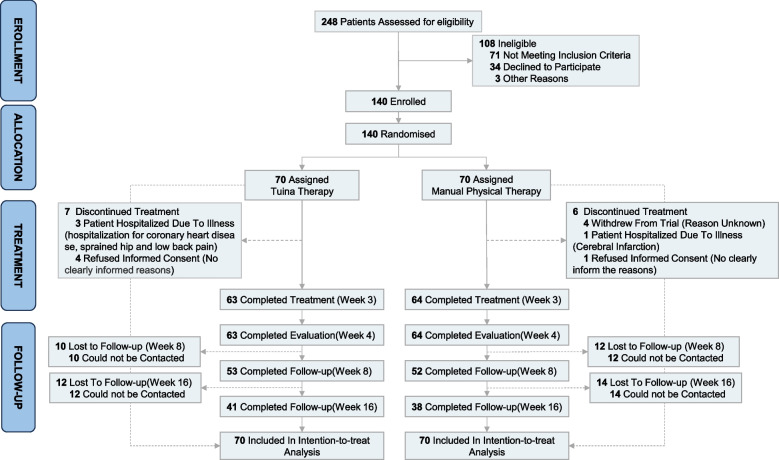
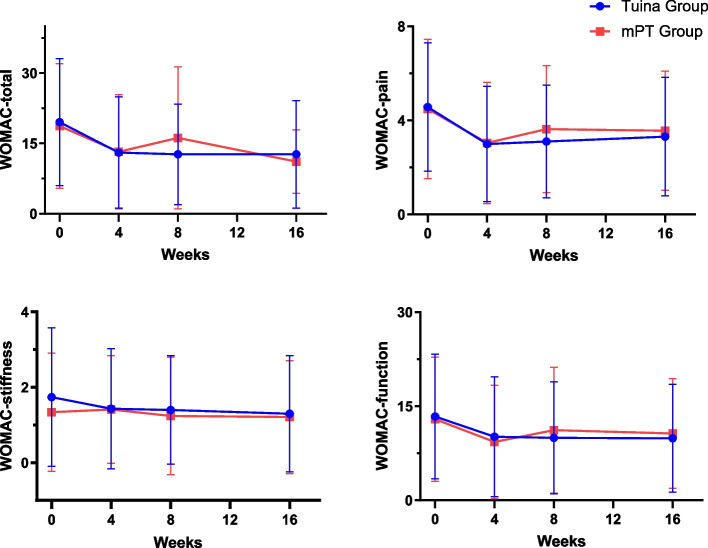
Results: Of the 140 patients allocated to Tuina or mPT, 127 completed the treatment. There was significant intervention × time interaction observed in the WOMAC-total (F(2, 266) = 3.87, P = 0.02), there was no statistically significant between groups at week 4 (between-group difference: -1.00, 95%CI: -5.33 to 3.33, P = 0.79, Bonferroni correction). By week 8, Tuina showed significantly consistent improvement compared to mPT (between-group difference: -4.33, 95%CI: -8.34 to -0.31, P = 0.03, Bonferroni correction), whereas there were no statistically significant differences between groups at week 16 (between-group difference: 0.74, 95%CI: -3.67 to 5.15, P = 0.37, Bonferroni correction). Most secondary outcomes showed no significant between-group differences, except for the Timed Up and Go Test Time favoring mPT (0.94, 95%CI: 0.03 to 1.85, P = 0.04). No serious adverse events occurred. One patient in the mPT group took the medication and no patients received other therapies for KOA.
Conclusions: Tuina produced beneficial effectiveness similar to mPT in treating KOA.
Trial registration: NCT03966248, Registered on 29/05/2019, ClinicalTrials.gov.




 京公网安备 11010802042870号
京ICP备2023020795号-1
京公网安备 11010802042870号
京ICP备2023020795号-1

 分享
分享
 求助内容:
求助内容: 应助结果提醒方式:
 扫码关注我们
