{"title":"从昆虫内共生体到韧皮部定植者:比较基因组学揭示了植物致病性Arsenophonus菌株的生活方式转变。","authors":"Mathieu Mahillon, Christophe Debonneville, Raphaël Groux, David Roquis, Justine Brodard, Franco Faoro, Xavier Foissac, Olivier Schumpp, Jessica Dittmer","doi":"10.1128/msystems.01496-24","DOIUrl":null,"url":null,"abstract":"<p><p>Bacteria infecting the plant phloem represent a growing threat worldwide. While these organisms often resist <i>in vitro</i> culture, they multiply both in plant sieve elements and hemipteran vectors. Such cross-kingdom parasitic lifestyle has emerged in diverse taxa via distinct ecological routes. In the genus <i>Arsenophonus</i>, the phloem pathogens \"<i>Candidatus</i> Arsenophonus phytopathogenicus\" (Ap) and \"<i>Ca</i>. Phlomobacter fragariae\" (Pf) have evolved from insect endosymbionts, but the genetic mechanisms underlying this transition have not been explored. To fill this gap, we obtained the genomes of both strains from insect host metagenomes. The resulting assemblies are highly similar in size and functional repertoire, rich in viral sequences, and closely resemble the genomes of several facultative endosymbiotic <i>Arsenophonus</i> strains of sap-sucking hemipterans. However, a phylogenomic analysis demonstrated distinct origins, as Ap belongs to the \"<i>Triatominarum</i>\" clade, whereas Pf represents a distant species. We identified a set of orthologs encoded only by Ap and Pf in the genus, including hydrolytic enzymes likely targeting plant substrates. In particular, both bacteria encode putative plant cell wall-degrading enzymes and cysteine peptidases related to xylellain, a papain-like peptidase from <i>Xylella fastidiosa</i>, for which close homologs are found in diverse <i>Pseudomonadota</i> infecting the plant vasculature. <i>In silico</i> predictions and gene expression analyses further support a role during phloem colonization for several of the shared orthologs. We conclude that the double emergence of phytopathogenicity in <i>Arsenophonus</i> may have been mediated by a few horizontal gene transfer events, involving genes acquired from other <i>Pseudomonadota</i>, including phytopathogens.</p><p><strong>Importance: </strong>We investigate the genetic mechanisms of a transition in bacterial lifestyle. We focus on two phloem pathogens belonging to the genus <i>Arsenophonus</i>: \"<i>Candidatus</i> Arsenophonus phytopathogenicus\" and \"<i>Ca</i>. Phlomobacter fragariae.\" Both bacteria cause economically significant pathologies, and they have likely emerged among facultative insect endosymbionts. Our genomic analyses show that both strains are highly similar to other strains of the genus associated with sap-sucking hemipterans, suggesting a recent lifestyle shift. Importantly, although the phytopathogenic <i>Arsenophonus</i> strains belong to distant clades, they share a small set of orthologs unique in the genus pangenome. We provide evidence that several of these genes produce hydrolytic enzymes that are secreted and may target plant substrates. The acquisition and exchange of these genes may thus have played a pivotal role in the lifestyle transition of the phytopathogenic <i>Arsenophonus</i> strains.</p>","PeriodicalId":18819,"journal":{"name":"mSystems","volume":" ","pages":"e0149624"},"PeriodicalIF":5.2000,"publicationDate":"2025-05-20","publicationTypes":"Journal Article","fieldsOfStudy":null,"isOpenAccess":false,"openAccessPdf":"https://www.ncbi.nlm.nih.gov/pmc/articles/PMC12090721/pdf/","citationCount":"0","resultStr":"{\"title\":\"From insect endosymbiont to phloem colonizer: comparative genomics unveils the lifestyle transition of phytopathogenic <i>Arsenophonus</i> strains.\",\"authors\":\"Mathieu Mahillon, Christophe Debonneville, Raphaël Groux, David Roquis, Justine Brodard, Franco Faoro, Xavier Foissac, Olivier Schumpp, Jessica Dittmer\",\"doi\":\"10.1128/msystems.01496-24\",\"DOIUrl\":null,\"url\":null,\"abstract\":\"<p><p>Bacteria infecting the plant phloem represent a growing threat worldwide. While these organisms often resist <i>in vitro</i> culture, they multiply both in plant sieve elements and hemipteran vectors. Such cross-kingdom parasitic lifestyle has emerged in diverse taxa via distinct ecological routes. In the genus <i>Arsenophonus</i>, the phloem pathogens \\\"<i>Candidatus</i> Arsenophonus phytopathogenicus\\\" (Ap) and \\\"<i>Ca</i>. Phlomobacter fragariae\\\" (Pf) have evolved from insect endosymbionts, but the genetic mechanisms underlying this transition have not been explored. To fill this gap, we obtained the genomes of both strains from insect host metagenomes. The resulting assemblies are highly similar in size and functional repertoire, rich in viral sequences, and closely resemble the genomes of several facultative endosymbiotic <i>Arsenophonus</i> strains of sap-sucking hemipterans. However, a phylogenomic analysis demonstrated distinct origins, as Ap belongs to the \\\"<i>Triatominarum</i>\\\" clade, whereas Pf represents a distant species. We identified a set of orthologs encoded only by Ap and Pf in the genus, including hydrolytic enzymes likely targeting plant substrates. In particular, both bacteria encode putative plant cell wall-degrading enzymes and cysteine peptidases related to xylellain, a papain-like peptidase from <i>Xylella fastidiosa</i>, for which close homologs are found in diverse <i>Pseudomonadota</i> infecting the plant vasculature. <i>In silico</i> predictions and gene expression analyses further support a role during phloem colonization for several of the shared orthologs. We conclude that the double emergence of phytopathogenicity in <i>Arsenophonus</i> may have been mediated by a few horizontal gene transfer events, involving genes acquired from other <i>Pseudomonadota</i>, including phytopathogens.</p><p><strong>Importance: </strong>We investigate the genetic mechanisms of a transition in bacterial lifestyle. We focus on two phloem pathogens belonging to the genus <i>Arsenophonus</i>: \\\"<i>Candidatus</i> Arsenophonus phytopathogenicus\\\" and \\\"<i>Ca</i>. Phlomobacter fragariae.\\\" Both bacteria cause economically significant pathologies, and they have likely emerged among facultative insect endosymbionts. Our genomic analyses show that both strains are highly similar to other strains of the genus associated with sap-sucking hemipterans, suggesting a recent lifestyle shift. Importantly, although the phytopathogenic <i>Arsenophonus</i> strains belong to distant clades, they share a small set of orthologs unique in the genus pangenome. We provide evidence that several of these genes produce hydrolytic enzymes that are secreted and may target plant substrates. The acquisition and exchange of these genes may thus have played a pivotal role in the lifestyle transition of the phytopathogenic <i>Arsenophonus</i> strains.</p>\",\"PeriodicalId\":18819,\"journal\":{\"name\":\"mSystems\",\"volume\":\" \",\"pages\":\"e0149624\"},\"PeriodicalIF\":5.2000,\"publicationDate\":\"2025-05-20\",\"publicationTypes\":\"Journal Article\",\"fieldsOfStudy\":null,\"isOpenAccess\":false,\"openAccessPdf\":\"https://www.ncbi.nlm.nih.gov/pmc/articles/PMC12090721/pdf/\",\"citationCount\":\"0\",\"resultStr\":null,\"platform\":\"Semanticscholar\",\"paperid\":null,\"PeriodicalName\":\"mSystems\",\"FirstCategoryId\":\"99\",\"ListUrlMain\":\"https://doi.org/10.1128/msystems.01496-24\",\"RegionNum\":2,\"RegionCategory\":\"生物学\",\"ArticlePicture\":[],\"TitleCN\":null,\"AbstractTextCN\":null,\"PMCID\":null,\"EPubDate\":\"2025/4/9 0:00:00\",\"PubModel\":\"Epub\",\"JCR\":\"Q1\",\"JCRName\":\"MICROBIOLOGY\",\"Score\":null,\"Total\":0}","platform":"Semanticscholar","paperid":null,"PeriodicalName":"mSystems","FirstCategoryId":"99","ListUrlMain":"https://doi.org/10.1128/msystems.01496-24","RegionNum":2,"RegionCategory":"生物学","ArticlePicture":[],"TitleCN":null,"AbstractTextCN":null,"PMCID":null,"EPubDate":"2025/4/9 0:00:00","PubModel":"Epub","JCR":"Q1","JCRName":"MICROBIOLOGY","Score":null,"Total":0}
From insect endosymbiont to phloem colonizer: comparative genomics unveils the lifestyle transition of phytopathogenic Arsenophonus strains.
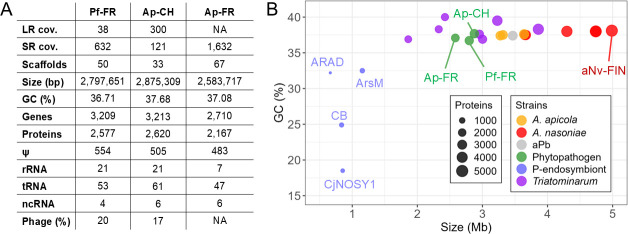
Bacteria infecting the plant phloem represent a growing threat worldwide. While these organisms often resist in vitro culture, they multiply both in plant sieve elements and hemipteran vectors. Such cross-kingdom parasitic lifestyle has emerged in diverse taxa via distinct ecological routes. In the genus Arsenophonus, the phloem pathogens "Candidatus Arsenophonus phytopathogenicus" (Ap) and "Ca. Phlomobacter fragariae" (Pf) have evolved from insect endosymbionts, but the genetic mechanisms underlying this transition have not been explored. To fill this gap, we obtained the genomes of both strains from insect host metagenomes. The resulting assemblies are highly similar in size and functional repertoire, rich in viral sequences, and closely resemble the genomes of several facultative endosymbiotic Arsenophonus strains of sap-sucking hemipterans. However, a phylogenomic analysis demonstrated distinct origins, as Ap belongs to the "Triatominarum" clade, whereas Pf represents a distant species. We identified a set of orthologs encoded only by Ap and Pf in the genus, including hydrolytic enzymes likely targeting plant substrates. In particular, both bacteria encode putative plant cell wall-degrading enzymes and cysteine peptidases related to xylellain, a papain-like peptidase from Xylella fastidiosa, for which close homologs are found in diverse Pseudomonadota infecting the plant vasculature. In silico predictions and gene expression analyses further support a role during phloem colonization for several of the shared orthologs. We conclude that the double emergence of phytopathogenicity in Arsenophonus may have been mediated by a few horizontal gene transfer events, involving genes acquired from other Pseudomonadota, including phytopathogens.
Importance: We investigate the genetic mechanisms of a transition in bacterial lifestyle. We focus on two phloem pathogens belonging to the genus Arsenophonus: "Candidatus Arsenophonus phytopathogenicus" and "Ca. Phlomobacter fragariae." Both bacteria cause economically significant pathologies, and they have likely emerged among facultative insect endosymbionts. Our genomic analyses show that both strains are highly similar to other strains of the genus associated with sap-sucking hemipterans, suggesting a recent lifestyle shift. Importantly, although the phytopathogenic Arsenophonus strains belong to distant clades, they share a small set of orthologs unique in the genus pangenome. We provide evidence that several of these genes produce hydrolytic enzymes that are secreted and may target plant substrates. The acquisition and exchange of these genes may thus have played a pivotal role in the lifestyle transition of the phytopathogenic Arsenophonus strains.
mSystemsBiochemistry, Genetics and Molecular Biology-Biochemistry
CiteScore
10.50
自引率
3.10%
发文量
308
审稿时长
13 weeks
期刊介绍:
mSystems™ will publish preeminent work that stems from applying technologies for high-throughput analyses to achieve insights into the metabolic and regulatory systems at the scale of both the single cell and microbial communities. The scope of mSystems™ encompasses all important biological and biochemical findings drawn from analyses of large data sets, as well as new computational approaches for deriving these insights. mSystems™ will welcome submissions from researchers who focus on the microbiome, genomics, metagenomics, transcriptomics, metabolomics, proteomics, glycomics, bioinformatics, and computational microbiology. mSystems™ will provide streamlined decisions, while carrying on ASM''s tradition of rigorous peer review.






 京公网安备 11010802042870号
京ICP备2023020795号-1
京公网安备 11010802042870号
京ICP备2023020795号-1

 分享
分享
 求助内容:
求助内容: 应助结果提醒方式:
 扫码关注我们
