{"title":"乙烯基过氧自由基CH2CHOO的微波光谱","authors":"Masakazu Nakajima and Yasuki Endo","doi":"10.1039/D5CP00649J","DOIUrl":null,"url":null,"abstract":"<p >Vinylperoxy radicals were produced in a pulsed supersonic jet by discharging a gas mixture of vinyl bromide and molecular oxygen largely diluted in the Ar or Ne buffer gas. Two conformers of the radical, s-<em>trans</em> and s-<em>cis</em>, were detected through their pure rotational transitions <em>via</em> Fourier-transform microwave spectroscopy. Fine and hyperfine components in the observed spectra were fully assigned and analyzed to determine precise molecular constants for each conformer. The Fermi coupling constants determined for the –CH<small><sub>2</sub></small> protons indicate that non-negligible unpaired spin density is located on the terminal carbon atom, although the radical is generally considered as the oxygen-centered radical. The intensities of the observed spectra are much weaker than expected, probably because most of nascent vinylperoxy radicals formed by the association of the vinyl radical and O<small><sub>2</sub></small> promptly dissociate either to the vinoxy radical and atomic oxygen, or to formaldehyde and the formyl radical, even under jet-cooled conditions.</p>","PeriodicalId":99,"journal":{"name":"Physical Chemistry Chemical Physics","volume":" 17","pages":" 8932-8938"},"PeriodicalIF":2.9000,"publicationDate":"2025-04-10","publicationTypes":"Journal Article","fieldsOfStudy":null,"isOpenAccess":false,"openAccessPdf":"https://pubs.rsc.org/en/content/articlepdf/2025/cp/d5cp00649j?page=search","citationCount":"0","resultStr":"{\"title\":\"Microwave spectroscopy of the vinylperoxy radical, CH2CHOO†\",\"authors\":\"Masakazu Nakajima and Yasuki Endo\",\"doi\":\"10.1039/D5CP00649J\",\"DOIUrl\":null,\"url\":null,\"abstract\":\"<p >Vinylperoxy radicals were produced in a pulsed supersonic jet by discharging a gas mixture of vinyl bromide and molecular oxygen largely diluted in the Ar or Ne buffer gas. Two conformers of the radical, s-<em>trans</em> and s-<em>cis</em>, were detected through their pure rotational transitions <em>via</em> Fourier-transform microwave spectroscopy. Fine and hyperfine components in the observed spectra were fully assigned and analyzed to determine precise molecular constants for each conformer. The Fermi coupling constants determined for the –CH<small><sub>2</sub></small> protons indicate that non-negligible unpaired spin density is located on the terminal carbon atom, although the radical is generally considered as the oxygen-centered radical. The intensities of the observed spectra are much weaker than expected, probably because most of nascent vinylperoxy radicals formed by the association of the vinyl radical and O<small><sub>2</sub></small> promptly dissociate either to the vinoxy radical and atomic oxygen, or to formaldehyde and the formyl radical, even under jet-cooled conditions.</p>\",\"PeriodicalId\":99,\"journal\":{\"name\":\"Physical Chemistry Chemical Physics\",\"volume\":\" 17\",\"pages\":\" 8932-8938\"},\"PeriodicalIF\":2.9000,\"publicationDate\":\"2025-04-10\",\"publicationTypes\":\"Journal Article\",\"fieldsOfStudy\":null,\"isOpenAccess\":false,\"openAccessPdf\":\"https://pubs.rsc.org/en/content/articlepdf/2025/cp/d5cp00649j?page=search\",\"citationCount\":\"0\",\"resultStr\":null,\"platform\":\"Semanticscholar\",\"paperid\":null,\"PeriodicalName\":\"Physical Chemistry Chemical Physics\",\"FirstCategoryId\":\"92\",\"ListUrlMain\":\"https://pubs.rsc.org/en/content/articlelanding/2025/cp/d5cp00649j\",\"RegionNum\":3,\"RegionCategory\":\"化学\",\"ArticlePicture\":[],\"TitleCN\":null,\"AbstractTextCN\":null,\"PMCID\":null,\"EPubDate\":\"\",\"PubModel\":\"\",\"JCR\":\"Q3\",\"JCRName\":\"CHEMISTRY, PHYSICAL\",\"Score\":null,\"Total\":0}","platform":"Semanticscholar","paperid":null,"PeriodicalName":"Physical Chemistry Chemical Physics","FirstCategoryId":"92","ListUrlMain":"https://pubs.rsc.org/en/content/articlelanding/2025/cp/d5cp00649j","RegionNum":3,"RegionCategory":"化学","ArticlePicture":[],"TitleCN":null,"AbstractTextCN":null,"PMCID":null,"EPubDate":"","PubModel":"","JCR":"Q3","JCRName":"CHEMISTRY, PHYSICAL","Score":null,"Total":0}
Microwave spectroscopy of the vinylperoxy radical, CH2CHOO†
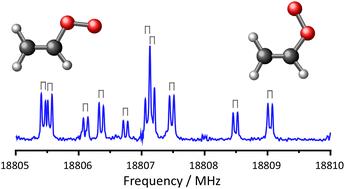
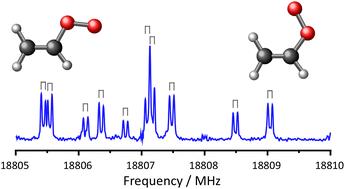
Vinylperoxy radicals were produced in a pulsed supersonic jet by discharging a gas mixture of vinyl bromide and molecular oxygen largely diluted in the Ar or Ne buffer gas. Two conformers of the radical, s-trans and s-cis, were detected through their pure rotational transitions via Fourier-transform microwave spectroscopy. Fine and hyperfine components in the observed spectra were fully assigned and analyzed to determine precise molecular constants for each conformer. The Fermi coupling constants determined for the –CH2 protons indicate that non-negligible unpaired spin density is located on the terminal carbon atom, although the radical is generally considered as the oxygen-centered radical. The intensities of the observed spectra are much weaker than expected, probably because most of nascent vinylperoxy radicals formed by the association of the vinyl radical and O2 promptly dissociate either to the vinoxy radical and atomic oxygen, or to formaldehyde and the formyl radical, even under jet-cooled conditions.
期刊介绍:
Physical Chemistry Chemical Physics (PCCP) is an international journal co-owned by 19 physical chemistry and physics societies from around the world. This journal publishes original, cutting-edge research in physical chemistry, chemical physics and biophysical chemistry. To be suitable for publication in PCCP, articles must include significant innovation and/or insight into physical chemistry; this is the most important criterion that reviewers and Editors will judge against when evaluating submissions.
The journal has a broad scope and welcomes contributions spanning experiment, theory, computation and data science. Topical coverage includes spectroscopy, dynamics, kinetics, statistical mechanics, thermodynamics, electrochemistry, catalysis, surface science, quantum mechanics, quantum computing and machine learning. Interdisciplinary research areas such as polymers and soft matter, materials, nanoscience, energy, surfaces/interfaces, and biophysical chemistry are welcomed if they demonstrate significant innovation and/or insight into physical chemistry. Joined experimental/theoretical studies are particularly appreciated when complementary and based on up-to-date approaches.




 京公网安备 11010802042870号
京ICP备2023020795号-1
京公网安备 11010802042870号
京ICP备2023020795号-1

 分享
分享
 求助内容:
求助内容: 应助结果提醒方式:
 扫码关注我们
