Jieyu Yang, Chenyu Zhang, Ting Zhou, Yuanyuan Chen, Yanqiu Wang, Kuang Sheng, Luqiong Liu, Jie Li, Wenzhang Li and Yang Liu
{"title":"梯度氧空位工程在RuO2-x高效酸性水氧化中的应用","authors":"Jieyu Yang, Chenyu Zhang, Ting Zhou, Yuanyuan Chen, Yanqiu Wang, Kuang Sheng, Luqiong Liu, Jie Li, Wenzhang Li and Yang Liu","doi":"10.1039/D5TA01078K","DOIUrl":null,"url":null,"abstract":"<p >As the most active catalyst material in acidic environments, the catalytic activity of RuO<small><sub>2</sub></small> is higher than that of IrO<small><sub>2</sub></small>, but poor stability limits its application. To this end, we propose a simple defect engineering strategy, namely the preparation of RuO<small><sub>2</sub></small> nanoparticles (D-RuO<small><sub>2</sub></small>) with gradient distribution of oxygen vacancies as efficient acidic oxygen evolution reaction (OER) catalysts. Oxygen vacancies (V<small><sub>O</sub></small>) participate in lattice compression to form an unsaturated coordination environment, which decreases the covalency of Ru–O bonds, effectively optimizes the adsorption of intermediates in the OER process, and stabilizes the structure of the active site. Density functional theory (DFT) calculations show that the presence of V<small><sub>O</sub></small> shifts Ru's d band center closer to the Fermi level, which promotes the adsorption of oxygen-containing intermediates and accelerates the adsorbate evolution mechanism (AEM) process. D-RuO<small><sub>2</sub></small> exhibits a lower overpotential (<em>η</em><small><sub>10</sub></small> = 197 mV) and a lower Tafel slope (58.67 mV dec<small><sup>−1</sup></small>), with a stability of 60 h measured in 0.5 M H<small><sub>2</sub></small>SO<small><sub>4</sub></small>. This strategy provides a simple method to improve the activity and stability of RuO<small><sub>2</sub></small> by regulating oxygen vacancies.</p>","PeriodicalId":82,"journal":{"name":"Journal of Materials Chemistry A","volume":" 21","pages":" 15832-15840"},"PeriodicalIF":9.5000,"publicationDate":"2025-04-09","publicationTypes":"Journal Article","fieldsOfStudy":null,"isOpenAccess":false,"openAccessPdf":"","citationCount":"0","resultStr":"{\"title\":\"Gradient oxygen vacancy engineering of RuO2−x for efficient acidic water oxidation†\",\"authors\":\"Jieyu Yang, Chenyu Zhang, Ting Zhou, Yuanyuan Chen, Yanqiu Wang, Kuang Sheng, Luqiong Liu, Jie Li, Wenzhang Li and Yang Liu\",\"doi\":\"10.1039/D5TA01078K\",\"DOIUrl\":null,\"url\":null,\"abstract\":\"<p >As the most active catalyst material in acidic environments, the catalytic activity of RuO<small><sub>2</sub></small> is higher than that of IrO<small><sub>2</sub></small>, but poor stability limits its application. To this end, we propose a simple defect engineering strategy, namely the preparation of RuO<small><sub>2</sub></small> nanoparticles (D-RuO<small><sub>2</sub></small>) with gradient distribution of oxygen vacancies as efficient acidic oxygen evolution reaction (OER) catalysts. Oxygen vacancies (V<small><sub>O</sub></small>) participate in lattice compression to form an unsaturated coordination environment, which decreases the covalency of Ru–O bonds, effectively optimizes the adsorption of intermediates in the OER process, and stabilizes the structure of the active site. Density functional theory (DFT) calculations show that the presence of V<small><sub>O</sub></small> shifts Ru's d band center closer to the Fermi level, which promotes the adsorption of oxygen-containing intermediates and accelerates the adsorbate evolution mechanism (AEM) process. D-RuO<small><sub>2</sub></small> exhibits a lower overpotential (<em>η</em><small><sub>10</sub></small> = 197 mV) and a lower Tafel slope (58.67 mV dec<small><sup>−1</sup></small>), with a stability of 60 h measured in 0.5 M H<small><sub>2</sub></small>SO<small><sub>4</sub></small>. This strategy provides a simple method to improve the activity and stability of RuO<small><sub>2</sub></small> by regulating oxygen vacancies.</p>\",\"PeriodicalId\":82,\"journal\":{\"name\":\"Journal of Materials Chemistry A\",\"volume\":\" 21\",\"pages\":\" 15832-15840\"},\"PeriodicalIF\":9.5000,\"publicationDate\":\"2025-04-09\",\"publicationTypes\":\"Journal Article\",\"fieldsOfStudy\":null,\"isOpenAccess\":false,\"openAccessPdf\":\"\",\"citationCount\":\"0\",\"resultStr\":null,\"platform\":\"Semanticscholar\",\"paperid\":null,\"PeriodicalName\":\"Journal of Materials Chemistry A\",\"FirstCategoryId\":\"88\",\"ListUrlMain\":\"https://pubs.rsc.org/en/content/articlelanding/2025/ta/d5ta01078k\",\"RegionNum\":2,\"RegionCategory\":\"材料科学\",\"ArticlePicture\":[],\"TitleCN\":null,\"AbstractTextCN\":null,\"PMCID\":null,\"EPubDate\":\"\",\"PubModel\":\"\",\"JCR\":\"Q1\",\"JCRName\":\"CHEMISTRY, PHYSICAL\",\"Score\":null,\"Total\":0}","platform":"Semanticscholar","paperid":null,"PeriodicalName":"Journal of Materials Chemistry A","FirstCategoryId":"88","ListUrlMain":"https://pubs.rsc.org/en/content/articlelanding/2025/ta/d5ta01078k","RegionNum":2,"RegionCategory":"材料科学","ArticlePicture":[],"TitleCN":null,"AbstractTextCN":null,"PMCID":null,"EPubDate":"","PubModel":"","JCR":"Q1","JCRName":"CHEMISTRY, PHYSICAL","Score":null,"Total":0}
引用次数: 0
摘要
RuO2作为酸性环境中活性最高的催化剂材料,其催化活性高于IrO2,但其稳定性较差,限制了其应用。为此,我们提出了一种简单的缺陷工程策略,即制备氧空位梯度分布的RuO2纳米颗粒(D-RuO2)作为高效的酸性析氧反应(OER)催化剂。氧空位参与晶格压缩形成不饱和配位环境,增加了Ru-O键的共价,有效优化了OER过程中中间体的吸附,稳定了活性位点的结构。密度泛函理论(DFT)计算表明,氧缺陷使Ru的d带中心下移,平衡了含氧中间体在RuO2表面的吸附和解吸行为,降低了OER过程的反应势垒,促进了反应的进行。D-RuO2表现出较低的过电位(η10 = 197 mV)和较低的Tafel斜率(58.67 mV dec1),在0.5 M H2SO4中稳定性为60 h。该策略为通过调节氧空位来提高RuO2的活性和稳定性提供了一种简单的方法。
Gradient oxygen vacancy engineering of RuO2−x for efficient acidic water oxidation†
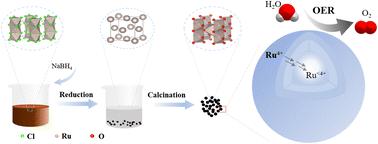
As the most active catalyst material in acidic environments, the catalytic activity of RuO2 is higher than that of IrO2, but poor stability limits its application. To this end, we propose a simple defect engineering strategy, namely the preparation of RuO2 nanoparticles (D-RuO2) with gradient distribution of oxygen vacancies as efficient acidic oxygen evolution reaction (OER) catalysts. Oxygen vacancies (VO) participate in lattice compression to form an unsaturated coordination environment, which decreases the covalency of Ru–O bonds, effectively optimizes the adsorption of intermediates in the OER process, and stabilizes the structure of the active site. Density functional theory (DFT) calculations show that the presence of VO shifts Ru's d band center closer to the Fermi level, which promotes the adsorption of oxygen-containing intermediates and accelerates the adsorbate evolution mechanism (AEM) process. D-RuO2 exhibits a lower overpotential (η10 = 197 mV) and a lower Tafel slope (58.67 mV dec−1), with a stability of 60 h measured in 0.5 M H2SO4. This strategy provides a simple method to improve the activity and stability of RuO2 by regulating oxygen vacancies.
期刊介绍:
The Journal of Materials Chemistry A, B & C covers a wide range of high-quality studies in the field of materials chemistry, with each section focusing on specific applications of the materials studied. Journal of Materials Chemistry A emphasizes applications in energy and sustainability, including topics such as artificial photosynthesis, batteries, and fuel cells. Journal of Materials Chemistry B focuses on applications in biology and medicine, while Journal of Materials Chemistry C covers applications in optical, magnetic, and electronic devices. Example topic areas within the scope of Journal of Materials Chemistry A include catalysis, green/sustainable materials, sensors, and water treatment, among others.




 京公网安备 11010802042870号
京ICP备2023020795号-1
京公网安备 11010802042870号
京ICP备2023020795号-1

 分享
分享
 求助内容:
求助内容: 应助结果提醒方式:
 扫码关注我们
