Man Guo, Xiaopeng Zhu, Tao Ma, Chenxing Xu, Dongting Zhangsun, Jinpeng Yu, Quentin Kaas, Peta J. Harvey, J. Michael McIntosh, David J. Craik, Sulan Luo
{"title":"LvID 对大鼠 α7 尼古丁乙酰胆碱受体的选择性抑制作用,LvID 是一种新发现的芋螺α4/7-神经毒素","authors":"Man Guo, Xiaopeng Zhu, Tao Ma, Chenxing Xu, Dongting Zhangsun, Jinpeng Yu, Quentin Kaas, Peta J. Harvey, J. Michael McIntosh, David J. Craik, Sulan Luo","doi":"10.1021/acs.jmedchem.4c02810","DOIUrl":null,"url":null,"abstract":"The α7 nicotinic acetylcholine receptors (nAChRs), identified in peripheral and central nervous systems, are crucial for cognitive function, memory, inflammation, and are linked to disorders like Alzheimer’s disease (AD), lung cancer, myasthenia gravis, and atherosclerosis. Here we report that a novel α4/7-conotoxin (CTx) LvID, from <i>Conus lividus</i>, potently inhibits rat α7 nAChRs expressed in <i>Xenopus</i> oocytes with an IC<sub>50</sub> of 13.8 nM, showing little activity against other rat nAChR subtypes. The structure of LvID was elucidated using nuclear magnetic resonance (NMR) spectroscopy and comprises a short helix braced by disulfide bonds. The key residues of LvID that bind to the α7 nAChRs were determined from a series of alanine mutants. Molecular simulation provided a possible explanation for the activity and specificity of LvID binding to α7 nAChRs. This finding offers a vital pharmacological tool for investigating the structural features and functional mechanisms of α7 nAChRs.","PeriodicalId":46,"journal":{"name":"Journal of Medicinal Chemistry","volume":"108 1","pages":""},"PeriodicalIF":7.3000,"publicationDate":"2025-04-09","publicationTypes":"Journal Article","fieldsOfStudy":null,"isOpenAccess":false,"openAccessPdf":"","citationCount":"0","resultStr":"{\"title\":\"Selective Inhibition of Rat α7 Nicotinic Acetylcholine Receptors by LvID, a Newly Characterized α4/7-Conotoxin from Conus lividus\",\"authors\":\"Man Guo, Xiaopeng Zhu, Tao Ma, Chenxing Xu, Dongting Zhangsun, Jinpeng Yu, Quentin Kaas, Peta J. Harvey, J. Michael McIntosh, David J. Craik, Sulan Luo\",\"doi\":\"10.1021/acs.jmedchem.4c02810\",\"DOIUrl\":null,\"url\":null,\"abstract\":\"The α7 nicotinic acetylcholine receptors (nAChRs), identified in peripheral and central nervous systems, are crucial for cognitive function, memory, inflammation, and are linked to disorders like Alzheimer’s disease (AD), lung cancer, myasthenia gravis, and atherosclerosis. Here we report that a novel α4/7-conotoxin (CTx) LvID, from <i>Conus lividus</i>, potently inhibits rat α7 nAChRs expressed in <i>Xenopus</i> oocytes with an IC<sub>50</sub> of 13.8 nM, showing little activity against other rat nAChR subtypes. The structure of LvID was elucidated using nuclear magnetic resonance (NMR) spectroscopy and comprises a short helix braced by disulfide bonds. The key residues of LvID that bind to the α7 nAChRs were determined from a series of alanine mutants. Molecular simulation provided a possible explanation for the activity and specificity of LvID binding to α7 nAChRs. This finding offers a vital pharmacological tool for investigating the structural features and functional mechanisms of α7 nAChRs.\",\"PeriodicalId\":46,\"journal\":{\"name\":\"Journal of Medicinal Chemistry\",\"volume\":\"108 1\",\"pages\":\"\"},\"PeriodicalIF\":7.3000,\"publicationDate\":\"2025-04-09\",\"publicationTypes\":\"Journal Article\",\"fieldsOfStudy\":null,\"isOpenAccess\":false,\"openAccessPdf\":\"\",\"citationCount\":\"0\",\"resultStr\":null,\"platform\":\"Semanticscholar\",\"paperid\":null,\"PeriodicalName\":\"Journal of Medicinal Chemistry\",\"FirstCategoryId\":\"3\",\"ListUrlMain\":\"https://doi.org/10.1021/acs.jmedchem.4c02810\",\"RegionNum\":1,\"RegionCategory\":\"医学\",\"ArticlePicture\":[],\"TitleCN\":null,\"AbstractTextCN\":null,\"PMCID\":null,\"EPubDate\":\"\",\"PubModel\":\"\",\"JCR\":\"Q1\",\"JCRName\":\"CHEMISTRY, MEDICINAL\",\"Score\":null,\"Total\":0}","platform":"Semanticscholar","paperid":null,"PeriodicalName":"Journal of Medicinal Chemistry","FirstCategoryId":"3","ListUrlMain":"https://doi.org/10.1021/acs.jmedchem.4c02810","RegionNum":1,"RegionCategory":"医学","ArticlePicture":[],"TitleCN":null,"AbstractTextCN":null,"PMCID":null,"EPubDate":"","PubModel":"","JCR":"Q1","JCRName":"CHEMISTRY, MEDICINAL","Score":null,"Total":0}
Selective Inhibition of Rat α7 Nicotinic Acetylcholine Receptors by LvID, a Newly Characterized α4/7-Conotoxin from Conus lividus
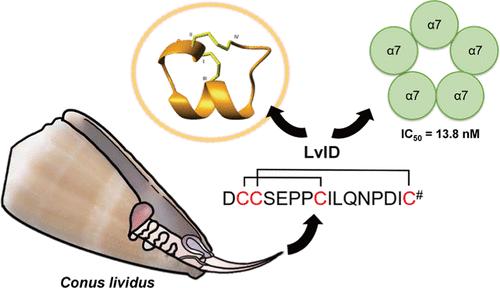
The α7 nicotinic acetylcholine receptors (nAChRs), identified in peripheral and central nervous systems, are crucial for cognitive function, memory, inflammation, and are linked to disorders like Alzheimer’s disease (AD), lung cancer, myasthenia gravis, and atherosclerosis. Here we report that a novel α4/7-conotoxin (CTx) LvID, from Conus lividus, potently inhibits rat α7 nAChRs expressed in Xenopus oocytes with an IC50 of 13.8 nM, showing little activity against other rat nAChR subtypes. The structure of LvID was elucidated using nuclear magnetic resonance (NMR) spectroscopy and comprises a short helix braced by disulfide bonds. The key residues of LvID that bind to the α7 nAChRs were determined from a series of alanine mutants. Molecular simulation provided a possible explanation for the activity and specificity of LvID binding to α7 nAChRs. This finding offers a vital pharmacological tool for investigating the structural features and functional mechanisms of α7 nAChRs.
期刊介绍:
The Journal of Medicinal Chemistry is a prestigious biweekly peer-reviewed publication that focuses on the multifaceted field of medicinal chemistry. Since its inception in 1959 as the Journal of Medicinal and Pharmaceutical Chemistry, it has evolved to become a cornerstone in the dissemination of research findings related to the design, synthesis, and development of therapeutic agents.
The Journal of Medicinal Chemistry is recognized for its significant impact in the scientific community, as evidenced by its 2022 impact factor of 7.3. This metric reflects the journal's influence and the importance of its content in shaping the future of drug discovery and development. The journal serves as a vital resource for chemists, pharmacologists, and other researchers interested in the molecular mechanisms of drug action and the optimization of therapeutic compounds.




 京公网安备 11010802042870号
京ICP备2023020795号-1
京公网安备 11010802042870号
京ICP备2023020795号-1

 分享
分享
 求助内容:
求助内容: 应助结果提醒方式:
 扫码关注我们
