Conghui Zhang, Hao Chen, Chenyue Zhou, Wan Cui, Shuangxing Cui, Minghui Xu, Guochang Li and Lei Han*,
{"title":"纳米银修饰nife - mof作为高效电催化剂的整体水分解研究","authors":"Conghui Zhang, Hao Chen, Chenyue Zhou, Wan Cui, Shuangxing Cui, Minghui Xu, Guochang Li and Lei Han*, ","doi":"10.1021/acsanm.4c06793","DOIUrl":null,"url":null,"abstract":"<p >Designing clean, stable, and efficient electrocatalysts is the key to achieving overall water splitting. The introduction of active metals or metal nanoparticles into metal–organic frameworks (MOFs) is a research strategy. In this work, silver nanoparticles (Ag NPs) loaded on NiFe-MOF can increase the surface area, active sites, and conductivity of the catalyst. Therefore, the electrocatalytic performances of Ag/NiFe-MOF exhibit higher activity for HER and OER in an alkaline medium, and the overpotential is also significantly lower than that when NiFe-MOF is used alone. When the current density is 10 mA cm<sup>–2</sup>, the overpotential of the optimized Ag/NiFe-MOF-30 catalyst is 138 mV for HER and 173 mV for OER. In addition, when Ag/NiFe-MOF-30 is used as a bifunctional electrocatalyst, the overall water splitting can be achieved with 1.61 V at 10 mA cm<sup>–2</sup>, and it demonstrates excellent stability of over 100 h at 100 mA cm<sup>–2</sup>. This work provides an efficient approach for developing highly active MOF-based catalysts by loading coin metal nanoparticles for overall water splitting.</p>","PeriodicalId":6,"journal":{"name":"ACS Applied Nano Materials","volume":"8 14","pages":"6897–6906 6897–6906"},"PeriodicalIF":5.5000,"publicationDate":"2025-03-27","publicationTypes":"Journal Article","fieldsOfStudy":null,"isOpenAccess":false,"openAccessPdf":"","citationCount":"0","resultStr":"{\"title\":\"Silver Nanoparticle-Decorated NiFe-MOFs as Highly Active Electrocatalysts for Overall Water Splitting\",\"authors\":\"Conghui Zhang, Hao Chen, Chenyue Zhou, Wan Cui, Shuangxing Cui, Minghui Xu, Guochang Li and Lei Han*, \",\"doi\":\"10.1021/acsanm.4c06793\",\"DOIUrl\":null,\"url\":null,\"abstract\":\"<p >Designing clean, stable, and efficient electrocatalysts is the key to achieving overall water splitting. The introduction of active metals or metal nanoparticles into metal–organic frameworks (MOFs) is a research strategy. In this work, silver nanoparticles (Ag NPs) loaded on NiFe-MOF can increase the surface area, active sites, and conductivity of the catalyst. Therefore, the electrocatalytic performances of Ag/NiFe-MOF exhibit higher activity for HER and OER in an alkaline medium, and the overpotential is also significantly lower than that when NiFe-MOF is used alone. When the current density is 10 mA cm<sup>–2</sup>, the overpotential of the optimized Ag/NiFe-MOF-30 catalyst is 138 mV for HER and 173 mV for OER. In addition, when Ag/NiFe-MOF-30 is used as a bifunctional electrocatalyst, the overall water splitting can be achieved with 1.61 V at 10 mA cm<sup>–2</sup>, and it demonstrates excellent stability of over 100 h at 100 mA cm<sup>–2</sup>. This work provides an efficient approach for developing highly active MOF-based catalysts by loading coin metal nanoparticles for overall water splitting.</p>\",\"PeriodicalId\":6,\"journal\":{\"name\":\"ACS Applied Nano Materials\",\"volume\":\"8 14\",\"pages\":\"6897–6906 6897–6906\"},\"PeriodicalIF\":5.5000,\"publicationDate\":\"2025-03-27\",\"publicationTypes\":\"Journal Article\",\"fieldsOfStudy\":null,\"isOpenAccess\":false,\"openAccessPdf\":\"\",\"citationCount\":\"0\",\"resultStr\":null,\"platform\":\"Semanticscholar\",\"paperid\":null,\"PeriodicalName\":\"ACS Applied Nano Materials\",\"FirstCategoryId\":\"88\",\"ListUrlMain\":\"https://pubs.acs.org/doi/10.1021/acsanm.4c06793\",\"RegionNum\":2,\"RegionCategory\":\"材料科学\",\"ArticlePicture\":[],\"TitleCN\":null,\"AbstractTextCN\":null,\"PMCID\":null,\"EPubDate\":\"\",\"PubModel\":\"\",\"JCR\":\"Q2\",\"JCRName\":\"MATERIALS SCIENCE, MULTIDISCIPLINARY\",\"Score\":null,\"Total\":0}","platform":"Semanticscholar","paperid":null,"PeriodicalName":"ACS Applied Nano Materials","FirstCategoryId":"88","ListUrlMain":"https://pubs.acs.org/doi/10.1021/acsanm.4c06793","RegionNum":2,"RegionCategory":"材料科学","ArticlePicture":[],"TitleCN":null,"AbstractTextCN":null,"PMCID":null,"EPubDate":"","PubModel":"","JCR":"Q2","JCRName":"MATERIALS SCIENCE, MULTIDISCIPLINARY","Score":null,"Total":0}
引用次数: 0
摘要
设计清洁、稳定和高效的电催化剂是实现整体水分离的关键。在金属有机框架(MOFs)中引入活性金属或金属纳米粒子是一种研究策略。在本研究中,在 NiFe-MOF 上负载银纳米粒子(Ag NPs)可增加催化剂的表面积、活性位点和电导率。因此,Ag/NiFe-MOF 在碱性介质中对 HER 和 OER 的电催化性能表现出更高的活性,过电位也明显低于单独使用 NiFe-MOF 时的过电位。当电流密度为 10 mA cm-2 时,优化的 Ag/NiFe-MOF-30 催化剂的 HER 过电位为 138 mV,OER 过电位为 173 mV。此外,当 Ag/NiFe-MOF-30 用作双功能电催化剂时,在 10 mA cm-2 电流条件下可实现 1.61 V 的整体水分离,并且在 100 mA cm-2 电流条件下具有超过 100 小时的出色稳定性。这项工作为开发基于 MOF 的高活性催化剂提供了一种有效的方法,即通过负载硬币状金属纳米颗粒实现整体水分离。
Silver Nanoparticle-Decorated NiFe-MOFs as Highly Active Electrocatalysts for Overall Water Splitting
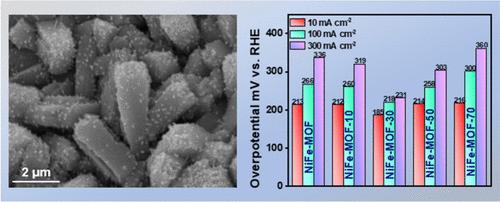
Designing clean, stable, and efficient electrocatalysts is the key to achieving overall water splitting. The introduction of active metals or metal nanoparticles into metal–organic frameworks (MOFs) is a research strategy. In this work, silver nanoparticles (Ag NPs) loaded on NiFe-MOF can increase the surface area, active sites, and conductivity of the catalyst. Therefore, the electrocatalytic performances of Ag/NiFe-MOF exhibit higher activity for HER and OER in an alkaline medium, and the overpotential is also significantly lower than that when NiFe-MOF is used alone. When the current density is 10 mA cm–2, the overpotential of the optimized Ag/NiFe-MOF-30 catalyst is 138 mV for HER and 173 mV for OER. In addition, when Ag/NiFe-MOF-30 is used as a bifunctional electrocatalyst, the overall water splitting can be achieved with 1.61 V at 10 mA cm–2, and it demonstrates excellent stability of over 100 h at 100 mA cm–2. This work provides an efficient approach for developing highly active MOF-based catalysts by loading coin metal nanoparticles for overall water splitting.
期刊介绍:
ACS Applied Nano Materials is an interdisciplinary journal publishing original research covering all aspects of engineering, chemistry, physics and biology relevant to applications of nanomaterials. The journal is devoted to reports of new and original experimental and theoretical research of an applied nature that integrate knowledge in the areas of materials, engineering, physics, bioscience, and chemistry into important applications of nanomaterials.




 京公网安备 11010802042870号
京ICP备2023020795号-1
京公网安备 11010802042870号
京ICP备2023020795号-1

 分享
分享
 求助内容:
求助内容: 应助结果提醒方式:
 扫码关注我们
