Xin Peng, Fanfan Qi, Xiong Shen, Limin Bian, He Liu, Gaozhao Chen, Wentao Hao and Qiuyun Ouyang*,
{"title":"稳定的蛋黄壳钙钛矿CsPbBr3/Rb4PbBr6纳米晶体用于绿色发光二极管","authors":"Xin Peng, Fanfan Qi, Xiong Shen, Limin Bian, He Liu, Gaozhao Chen, Wentao Hao and Qiuyun Ouyang*, ","doi":"10.1021/acsanm.5c01508","DOIUrl":null,"url":null,"abstract":"<p >Perovskite CsPbBr<sub>3</sub>/Rb<sub>4</sub>PbBr<sub>6</sub> yolk–shell structure was synthesized by using the hot injection method. X-ray diffraction confirms that the crystal structure of CsPbBr<sub>3</sub> NCs remains unaffected after being encapsulated with Rb<sub>4</sub>PbBr<sub>6</sub> coating. The photoluminescence (PL) intensity of the CsPbBr<sub>3</sub>/Rb<sub>4</sub>PbBr<sub>6</sub> yolk–shell structure is 1.5 times greater than that of CsPbBr<sub>3</sub> NCs. The PL lifetime of the CsPbBr<sub>3</sub>/Rb<sub>4</sub>PbBr<sub>6</sub> yolk–shell structure increases by 2 orders of magnitude compared to that of CsPbBr<sub>3</sub> NCs. This indicates that the surface defects of CsPbBr<sub>3</sub> NCs have been successfully passivated by Rb<sub>4</sub>PbBr<sub>6</sub> coating, thereby suppressing nonradiative recombination. Importantly, the water stability and thermal stability of the CsPbBr<sub>3</sub>/Rb<sub>4</sub>PbBr<sub>6</sub> yolk–shell structure have been significantly enhanced. Subsequently, the CsPbBr<sub>3</sub>/Rb<sub>4</sub>PbBr<sub>6</sub> yolk–shell structure was dispersed in methyl methacrylate to prepare CsPbBr<sub>3</sub>/Rb<sub>4</sub>PbBr<sub>6</sub>/PMMA organic glasses (OGs). The air stability of the CsPbBr<sub>3</sub>/Rb<sub>4</sub>PbBr<sub>6</sub>/PMMA OGs has been improved. The temperature-dependent PL spectra of CsPbBr<sub>3</sub> NCs and the CsPbBr<sub>3</sub>/Rb<sub>4</sub>PbBr<sub>6</sub> yolk–shell structure were studied. The high PL intensity and long lifetime of the CsPbBr<sub>3</sub>/Rb<sub>4</sub>PbBr<sub>6</sub> yolk–shell structure are attributed to the enhanced electron–hole interactions. Additionally, green light-emitting diodes fabricated with the CsPbBr<sub>3</sub>/Rb<sub>4</sub>PbBr<sub>6</sub> yolk–shell structure and CsPbBr<sub>3</sub>/Rb<sub>4</sub>PbBr<sub>6</sub>/PMMA OGs have stable light conversion and maintain high color output quality. This research offers an effective method for the fabrication of perovskite-based optoelectronic devices.</p>","PeriodicalId":6,"journal":{"name":"ACS Applied Nano Materials","volume":"8 14","pages":"7383–7393 7383–7393"},"PeriodicalIF":5.5000,"publicationDate":"2025-03-27","publicationTypes":"Journal Article","fieldsOfStudy":null,"isOpenAccess":false,"openAccessPdf":"","citationCount":"0","resultStr":"{\"title\":\"Stabilized Yolk–Shell Perovskite CsPbBr3/Rb4PbBr6 Nanocrystals for Green-Emitting Light-Emitting Diodes\",\"authors\":\"Xin Peng, Fanfan Qi, Xiong Shen, Limin Bian, He Liu, Gaozhao Chen, Wentao Hao and Qiuyun Ouyang*, \",\"doi\":\"10.1021/acsanm.5c01508\",\"DOIUrl\":null,\"url\":null,\"abstract\":\"<p >Perovskite CsPbBr<sub>3</sub>/Rb<sub>4</sub>PbBr<sub>6</sub> yolk–shell structure was synthesized by using the hot injection method. X-ray diffraction confirms that the crystal structure of CsPbBr<sub>3</sub> NCs remains unaffected after being encapsulated with Rb<sub>4</sub>PbBr<sub>6</sub> coating. The photoluminescence (PL) intensity of the CsPbBr<sub>3</sub>/Rb<sub>4</sub>PbBr<sub>6</sub> yolk–shell structure is 1.5 times greater than that of CsPbBr<sub>3</sub> NCs. The PL lifetime of the CsPbBr<sub>3</sub>/Rb<sub>4</sub>PbBr<sub>6</sub> yolk–shell structure increases by 2 orders of magnitude compared to that of CsPbBr<sub>3</sub> NCs. This indicates that the surface defects of CsPbBr<sub>3</sub> NCs have been successfully passivated by Rb<sub>4</sub>PbBr<sub>6</sub> coating, thereby suppressing nonradiative recombination. Importantly, the water stability and thermal stability of the CsPbBr<sub>3</sub>/Rb<sub>4</sub>PbBr<sub>6</sub> yolk–shell structure have been significantly enhanced. Subsequently, the CsPbBr<sub>3</sub>/Rb<sub>4</sub>PbBr<sub>6</sub> yolk–shell structure was dispersed in methyl methacrylate to prepare CsPbBr<sub>3</sub>/Rb<sub>4</sub>PbBr<sub>6</sub>/PMMA organic glasses (OGs). The air stability of the CsPbBr<sub>3</sub>/Rb<sub>4</sub>PbBr<sub>6</sub>/PMMA OGs has been improved. The temperature-dependent PL spectra of CsPbBr<sub>3</sub> NCs and the CsPbBr<sub>3</sub>/Rb<sub>4</sub>PbBr<sub>6</sub> yolk–shell structure were studied. The high PL intensity and long lifetime of the CsPbBr<sub>3</sub>/Rb<sub>4</sub>PbBr<sub>6</sub> yolk–shell structure are attributed to the enhanced electron–hole interactions. Additionally, green light-emitting diodes fabricated with the CsPbBr<sub>3</sub>/Rb<sub>4</sub>PbBr<sub>6</sub> yolk–shell structure and CsPbBr<sub>3</sub>/Rb<sub>4</sub>PbBr<sub>6</sub>/PMMA OGs have stable light conversion and maintain high color output quality. This research offers an effective method for the fabrication of perovskite-based optoelectronic devices.</p>\",\"PeriodicalId\":6,\"journal\":{\"name\":\"ACS Applied Nano Materials\",\"volume\":\"8 14\",\"pages\":\"7383–7393 7383–7393\"},\"PeriodicalIF\":5.5000,\"publicationDate\":\"2025-03-27\",\"publicationTypes\":\"Journal Article\",\"fieldsOfStudy\":null,\"isOpenAccess\":false,\"openAccessPdf\":\"\",\"citationCount\":\"0\",\"resultStr\":null,\"platform\":\"Semanticscholar\",\"paperid\":null,\"PeriodicalName\":\"ACS Applied Nano Materials\",\"FirstCategoryId\":\"88\",\"ListUrlMain\":\"https://pubs.acs.org/doi/10.1021/acsanm.5c01508\",\"RegionNum\":2,\"RegionCategory\":\"材料科学\",\"ArticlePicture\":[],\"TitleCN\":null,\"AbstractTextCN\":null,\"PMCID\":null,\"EPubDate\":\"\",\"PubModel\":\"\",\"JCR\":\"Q2\",\"JCRName\":\"MATERIALS SCIENCE, MULTIDISCIPLINARY\",\"Score\":null,\"Total\":0}","platform":"Semanticscholar","paperid":null,"PeriodicalName":"ACS Applied Nano Materials","FirstCategoryId":"88","ListUrlMain":"https://pubs.acs.org/doi/10.1021/acsanm.5c01508","RegionNum":2,"RegionCategory":"材料科学","ArticlePicture":[],"TitleCN":null,"AbstractTextCN":null,"PMCID":null,"EPubDate":"","PubModel":"","JCR":"Q2","JCRName":"MATERIALS SCIENCE, MULTIDISCIPLINARY","Score":null,"Total":0}
Stabilized Yolk–Shell Perovskite CsPbBr3/Rb4PbBr6 Nanocrystals for Green-Emitting Light-Emitting Diodes
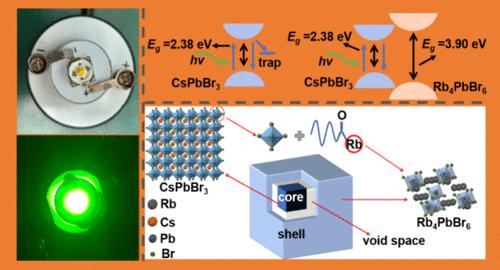
Perovskite CsPbBr3/Rb4PbBr6 yolk–shell structure was synthesized by using the hot injection method. X-ray diffraction confirms that the crystal structure of CsPbBr3 NCs remains unaffected after being encapsulated with Rb4PbBr6 coating. The photoluminescence (PL) intensity of the CsPbBr3/Rb4PbBr6 yolk–shell structure is 1.5 times greater than that of CsPbBr3 NCs. The PL lifetime of the CsPbBr3/Rb4PbBr6 yolk–shell structure increases by 2 orders of magnitude compared to that of CsPbBr3 NCs. This indicates that the surface defects of CsPbBr3 NCs have been successfully passivated by Rb4PbBr6 coating, thereby suppressing nonradiative recombination. Importantly, the water stability and thermal stability of the CsPbBr3/Rb4PbBr6 yolk–shell structure have been significantly enhanced. Subsequently, the CsPbBr3/Rb4PbBr6 yolk–shell structure was dispersed in methyl methacrylate to prepare CsPbBr3/Rb4PbBr6/PMMA organic glasses (OGs). The air stability of the CsPbBr3/Rb4PbBr6/PMMA OGs has been improved. The temperature-dependent PL spectra of CsPbBr3 NCs and the CsPbBr3/Rb4PbBr6 yolk–shell structure were studied. The high PL intensity and long lifetime of the CsPbBr3/Rb4PbBr6 yolk–shell structure are attributed to the enhanced electron–hole interactions. Additionally, green light-emitting diodes fabricated with the CsPbBr3/Rb4PbBr6 yolk–shell structure and CsPbBr3/Rb4PbBr6/PMMA OGs have stable light conversion and maintain high color output quality. This research offers an effective method for the fabrication of perovskite-based optoelectronic devices.
期刊介绍:
ACS Applied Nano Materials is an interdisciplinary journal publishing original research covering all aspects of engineering, chemistry, physics and biology relevant to applications of nanomaterials. The journal is devoted to reports of new and original experimental and theoretical research of an applied nature that integrate knowledge in the areas of materials, engineering, physics, bioscience, and chemistry into important applications of nanomaterials.




 京公网安备 11010802042870号
京ICP备2023020795号-1
京公网安备 11010802042870号
京ICP备2023020795号-1

 分享
分享
 求助内容:
求助内容: 应助结果提醒方式:
 扫码关注我们
