Changyu Weng, Hongmei Yuan, Yuxin Ji, Weidong Liu, Longlong Ma and Jianguo Liu
{"title":"高性能lib用生物质基可持续共价有机网络(CON)阳极的简易合成","authors":"Changyu Weng, Hongmei Yuan, Yuxin Ji, Weidong Liu, Longlong Ma and Jianguo Liu","doi":"10.1039/D5TA00620A","DOIUrl":null,"url":null,"abstract":"<p >Covalent organic networks (CONs) with reversible redox behaviour hold great promise as electrode materials for lithium-ion batteries (LIBs). However, the traditional synthesis of CONs relies heavily on organic monomers derived from fossil fuels, posing a significant challenge to the sustainable development of CON materials. In this study, we present a novel proof-of-concept CON material, named BIO, synthesized from biomass-derived monomers using a mild and straightforward process. This approach aligns with the principles of green and sustainable development while offering potential for large-scale preparation. The BIO-4C material was <em>in situ</em> grown on carbon nanotubes (CNTs) to enhance electronic conductivity. As a result, BIO-4C exhibited satisfactory long-cycle performance and high-rate capability. During the long cycle process, the maximum specific capacity of BIO-4C reached 804 mA h g<small><sup>−1</sup></small> (at 2000 mA g<small><sup>−1</sup></small>), significantly surpassing most previous reports and commercial graphite anodes. Detailed analysis, including X-ray photoelectron spectroscopy (XPS), density functional theory (DFT) calculations, theoretical capacity, and capacity contribution studies, revealed a storage mechanism based on an 11-electron redox process. This mechanism involves the reversible interaction of lithium ions with benzene rings, furan rings, and imine linkages in the BIO monomer. This work represents a step forward in the development of biomass-based sustainable organic electrodes, offering high performance and practicality for future organic rechargeable batteries.</p>","PeriodicalId":82,"journal":{"name":"Journal of Materials Chemistry A","volume":" 20","pages":" 15169-15177"},"PeriodicalIF":9.2000,"publicationDate":"2025-04-11","publicationTypes":"Journal Article","fieldsOfStudy":null,"isOpenAccess":false,"openAccessPdf":"","citationCount":"0","resultStr":"{\"title\":\"Facile synthesis of a biomass-based sustainable covalent organic network (CON) anode for high-performance LIBs†\",\"authors\":\"Changyu Weng, Hongmei Yuan, Yuxin Ji, Weidong Liu, Longlong Ma and Jianguo Liu\",\"doi\":\"10.1039/D5TA00620A\",\"DOIUrl\":null,\"url\":null,\"abstract\":\"<p >Covalent organic networks (CONs) with reversible redox behaviour hold great promise as electrode materials for lithium-ion batteries (LIBs). However, the traditional synthesis of CONs relies heavily on organic monomers derived from fossil fuels, posing a significant challenge to the sustainable development of CON materials. In this study, we present a novel proof-of-concept CON material, named BIO, synthesized from biomass-derived monomers using a mild and straightforward process. This approach aligns with the principles of green and sustainable development while offering potential for large-scale preparation. The BIO-4C material was <em>in situ</em> grown on carbon nanotubes (CNTs) to enhance electronic conductivity. As a result, BIO-4C exhibited satisfactory long-cycle performance and high-rate capability. During the long cycle process, the maximum specific capacity of BIO-4C reached 804 mA h g<small><sup>−1</sup></small> (at 2000 mA g<small><sup>−1</sup></small>), significantly surpassing most previous reports and commercial graphite anodes. Detailed analysis, including X-ray photoelectron spectroscopy (XPS), density functional theory (DFT) calculations, theoretical capacity, and capacity contribution studies, revealed a storage mechanism based on an 11-electron redox process. This mechanism involves the reversible interaction of lithium ions with benzene rings, furan rings, and imine linkages in the BIO monomer. This work represents a step forward in the development of biomass-based sustainable organic electrodes, offering high performance and practicality for future organic rechargeable batteries.</p>\",\"PeriodicalId\":82,\"journal\":{\"name\":\"Journal of Materials Chemistry A\",\"volume\":\" 20\",\"pages\":\" 15169-15177\"},\"PeriodicalIF\":9.2000,\"publicationDate\":\"2025-04-11\",\"publicationTypes\":\"Journal Article\",\"fieldsOfStudy\":null,\"isOpenAccess\":false,\"openAccessPdf\":\"\",\"citationCount\":\"0\",\"resultStr\":null,\"platform\":\"Semanticscholar\",\"paperid\":null,\"PeriodicalName\":\"Journal of Materials Chemistry A\",\"FirstCategoryId\":\"88\",\"ListUrlMain\":\"https://pubs.rsc.org/en/content/articlelanding/2025/ta/d5ta00620a\",\"RegionNum\":2,\"RegionCategory\":\"材料科学\",\"ArticlePicture\":[],\"TitleCN\":null,\"AbstractTextCN\":null,\"PMCID\":null,\"EPubDate\":\"\",\"PubModel\":\"\",\"JCR\":\"Q1\",\"JCRName\":\"CHEMISTRY, PHYSICAL\",\"Score\":null,\"Total\":0}","platform":"Semanticscholar","paperid":null,"PeriodicalName":"Journal of Materials Chemistry A","FirstCategoryId":"88","ListUrlMain":"https://pubs.rsc.org/en/content/articlelanding/2025/ta/d5ta00620a","RegionNum":2,"RegionCategory":"材料科学","ArticlePicture":[],"TitleCN":null,"AbstractTextCN":null,"PMCID":null,"EPubDate":"","PubModel":"","JCR":"Q1","JCRName":"CHEMISTRY, PHYSICAL","Score":null,"Total":0}
Facile synthesis of a biomass-based sustainable covalent organic network (CON) anode for high-performance LIBs†
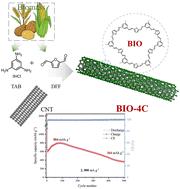
Covalent organic networks (CONs) with reversible redox behaviour hold great promise as electrode materials for lithium-ion batteries (LIBs). However, the traditional synthesis of CONs relies heavily on organic monomers derived from fossil fuels, posing a significant challenge to the sustainable development of CON materials. In this study, we present a novel proof-of-concept CON material, named BIO, synthesized from biomass-derived monomers using a mild and straightforward process. This approach aligns with the principles of green and sustainable development while offering potential for large-scale preparation. The BIO-4C material was in situ grown on carbon nanotubes (CNTs) to enhance electronic conductivity. As a result, BIO-4C exhibited satisfactory long-cycle performance and high-rate capability. During the long cycle process, the maximum specific capacity of BIO-4C reached 804 mA h g−1 (at 2000 mA g−1), significantly surpassing most previous reports and commercial graphite anodes. Detailed analysis, including X-ray photoelectron spectroscopy (XPS), density functional theory (DFT) calculations, theoretical capacity, and capacity contribution studies, revealed a storage mechanism based on an 11-electron redox process. This mechanism involves the reversible interaction of lithium ions with benzene rings, furan rings, and imine linkages in the BIO monomer. This work represents a step forward in the development of biomass-based sustainable organic electrodes, offering high performance and practicality for future organic rechargeable batteries.
期刊介绍:
The Journal of Materials Chemistry A, B & C covers a wide range of high-quality studies in the field of materials chemistry, with each section focusing on specific applications of the materials studied. Journal of Materials Chemistry A emphasizes applications in energy and sustainability, including topics such as artificial photosynthesis, batteries, and fuel cells. Journal of Materials Chemistry B focuses on applications in biology and medicine, while Journal of Materials Chemistry C covers applications in optical, magnetic, and electronic devices. Example topic areas within the scope of Journal of Materials Chemistry A include catalysis, green/sustainable materials, sensors, and water treatment, among others.




 京公网安备 11010802042870号
京ICP备2023020795号-1
京公网安备 11010802042870号
京ICP备2023020795号-1

 分享
分享
 求助内容:
求助内容: 应助结果提醒方式:
 扫码关注我们
