Huan Liu, Xinyue Yan, Xinyue He, Zhanhui Peng, Di Wu, Pengfei Liang, Lingling Wei, Xiaolian Chao and Zupei Yang
{"title":"CdCu3(Tb1/2Ta1/2)xTi4−xO12陶瓷优异介电性能的混合价态","authors":"Huan Liu, Xinyue Yan, Xinyue He, Zhanhui Peng, Di Wu, Pengfei Liang, Lingling Wei, Xiaolian Chao and Zupei Yang","doi":"10.1039/D5CP00195A","DOIUrl":null,"url":null,"abstract":"<p >The considerable demand for energy and the accelerated growth of the microelectronics sector has prompted extensive research into dielectric materials with high dielectric constants for use in electronic storage devices. In this study, a conventional solid-phase method was used to enhance the dielectric properties of CdCu<small><sub>3</sub></small>Ti<small><sub>4</sub></small>O<small><sub>12</sub></small> by co-doping Ti sites with Tb and Ta ions. Impressively, the CdCu<small><sub>3</sub></small>(Tb<small><sub>1/2</sub></small>Ta<small><sub>1/2</sub></small>)<small><sub><em>x</em></sub></small>Ti<small><sub>4−<em>x</em></sub></small>O<small><sub>12</sub></small> ceramics exhibit superior dielectric properties with a dielectric constant (<em>ε</em> ∼ 3.21 × 10<small><sup>4</sup></small>) and a low loss tangent (tan <em>δ</em> ∼ 0.020) at 1 kHz. In addition, the temperature dependent-coefficient of variation of its dielectric constant (Δ<em>ε</em>/<em>ε</em><small><sub>25 °C</sub></small>) is less than ±15% over the temperature range of −13 to 174 °C. The dielectric response is mainly due to intrinsic and extrinsic effects, and the inherent effects may be due to the formation of defect clusters (<em>i.e.</em>, <img>, <img> and <img>). While the non-intrinsic effects are caused by the microstructure of the internal barrier layer capacitor, the impedance spectra show the presence of semiconductor grains as well as the huge resistance at the grain boundaries, where the heterogeneous structure causes an increase in grain boundary resistance. This study explores the dielectric response of a new type of giant dielectric ceramics and provides a new candidate for the fabrication of ceramic capacitors.</p>","PeriodicalId":99,"journal":{"name":"Physical Chemistry Chemical Physics","volume":" 17","pages":" 8939-8948"},"PeriodicalIF":3.0000,"publicationDate":"2025-04-11","publicationTypes":"Journal Article","fieldsOfStudy":null,"isOpenAccess":false,"openAccessPdf":"","citationCount":"0","resultStr":"{\"title\":\"Mixed valence that induces superior dielectric properties of CdCu3(Tb1/2Ta1/2)xTi4−xO12 ceramics†\",\"authors\":\"Huan Liu, Xinyue Yan, Xinyue He, Zhanhui Peng, Di Wu, Pengfei Liang, Lingling Wei, Xiaolian Chao and Zupei Yang\",\"doi\":\"10.1039/D5CP00195A\",\"DOIUrl\":null,\"url\":null,\"abstract\":\"<p >The considerable demand for energy and the accelerated growth of the microelectronics sector has prompted extensive research into dielectric materials with high dielectric constants for use in electronic storage devices. In this study, a conventional solid-phase method was used to enhance the dielectric properties of CdCu<small><sub>3</sub></small>Ti<small><sub>4</sub></small>O<small><sub>12</sub></small> by co-doping Ti sites with Tb and Ta ions. Impressively, the CdCu<small><sub>3</sub></small>(Tb<small><sub>1/2</sub></small>Ta<small><sub>1/2</sub></small>)<small><sub><em>x</em></sub></small>Ti<small><sub>4−<em>x</em></sub></small>O<small><sub>12</sub></small> ceramics exhibit superior dielectric properties with a dielectric constant (<em>ε</em> ∼ 3.21 × 10<small><sup>4</sup></small>) and a low loss tangent (tan <em>δ</em> ∼ 0.020) at 1 kHz. In addition, the temperature dependent-coefficient of variation of its dielectric constant (Δ<em>ε</em>/<em>ε</em><small><sub>25 °C</sub></small>) is less than ±15% over the temperature range of −13 to 174 °C. The dielectric response is mainly due to intrinsic and extrinsic effects, and the inherent effects may be due to the formation of defect clusters (<em>i.e.</em>, <img>, <img> and <img>). While the non-intrinsic effects are caused by the microstructure of the internal barrier layer capacitor, the impedance spectra show the presence of semiconductor grains as well as the huge resistance at the grain boundaries, where the heterogeneous structure causes an increase in grain boundary resistance. This study explores the dielectric response of a new type of giant dielectric ceramics and provides a new candidate for the fabrication of ceramic capacitors.</p>\",\"PeriodicalId\":99,\"journal\":{\"name\":\"Physical Chemistry Chemical Physics\",\"volume\":\" 17\",\"pages\":\" 8939-8948\"},\"PeriodicalIF\":3.0000,\"publicationDate\":\"2025-04-11\",\"publicationTypes\":\"Journal Article\",\"fieldsOfStudy\":null,\"isOpenAccess\":false,\"openAccessPdf\":\"\",\"citationCount\":\"0\",\"resultStr\":null,\"platform\":\"Semanticscholar\",\"paperid\":null,\"PeriodicalName\":\"Physical Chemistry Chemical Physics\",\"FirstCategoryId\":\"92\",\"ListUrlMain\":\"https://pubs.rsc.org/en/content/articlelanding/2025/cp/d5cp00195a\",\"RegionNum\":3,\"RegionCategory\":\"化学\",\"ArticlePicture\":[],\"TitleCN\":null,\"AbstractTextCN\":null,\"PMCID\":null,\"EPubDate\":\"\",\"PubModel\":\"\",\"JCR\":\"Q3\",\"JCRName\":\"CHEMISTRY, PHYSICAL\",\"Score\":null,\"Total\":0}","platform":"Semanticscholar","paperid":null,"PeriodicalName":"Physical Chemistry Chemical Physics","FirstCategoryId":"92","ListUrlMain":"https://pubs.rsc.org/en/content/articlelanding/2025/cp/d5cp00195a","RegionNum":3,"RegionCategory":"化学","ArticlePicture":[],"TitleCN":null,"AbstractTextCN":null,"PMCID":null,"EPubDate":"","PubModel":"","JCR":"Q3","JCRName":"CHEMISTRY, PHYSICAL","Score":null,"Total":0}
Mixed valence that induces superior dielectric properties of CdCu3(Tb1/2Ta1/2)xTi4−xO12 ceramics†
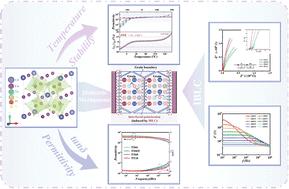
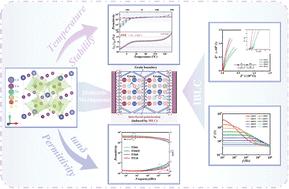
The considerable demand for energy and the accelerated growth of the microelectronics sector has prompted extensive research into dielectric materials with high dielectric constants for use in electronic storage devices. In this study, a conventional solid-phase method was used to enhance the dielectric properties of CdCu3Ti4O12 by co-doping Ti sites with Tb and Ta ions. Impressively, the CdCu3(Tb1/2Ta1/2)xTi4−xO12 ceramics exhibit superior dielectric properties with a dielectric constant (ε ∼ 3.21 × 10⁴) and a low loss tangent (tan δ ∼ 0.020) at 1 kHz. In addition, the temperature dependent-coefficient of variation of its dielectric constant (Δε/ε25 °C) is less than ±15% over the temperature range of −13 to 174 °C. The dielectric response is mainly due to intrinsic and extrinsic effects, and the inherent effects may be due to the formation of defect clusters (i.e., , and ). While the non-intrinsic effects are caused by the microstructure of the internal barrier layer capacitor, the impedance spectra show the presence of semiconductor grains as well as the huge resistance at the grain boundaries, where the heterogeneous structure causes an increase in grain boundary resistance. This study explores the dielectric response of a new type of giant dielectric ceramics and provides a new candidate for the fabrication of ceramic capacitors.
期刊介绍:
Physical Chemistry Chemical Physics (PCCP) is an international journal co-owned by 19 physical chemistry and physics societies from around the world. This journal publishes original, cutting-edge research in physical chemistry, chemical physics and biophysical chemistry. To be suitable for publication in PCCP, articles must include significant innovation and/or insight into physical chemistry; this is the most important criterion that reviewers and Editors will judge against when evaluating submissions.
The journal has a broad scope and welcomes contributions spanning experiment, theory, computation and data science. Topical coverage includes spectroscopy, dynamics, kinetics, statistical mechanics, thermodynamics, electrochemistry, catalysis, surface science, quantum mechanics, quantum computing and machine learning. Interdisciplinary research areas such as polymers and soft matter, materials, nanoscience, energy, surfaces/interfaces, and biophysical chemistry are welcomed if they demonstrate significant innovation and/or insight into physical chemistry. Joined experimental/theoretical studies are particularly appreciated when complementary and based on up-to-date approaches.





 京公网安备 11010802042870号
京ICP备2023020795号-1
京公网安备 11010802042870号
京ICP备2023020795号-1

 分享
分享
 求助内容:
求助内容: 应助结果提醒方式:
 扫码关注我们
