Yang Wang, Wenhao Zhu, Xuanheng Chen, Xiantao Yang, Anling Tong, Sheng Yang, Jihuai Wu and Weihai Sun
{"title":"全无机CsPbBr3钙钛矿太阳能电池ZnO ETL的体积和表面缺陷处理","authors":"Yang Wang, Wenhao Zhu, Xuanheng Chen, Xiantao Yang, Anling Tong, Sheng Yang, Jihuai Wu and Weihai Sun","doi":"10.1039/D5NR00315F","DOIUrl":null,"url":null,"abstract":"<p >The electron transport layer (ETL) in traditional CsPbBr<small><sub>3</sub></small> perovskite solar cells (PSCs) without a hole transport layer (HTL) presents the capability to transport electrons and block hole transport, which radically affects the photovoltaic performance of PSCs. However, ZnO ETL prepared using the classic sol–gel method exhibits obvious drawbacks, such as serious interfacial recombination reactions, inducement of oxygen vacancies (V<small><sub>O</sub></small>) and zinc interstitials (Zn<small><sub>i</sub></small>). Herein, we demonstrate that alkali metal chloride (<em>e.g.</em> KCl), serving as the passivating agent for the surface and bulk phase, can promote surface modification and doping in the ZnO ETL, respectively. Experimental results show that the interaction between K<small><sup>+</sup></small> and Zn<small><sup>2+</sup></small>, and the occupation of V<small><sub>O</sub></small> by Cl<small><sup>−</sup></small>, suppresses the internal defect states of the ZnO films, which enhances the crystal coordination between ZnO and CsPbBr<small><sub>3</sub></small> and improves the film morphology and the quality of the upper perovskite (PVK) films. Experimental PSCs based on the doping approach achieved the highest power conversion efficiency (PCE) of 9.22%, which ranks the highest PCE of the (FTO/ITO)/ZnO/CsPbBr<small><sub>3</sub></small>/carbon structure. Moreover, the unpackaged devices of the two experimental PSCs could maintain 97.15% and 74.76% of the original PCE after being exposed for 28 days in the ambient environment, demonstrating the powerful effect of KCl on the regulation of surface and bulk phase defects in the ZnO ETL.</p>","PeriodicalId":92,"journal":{"name":"Nanoscale","volume":" 19","pages":" 12299-12309"},"PeriodicalIF":5.2000,"publicationDate":"2025-04-12","publicationTypes":"Journal Article","fieldsOfStudy":null,"isOpenAccess":false,"openAccessPdf":"","citationCount":"0","resultStr":"{\"title\":\"Bulk and surface defect manipulation of the ZnO ETL for all-inorganic CsPbBr3 perovskite solar cells†\",\"authors\":\"Yang Wang, Wenhao Zhu, Xuanheng Chen, Xiantao Yang, Anling Tong, Sheng Yang, Jihuai Wu and Weihai Sun\",\"doi\":\"10.1039/D5NR00315F\",\"DOIUrl\":null,\"url\":null,\"abstract\":\"<p >The electron transport layer (ETL) in traditional CsPbBr<small><sub>3</sub></small> perovskite solar cells (PSCs) without a hole transport layer (HTL) presents the capability to transport electrons and block hole transport, which radically affects the photovoltaic performance of PSCs. However, ZnO ETL prepared using the classic sol–gel method exhibits obvious drawbacks, such as serious interfacial recombination reactions, inducement of oxygen vacancies (V<small><sub>O</sub></small>) and zinc interstitials (Zn<small><sub>i</sub></small>). Herein, we demonstrate that alkali metal chloride (<em>e.g.</em> KCl), serving as the passivating agent for the surface and bulk phase, can promote surface modification and doping in the ZnO ETL, respectively. Experimental results show that the interaction between K<small><sup>+</sup></small> and Zn<small><sup>2+</sup></small>, and the occupation of V<small><sub>O</sub></small> by Cl<small><sup>−</sup></small>, suppresses the internal defect states of the ZnO films, which enhances the crystal coordination between ZnO and CsPbBr<small><sub>3</sub></small> and improves the film morphology and the quality of the upper perovskite (PVK) films. Experimental PSCs based on the doping approach achieved the highest power conversion efficiency (PCE) of 9.22%, which ranks the highest PCE of the (FTO/ITO)/ZnO/CsPbBr<small><sub>3</sub></small>/carbon structure. Moreover, the unpackaged devices of the two experimental PSCs could maintain 97.15% and 74.76% of the original PCE after being exposed for 28 days in the ambient environment, demonstrating the powerful effect of KCl on the regulation of surface and bulk phase defects in the ZnO ETL.</p>\",\"PeriodicalId\":92,\"journal\":{\"name\":\"Nanoscale\",\"volume\":\" 19\",\"pages\":\" 12299-12309\"},\"PeriodicalIF\":5.2000,\"publicationDate\":\"2025-04-12\",\"publicationTypes\":\"Journal Article\",\"fieldsOfStudy\":null,\"isOpenAccess\":false,\"openAccessPdf\":\"\",\"citationCount\":\"0\",\"resultStr\":null,\"platform\":\"Semanticscholar\",\"paperid\":null,\"PeriodicalName\":\"Nanoscale\",\"FirstCategoryId\":\"88\",\"ListUrlMain\":\"https://pubs.rsc.org/en/content/articlelanding/2025/nr/d5nr00315f\",\"RegionNum\":3,\"RegionCategory\":\"材料科学\",\"ArticlePicture\":[],\"TitleCN\":null,\"AbstractTextCN\":null,\"PMCID\":null,\"EPubDate\":\"\",\"PubModel\":\"\",\"JCR\":\"Q1\",\"JCRName\":\"CHEMISTRY, MULTIDISCIPLINARY\",\"Score\":null,\"Total\":0}","platform":"Semanticscholar","paperid":null,"PeriodicalName":"Nanoscale","FirstCategoryId":"88","ListUrlMain":"https://pubs.rsc.org/en/content/articlelanding/2025/nr/d5nr00315f","RegionNum":3,"RegionCategory":"材料科学","ArticlePicture":[],"TitleCN":null,"AbstractTextCN":null,"PMCID":null,"EPubDate":"","PubModel":"","JCR":"Q1","JCRName":"CHEMISTRY, MULTIDISCIPLINARY","Score":null,"Total":0}
Bulk and surface defect manipulation of the ZnO ETL for all-inorganic CsPbBr3 perovskite solar cells†
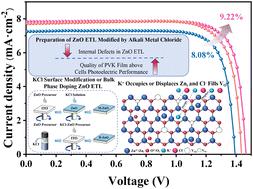
The electron transport layer (ETL) in traditional CsPbBr3 perovskite solar cells (PSCs) without a hole transport layer (HTL) presents the capability to transport electrons and block hole transport, which radically affects the photovoltaic performance of PSCs. However, ZnO ETL prepared using the classic sol–gel method exhibits obvious drawbacks, such as serious interfacial recombination reactions, inducement of oxygen vacancies (VO) and zinc interstitials (Zni). Herein, we demonstrate that alkali metal chloride (e.g. KCl), serving as the passivating agent for the surface and bulk phase, can promote surface modification and doping in the ZnO ETL, respectively. Experimental results show that the interaction between K+ and Zn2+, and the occupation of VO by Cl−, suppresses the internal defect states of the ZnO films, which enhances the crystal coordination between ZnO and CsPbBr3 and improves the film morphology and the quality of the upper perovskite (PVK) films. Experimental PSCs based on the doping approach achieved the highest power conversion efficiency (PCE) of 9.22%, which ranks the highest PCE of the (FTO/ITO)/ZnO/CsPbBr3/carbon structure. Moreover, the unpackaged devices of the two experimental PSCs could maintain 97.15% and 74.76% of the original PCE after being exposed for 28 days in the ambient environment, demonstrating the powerful effect of KCl on the regulation of surface and bulk phase defects in the ZnO ETL.
期刊介绍:
Nanoscale is a high-impact international journal, publishing high-quality research across nanoscience and nanotechnology. Nanoscale publishes a full mix of research articles on experimental and theoretical work, including reviews, communications, and full papers.Highly interdisciplinary, this journal appeals to scientists, researchers and professionals interested in nanoscience and nanotechnology, quantum materials and quantum technology, including the areas of physics, chemistry, biology, medicine, materials, energy/environment, information technology, detection science, healthcare and drug discovery, and electronics.




 京公网安备 11010802042870号
京ICP备2023020795号-1
京公网安备 11010802042870号
京ICP备2023020795号-1

 分享
分享
 求助内容:
求助内容: 应助结果提醒方式:
 扫码关注我们
