{"title":"高稳定性和导电性的1,3-二恶烷/碳氢化合物基电解质溶剂用于先进的锂硫电池","authors":"Faiz Ahmed, Defu Li, Gao Liu","doi":"10.1002/celc.202400588","DOIUrl":null,"url":null,"abstract":"<p>Developing effective electrolytes is crucial for boosting the performance of Lithium-Sulfur (LiS) rechargeable battery. Recent improvements in electrolyte formulations have enhanced cyclability by increasing electrochemical stability at the electrode interfaces. However, achieving both high ionic conductivity (σ) and stability at these interfaces simultaneously remains a significant challenge. In this study, we utilized a strategy to suppress polysulfide dissolution by employing a mixture of 1,3-dioxolane (DOL) and hydrocarbon solvents with lithium bis(trifluoromethanesulfonyl)imide (LiTFSI) electrolyte salt. Compared to the conventional electrolyte solution, which is 1 M LiTFSI salt in a 50/50 vol % mixture of DOL and dimethoxy ethane (DME), the LiTFSI electrolyte with DOL/hydrocarbon solvents demonstrate better cycling stability, compatibility with the Li-metal anode, and a high specific discharge capacity (Csp). Among the various DOL/hydrocarbon and LiTFSI electrolyte salts, the combination of DOL and n-hexane, a linear hydrocarbon, with LiTFSI electrolyte salt, (DnH40LiTFSI) exhibits remarkable σ (6.5×10<sup>−3</sup> S/cm at 30 °C), compatibility with the Li-metal anode, an initial Csp of ca. 1264 mAh/g, cycling stability (Csp and Coulombic efficiency are 811 mAh/g and 98.09 % after 120 cycles) at 0.1 C by forming a good protective layer on the Li-metal surface and preventing polysulfide dissolution.</p>","PeriodicalId":142,"journal":{"name":"ChemElectroChem","volume":"12 8","pages":""},"PeriodicalIF":3.5000,"publicationDate":"2025-03-26","publicationTypes":"Journal Article","fieldsOfStudy":null,"isOpenAccess":false,"openAccessPdf":"https://onlinelibrary.wiley.com/doi/epdf/10.1002/celc.202400588","citationCount":"0","resultStr":"{\"title\":\"Highly Stable and Conductive 1,3-Dioxolane/Hydrocarbon Based Electrolyte Solvent for Advanced Lithium-Sulfur Batteries\",\"authors\":\"Faiz Ahmed, Defu Li, Gao Liu\",\"doi\":\"10.1002/celc.202400588\",\"DOIUrl\":null,\"url\":null,\"abstract\":\"<p>Developing effective electrolytes is crucial for boosting the performance of Lithium-Sulfur (LiS) rechargeable battery. Recent improvements in electrolyte formulations have enhanced cyclability by increasing electrochemical stability at the electrode interfaces. However, achieving both high ionic conductivity (σ) and stability at these interfaces simultaneously remains a significant challenge. In this study, we utilized a strategy to suppress polysulfide dissolution by employing a mixture of 1,3-dioxolane (DOL) and hydrocarbon solvents with lithium bis(trifluoromethanesulfonyl)imide (LiTFSI) electrolyte salt. Compared to the conventional electrolyte solution, which is 1 M LiTFSI salt in a 50/50 vol % mixture of DOL and dimethoxy ethane (DME), the LiTFSI electrolyte with DOL/hydrocarbon solvents demonstrate better cycling stability, compatibility with the Li-metal anode, and a high specific discharge capacity (Csp). Among the various DOL/hydrocarbon and LiTFSI electrolyte salts, the combination of DOL and n-hexane, a linear hydrocarbon, with LiTFSI electrolyte salt, (DnH40LiTFSI) exhibits remarkable σ (6.5×10<sup>−3</sup> S/cm at 30 °C), compatibility with the Li-metal anode, an initial Csp of ca. 1264 mAh/g, cycling stability (Csp and Coulombic efficiency are 811 mAh/g and 98.09 % after 120 cycles) at 0.1 C by forming a good protective layer on the Li-metal surface and preventing polysulfide dissolution.</p>\",\"PeriodicalId\":142,\"journal\":{\"name\":\"ChemElectroChem\",\"volume\":\"12 8\",\"pages\":\"\"},\"PeriodicalIF\":3.5000,\"publicationDate\":\"2025-03-26\",\"publicationTypes\":\"Journal Article\",\"fieldsOfStudy\":null,\"isOpenAccess\":false,\"openAccessPdf\":\"https://onlinelibrary.wiley.com/doi/epdf/10.1002/celc.202400588\",\"citationCount\":\"0\",\"resultStr\":null,\"platform\":\"Semanticscholar\",\"paperid\":null,\"PeriodicalName\":\"ChemElectroChem\",\"FirstCategoryId\":\"92\",\"ListUrlMain\":\"https://chemistry-europe.onlinelibrary.wiley.com/doi/10.1002/celc.202400588\",\"RegionNum\":4,\"RegionCategory\":\"化学\",\"ArticlePicture\":[],\"TitleCN\":null,\"AbstractTextCN\":null,\"PMCID\":null,\"EPubDate\":\"\",\"PubModel\":\"\",\"JCR\":\"Q2\",\"JCRName\":\"ELECTROCHEMISTRY\",\"Score\":null,\"Total\":0}","platform":"Semanticscholar","paperid":null,"PeriodicalName":"ChemElectroChem","FirstCategoryId":"92","ListUrlMain":"https://chemistry-europe.onlinelibrary.wiley.com/doi/10.1002/celc.202400588","RegionNum":4,"RegionCategory":"化学","ArticlePicture":[],"TitleCN":null,"AbstractTextCN":null,"PMCID":null,"EPubDate":"","PubModel":"","JCR":"Q2","JCRName":"ELECTROCHEMISTRY","Score":null,"Total":0}
引用次数: 0
摘要
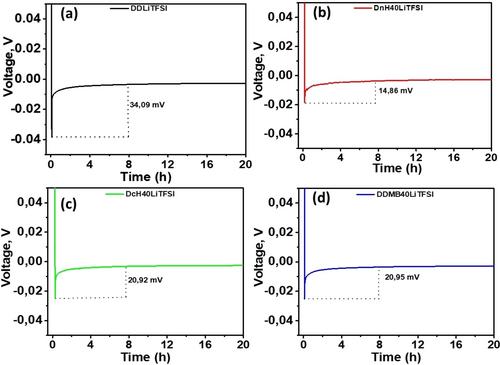
开发有效的电解液是提高锂硫电池性能的关键。最近电解质配方的改进通过增加电极界面的电化学稳定性来增强可循环性。然而,在这些界面上同时实现高离子电导率(σ)和稳定性仍然是一个重大挑战。在这项研究中,我们采用了一种抑制多硫化物溶解的策略,即使用1,3-二氧六烷(DOL)和碳氢化合物溶剂的混合物和锂二(三氟甲烷磺酰)亚胺(LiTFSI)电解质盐。与传统电解质溶液(1 M LiTFSI盐,DOL和二甲氧基乙烷(DME)的50/50 vol %混合物)相比,DOL/碳氢溶剂的LiTFSI电解质具有更好的循环稳定性,与锂金属阳极的相容性以及更高的比放电容量(Csp)。在各种DOL/碳氢化合物和LiTFSI电解质盐中,DOL和正己烷(一种线性碳氢化合物)与LiTFSI电解质盐(DnH40LiTFSI)的组合表现出显著的σ (6.5×10⁻³ S/cm, 30℃),与锂金属阳极的相容性,初始Csp约为1264 mAh/g,循环稳定性(Csp和库伦效率分别为811 mAh/g和98.09%,120次循环后)在0.1℃下在锂金属表面形成良好的保护层,防止多硫化物溶解。
Highly Stable and Conductive 1,3-Dioxolane/Hydrocarbon Based Electrolyte Solvent for Advanced Lithium-Sulfur Batteries
Developing effective electrolytes is crucial for boosting the performance of Lithium-Sulfur (LiS) rechargeable battery. Recent improvements in electrolyte formulations have enhanced cyclability by increasing electrochemical stability at the electrode interfaces. However, achieving both high ionic conductivity (σ) and stability at these interfaces simultaneously remains a significant challenge. In this study, we utilized a strategy to suppress polysulfide dissolution by employing a mixture of 1,3-dioxolane (DOL) and hydrocarbon solvents with lithium bis(trifluoromethanesulfonyl)imide (LiTFSI) electrolyte salt. Compared to the conventional electrolyte solution, which is 1 M LiTFSI salt in a 50/50 vol % mixture of DOL and dimethoxy ethane (DME), the LiTFSI electrolyte with DOL/hydrocarbon solvents demonstrate better cycling stability, compatibility with the Li-metal anode, and a high specific discharge capacity (Csp). Among the various DOL/hydrocarbon and LiTFSI electrolyte salts, the combination of DOL and n-hexane, a linear hydrocarbon, with LiTFSI electrolyte salt, (DnH40LiTFSI) exhibits remarkable σ (6.5×10⁻³ S/cm at 30 °C), compatibility with the Li-metal anode, an initial Csp of ca. 1264 mAh/g, cycling stability (Csp and Coulombic efficiency are 811 mAh/g and 98.09 % after 120 cycles) at 0.1 C by forming a good protective layer on the Li-metal surface and preventing polysulfide dissolution.
期刊介绍:
ChemElectroChem is aimed to become a top-ranking electrochemistry journal for primary research papers and critical secondary information from authors across the world. The journal covers the entire scope of pure and applied electrochemistry, the latter encompassing (among others) energy applications, electrochemistry at interfaces (including surfaces), photoelectrochemistry and bioelectrochemistry.







 京公网安备 11010802042870号
京ICP备2023020795号-1
京公网安备 11010802042870号
京ICP备2023020795号-1

 分享
分享
 求助内容:
求助内容: 应助结果提醒方式:
 扫码关注我们
