{"title":"核-壳磁瓶刷聚离子液体的自组装:形态与磁性能","authors":"Chunman Li , Mingzhe Zhao , Zenian Gou , Tengda Zhao , Huimin Han , Kongying Zhu , Xiaoyan Yuan , Lixia Ren","doi":"10.1039/d5py00277j","DOIUrl":null,"url":null,"abstract":"<div><div>Magnetic polymers show great potential in biomedical and electronic devices and magnetic responsive materials. The structure–property relationship is very important in the design of organic magnetic polymers. In this work, core-shell magnetic bottlebrush polymers (PS-<em>b</em>-QPDMA[FeCl<sub>4</sub>]) with polystyrene as a core block and magnetic poly(ionic liquid)s (QPDMA[FeCl<sub>4</sub>]) as a shell block are prepared by ring-opening metathesis polymerization and post-modification. The self-assembly of core-shell PS-<em>b</em>-QPDMA[FeCl<sub>4</sub>] is studied in core and shell selecting solvent. It self-assembles into single macromolecular core-shell nanorods in shell selecting solvent, while it self-assembles into core-shell nanoparticles in core selecting solvent. The magnetic properties of PS-<em>b</em>-QPDMA[FeCl<sub>4</sub>] are studied for different morphologies <em>via</em> magnetic field and temperature dependent magnetization. Compared with the paramagnetic linear block copolymer, the bottlebrush polymer without self-assembly shows ferromagnetic interaction at low temperature, with a bifurcation temperature (<em>T</em><sub>b</sub>) of the zero field cooling and field cooling curves of 3.2 K. The nanoparticle self-assemblies show a similar <em>T</em><sub>b</sub> of 3.8 K, while the single macromolecular nanorod self-assemblies show a high <em>T</em><sub>b</sub> of 9.8 K, demonstrating the much stronger ferromagnetic interaction for the nanorod self-assemblies. The increase of the <em>T</em><sub>b</sub> is probably due to the confinement of a glassy PS core in the nanorod self-assemblies, which decreases the Fe(<span>iii</span>)–Fe(<span>iii</span>) distance to enhance the ferromagnetic interaction of FeCl<sub>4</sub><sup>−</sup> units.</div></div>","PeriodicalId":100,"journal":{"name":"Polymer Chemistry","volume":"16 20","pages":"Pages 2413-2420"},"PeriodicalIF":3.9000,"publicationDate":"2025-04-22","publicationTypes":"Journal Article","fieldsOfStudy":null,"isOpenAccess":false,"openAccessPdf":"","citationCount":"0","resultStr":"{\"title\":\"Self-assembly of core-shell magnetic bottlebrush poly(ionic liquid)s: morphologies vs. magnetic properties†\",\"authors\":\"Chunman Li , Mingzhe Zhao , Zenian Gou , Tengda Zhao , Huimin Han , Kongying Zhu , Xiaoyan Yuan , Lixia Ren\",\"doi\":\"10.1039/d5py00277j\",\"DOIUrl\":null,\"url\":null,\"abstract\":\"<div><div>Magnetic polymers show great potential in biomedical and electronic devices and magnetic responsive materials. The structure–property relationship is very important in the design of organic magnetic polymers. In this work, core-shell magnetic bottlebrush polymers (PS-<em>b</em>-QPDMA[FeCl<sub>4</sub>]) with polystyrene as a core block and magnetic poly(ionic liquid)s (QPDMA[FeCl<sub>4</sub>]) as a shell block are prepared by ring-opening metathesis polymerization and post-modification. The self-assembly of core-shell PS-<em>b</em>-QPDMA[FeCl<sub>4</sub>] is studied in core and shell selecting solvent. It self-assembles into single macromolecular core-shell nanorods in shell selecting solvent, while it self-assembles into core-shell nanoparticles in core selecting solvent. The magnetic properties of PS-<em>b</em>-QPDMA[FeCl<sub>4</sub>] are studied for different morphologies <em>via</em> magnetic field and temperature dependent magnetization. Compared with the paramagnetic linear block copolymer, the bottlebrush polymer without self-assembly shows ferromagnetic interaction at low temperature, with a bifurcation temperature (<em>T</em><sub>b</sub>) of the zero field cooling and field cooling curves of 3.2 K. The nanoparticle self-assemblies show a similar <em>T</em><sub>b</sub> of 3.8 K, while the single macromolecular nanorod self-assemblies show a high <em>T</em><sub>b</sub> of 9.8 K, demonstrating the much stronger ferromagnetic interaction for the nanorod self-assemblies. The increase of the <em>T</em><sub>b</sub> is probably due to the confinement of a glassy PS core in the nanorod self-assemblies, which decreases the Fe(<span>iii</span>)–Fe(<span>iii</span>) distance to enhance the ferromagnetic interaction of FeCl<sub>4</sub><sup>−</sup> units.</div></div>\",\"PeriodicalId\":100,\"journal\":{\"name\":\"Polymer Chemistry\",\"volume\":\"16 20\",\"pages\":\"Pages 2413-2420\"},\"PeriodicalIF\":3.9000,\"publicationDate\":\"2025-04-22\",\"publicationTypes\":\"Journal Article\",\"fieldsOfStudy\":null,\"isOpenAccess\":false,\"openAccessPdf\":\"\",\"citationCount\":\"0\",\"resultStr\":null,\"platform\":\"Semanticscholar\",\"paperid\":null,\"PeriodicalName\":\"Polymer Chemistry\",\"FirstCategoryId\":\"92\",\"ListUrlMain\":\"https://www.sciencedirect.com/org/science/article/pii/S1759995425001500\",\"RegionNum\":2,\"RegionCategory\":\"化学\",\"ArticlePicture\":[],\"TitleCN\":null,\"AbstractTextCN\":null,\"PMCID\":null,\"EPubDate\":\"2025/4/14 0:00:00\",\"PubModel\":\"Epub\",\"JCR\":\"Q2\",\"JCRName\":\"POLYMER SCIENCE\",\"Score\":null,\"Total\":0}","platform":"Semanticscholar","paperid":null,"PeriodicalName":"Polymer Chemistry","FirstCategoryId":"92","ListUrlMain":"https://www.sciencedirect.com/org/science/article/pii/S1759995425001500","RegionNum":2,"RegionCategory":"化学","ArticlePicture":[],"TitleCN":null,"AbstractTextCN":null,"PMCID":null,"EPubDate":"2025/4/14 0:00:00","PubModel":"Epub","JCR":"Q2","JCRName":"POLYMER SCIENCE","Score":null,"Total":0}
Self-assembly of core-shell magnetic bottlebrush poly(ionic liquid)s: morphologies vs. magnetic properties†
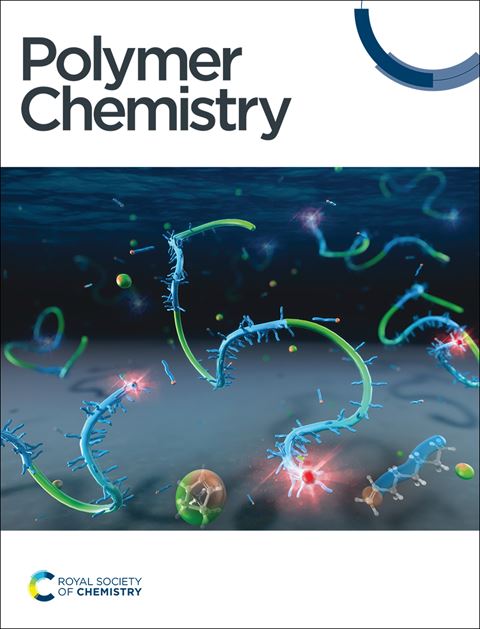
Magnetic polymers show great potential in biomedical and electronic devices and magnetic responsive materials. The structure–property relationship is very important in the design of organic magnetic polymers. In this work, core-shell magnetic bottlebrush polymers (PS-b-QPDMA[FeCl4]) with polystyrene as a core block and magnetic poly(ionic liquid)s (QPDMA[FeCl4]) as a shell block are prepared by ring-opening metathesis polymerization and post-modification. The self-assembly of core-shell PS-b-QPDMA[FeCl4] is studied in core and shell selecting solvent. It self-assembles into single macromolecular core-shell nanorods in shell selecting solvent, while it self-assembles into core-shell nanoparticles in core selecting solvent. The magnetic properties of PS-b-QPDMA[FeCl4] are studied for different morphologies via magnetic field and temperature dependent magnetization. Compared with the paramagnetic linear block copolymer, the bottlebrush polymer without self-assembly shows ferromagnetic interaction at low temperature, with a bifurcation temperature (Tb) of the zero field cooling and field cooling curves of 3.2 K. The nanoparticle self-assemblies show a similar Tb of 3.8 K, while the single macromolecular nanorod self-assemblies show a high Tb of 9.8 K, demonstrating the much stronger ferromagnetic interaction for the nanorod self-assemblies. The increase of the Tb is probably due to the confinement of a glassy PS core in the nanorod self-assemblies, which decreases the Fe(iii)–Fe(iii) distance to enhance the ferromagnetic interaction of FeCl4− units.
期刊介绍:
Polymer Chemistry welcomes submissions in all areas of polymer science that have a strong focus on macromolecular chemistry. Manuscripts may cover a broad range of fields, yet no direct application focus is required.




 京公网安备 11010802042870号
京ICP备2023020795号-1
京公网安备 11010802042870号
京ICP备2023020795号-1

 分享
分享
 求助内容:
求助内容: 应助结果提醒方式:
 扫码关注我们
