Xin Zhou, Limin Liu, Xiaoliang Zhou, Jingjie Li, Weilin Guo and Yang Tang
{"title":"Cu3P/TiO2纳米管作为一种新型碱性介质中水电解光电催化剂的性能研究","authors":"Xin Zhou, Limin Liu, Xiaoliang Zhou, Jingjie Li, Weilin Guo and Yang Tang","doi":"10.1039/D5NJ00120J","DOIUrl":null,"url":null,"abstract":"<p >Hydrogen is an ideal clean energy source, and electrolysis of water is one of the carbon free hydrogen production technologies. However, the kinetics of the oxygen evolution reaction (OER) at the anode is sluggish, making the enhancement of reaction efficiency crucial for the advancement of water electrolysis-based hydrogen production technology. In this study, titanium sheets were oxidized into TiO<small><sub>2</sub></small> nanotubes (TiO<small><sub>2</sub></small> NTs) by anodic oxidation, and then Cu(OH)<small><sub>2</sub></small> hydrotalcite (Cu(OH)<small><sub>2</sub></small>/TiO<small><sub>2</sub></small> NTs) was loaded onto the nanotubes by a hydrothermal method. Subsequently, a self-supporting Cu<small><sub>3</sub></small>P supported TiO<small><sub>2</sub></small> nanotube (Cu<small><sub>3</sub></small>P/TiO<small><sub>2</sub></small> NT) electrode was prepared by phosphating treatment under a N<small><sub>2</sub></small> atmosphere. The Cu<small><sub>3</sub></small>P formed a P–N heterojunction with TiO<small><sub>2</sub></small>, demonstrating excellent catalytic activity under visible light and electrical excitation. When Cu<small><sub>3</sub></small>P/TiO<small><sub>2</sub></small>-NT was used as an OER working electrode in a 1.0 M KOH solution at room temperature and under xenon lamp irradiation, the overpotential was 145 mV at a current density of 10 mA cm<small><sup>−2</sup></small>, which was 446 mV lower than under dark conditions. Cu<small><sub>3</sub></small>P/TiO<small><sub>2</sub></small>-NTs can operate stably for 22 hours at a current density of 20 mA cm<small><sup>−2</sup></small> without significant performance degradation. As a HER working electrode, the overpotential at a current density of 10 mV cm<small><sup>−2</sup></small> is 73 mV, which is 518 mV lower than under dark conditions. The efficient and stable OER catalytic performance is primarily attributed to the unique nanostructure and stable electrode architecture. The self-supporting non-precious metal catalyst developed in this work effectively had enhanced the reaction kinetics of the anode in water electrolysis.</p>","PeriodicalId":95,"journal":{"name":"New Journal of Chemistry","volume":" 16","pages":" 6793-6799"},"PeriodicalIF":2.5000,"publicationDate":"2025-03-22","publicationTypes":"Journal Article","fieldsOfStudy":null,"isOpenAccess":false,"openAccessPdf":"","citationCount":"0","resultStr":"{\"title\":\"The performance of Cu3P/TiO2 nanotubes as a novel photoelectrocatalyst for water electrolysis in an alkaline medium†\",\"authors\":\"Xin Zhou, Limin Liu, Xiaoliang Zhou, Jingjie Li, Weilin Guo and Yang Tang\",\"doi\":\"10.1039/D5NJ00120J\",\"DOIUrl\":null,\"url\":null,\"abstract\":\"<p >Hydrogen is an ideal clean energy source, and electrolysis of water is one of the carbon free hydrogen production technologies. However, the kinetics of the oxygen evolution reaction (OER) at the anode is sluggish, making the enhancement of reaction efficiency crucial for the advancement of water electrolysis-based hydrogen production technology. In this study, titanium sheets were oxidized into TiO<small><sub>2</sub></small> nanotubes (TiO<small><sub>2</sub></small> NTs) by anodic oxidation, and then Cu(OH)<small><sub>2</sub></small> hydrotalcite (Cu(OH)<small><sub>2</sub></small>/TiO<small><sub>2</sub></small> NTs) was loaded onto the nanotubes by a hydrothermal method. Subsequently, a self-supporting Cu<small><sub>3</sub></small>P supported TiO<small><sub>2</sub></small> nanotube (Cu<small><sub>3</sub></small>P/TiO<small><sub>2</sub></small> NT) electrode was prepared by phosphating treatment under a N<small><sub>2</sub></small> atmosphere. The Cu<small><sub>3</sub></small>P formed a P–N heterojunction with TiO<small><sub>2</sub></small>, demonstrating excellent catalytic activity under visible light and electrical excitation. When Cu<small><sub>3</sub></small>P/TiO<small><sub>2</sub></small>-NT was used as an OER working electrode in a 1.0 M KOH solution at room temperature and under xenon lamp irradiation, the overpotential was 145 mV at a current density of 10 mA cm<small><sup>−2</sup></small>, which was 446 mV lower than under dark conditions. Cu<small><sub>3</sub></small>P/TiO<small><sub>2</sub></small>-NTs can operate stably for 22 hours at a current density of 20 mA cm<small><sup>−2</sup></small> without significant performance degradation. As a HER working electrode, the overpotential at a current density of 10 mV cm<small><sup>−2</sup></small> is 73 mV, which is 518 mV lower than under dark conditions. The efficient and stable OER catalytic performance is primarily attributed to the unique nanostructure and stable electrode architecture. The self-supporting non-precious metal catalyst developed in this work effectively had enhanced the reaction kinetics of the anode in water electrolysis.</p>\",\"PeriodicalId\":95,\"journal\":{\"name\":\"New Journal of Chemistry\",\"volume\":\" 16\",\"pages\":\" 6793-6799\"},\"PeriodicalIF\":2.5000,\"publicationDate\":\"2025-03-22\",\"publicationTypes\":\"Journal Article\",\"fieldsOfStudy\":null,\"isOpenAccess\":false,\"openAccessPdf\":\"\",\"citationCount\":\"0\",\"resultStr\":null,\"platform\":\"Semanticscholar\",\"paperid\":null,\"PeriodicalName\":\"New Journal of Chemistry\",\"FirstCategoryId\":\"92\",\"ListUrlMain\":\"https://pubs.rsc.org/en/content/articlelanding/2025/nj/d5nj00120j\",\"RegionNum\":3,\"RegionCategory\":\"化学\",\"ArticlePicture\":[],\"TitleCN\":null,\"AbstractTextCN\":null,\"PMCID\":null,\"EPubDate\":\"\",\"PubModel\":\"\",\"JCR\":\"Q2\",\"JCRName\":\"CHEMISTRY, MULTIDISCIPLINARY\",\"Score\":null,\"Total\":0}","platform":"Semanticscholar","paperid":null,"PeriodicalName":"New Journal of Chemistry","FirstCategoryId":"92","ListUrlMain":"https://pubs.rsc.org/en/content/articlelanding/2025/nj/d5nj00120j","RegionNum":3,"RegionCategory":"化学","ArticlePicture":[],"TitleCN":null,"AbstractTextCN":null,"PMCID":null,"EPubDate":"","PubModel":"","JCR":"Q2","JCRName":"CHEMISTRY, MULTIDISCIPLINARY","Score":null,"Total":0}
引用次数: 0
摘要
氢是一种理想的清洁能源,电解水是无碳制氢技术之一。然而,阳极析氧反应(OER)的动力学是缓慢的,因此提高反应效率对于推进基于水的电解制氢技术至关重要。本研究采用阳极氧化法将钛片氧化成TiO2纳米管(TiO2 NTs),然后通过水热法将Cu(OH)2水滑石(Cu(OH)2/TiO2 NTs)负载到纳米管上。随后,在N2气氛下进行磷化处理,制备了自支持Cu3P负载的TiO2纳米管(Cu3P/TiO2 NT)电极。Cu3P与TiO2形成P-N异质结,在可见光和电激发下表现出优异的催化活性。当Cu3P/TiO2-NT作为OER工作电极,在1.0 M KOH溶液中,在室温氙灯照射下,电流密度为10 mA cm−2时,过电位为145 mV,比黑暗条件下低446 mV。Cu3P/TiO2-NTs可以在20 mA cm−2的电流密度下稳定工作22小时而不会出现明显的性能下降。作为HER工作电极,在电流密度为10 mV cm−2时,过电位为73 mV,比黑暗条件下低518 mV。其高效稳定的OER催化性能主要归功于其独特的纳米结构和稳定的电极结构。本研究开发的自支撑型非贵金属催化剂有效地提高了电解过程中阳极的反应动力学。
The performance of Cu3P/TiO2 nanotubes as a novel photoelectrocatalyst for water electrolysis in an alkaline medium†
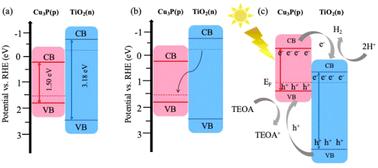
Hydrogen is an ideal clean energy source, and electrolysis of water is one of the carbon free hydrogen production technologies. However, the kinetics of the oxygen evolution reaction (OER) at the anode is sluggish, making the enhancement of reaction efficiency crucial for the advancement of water electrolysis-based hydrogen production technology. In this study, titanium sheets were oxidized into TiO2 nanotubes (TiO2 NTs) by anodic oxidation, and then Cu(OH)2 hydrotalcite (Cu(OH)2/TiO2 NTs) was loaded onto the nanotubes by a hydrothermal method. Subsequently, a self-supporting Cu3P supported TiO2 nanotube (Cu3P/TiO2 NT) electrode was prepared by phosphating treatment under a N2 atmosphere. The Cu3P formed a P–N heterojunction with TiO2, demonstrating excellent catalytic activity under visible light and electrical excitation. When Cu3P/TiO2-NT was used as an OER working electrode in a 1.0 M KOH solution at room temperature and under xenon lamp irradiation, the overpotential was 145 mV at a current density of 10 mA cm−2, which was 446 mV lower than under dark conditions. Cu3P/TiO2-NTs can operate stably for 22 hours at a current density of 20 mA cm−2 without significant performance degradation. As a HER working electrode, the overpotential at a current density of 10 mV cm−2 is 73 mV, which is 518 mV lower than under dark conditions. The efficient and stable OER catalytic performance is primarily attributed to the unique nanostructure and stable electrode architecture. The self-supporting non-precious metal catalyst developed in this work effectively had enhanced the reaction kinetics of the anode in water electrolysis.




 京公网安备 11010802042870号
京ICP备2023020795号-1
京公网安备 11010802042870号
京ICP备2023020795号-1

 分享
分享
 求助内容:
求助内容: 应助结果提醒方式:
 扫码关注我们
