Bernhard von Boehn, Francesca Genuzio, Tevfik O. Menteş, Andrea Locatelli, Ronald Imbihl
{"title":"VOx/Rh(111) 催化剂上氧气和氮氧化物的氨氧化作用:比较","authors":"Bernhard von Boehn, Francesca Genuzio, Tevfik O. Menteş, Andrea Locatelli, Ronald Imbihl","doi":"10.1021/acs.jpcc.5c00524","DOIUrl":null,"url":null,"abstract":"We have studied catalytic ammonia oxidation with NO and O<sub>2</sub> on a VO<sub><i>x</i></sub>/Rh(111) catalyst at θ<sub>V</sub> < 0.5 monolayer equivalents (MLE) with photoemission electron microscopy (PEEM) at 10<sup>–4</sup> mbar and with spectroscopic photoemission and low-energy electron microscopy (SPELEEM) in the 10<sup>–6</sup> mbar range. With O<sub>2</sub> as oxidant, VO<sub><i>x</i></sub> condenses into islands of macroscopic size, <i>i</i>.<i>e</i>., of diameters ranging from tens to several hundreds of microns. With NO a hole pattern in the VO<sub><i>x</i></sub> layer develops under reaction conditions. In the NH<sub>3</sub> + O<sub>2</sub> reaction microspot-LEED (μLEED) identifies a (√3 × √3)-moiré pattern inside the VO<sub><i>x</i></sub> islands and on the surrounding metal surface. In NH<sub>3</sub> oxidation with NO reaction microspot X-ray photoelectron spectroscopy (μXPS) shows the presence of nitrogen species on the bare metal surface, as well as on the VO<sub><i>x</i></sub> layer. With NO as reactant, the interface region between the VO<sub><i>x</i></sub> covered and bare metal surface areas is strongly broadened with about 100 μm width as compared to ≈30 μm width with O<sub>2</sub> as oxidant. Our data suggest that in ammonia oxidation over VO<sub><i>x</i></sub>/Rh(111), oxidation with NO is less effective than oxidation with O<sub>2</sub>.","PeriodicalId":61,"journal":{"name":"The Journal of Physical Chemistry C","volume":"7 1","pages":""},"PeriodicalIF":3.2000,"publicationDate":"2025-04-14","publicationTypes":"Journal Article","fieldsOfStudy":null,"isOpenAccess":false,"openAccessPdf":"","citationCount":"0","resultStr":"{\"title\":\"Ammonia Oxidation with O2 and NO on a VOx/Rh(111) Catalyst: A Comparison\",\"authors\":\"Bernhard von Boehn, Francesca Genuzio, Tevfik O. Menteş, Andrea Locatelli, Ronald Imbihl\",\"doi\":\"10.1021/acs.jpcc.5c00524\",\"DOIUrl\":null,\"url\":null,\"abstract\":\"We have studied catalytic ammonia oxidation with NO and O<sub>2</sub> on a VO<sub><i>x</i></sub>/Rh(111) catalyst at θ<sub>V</sub> < 0.5 monolayer equivalents (MLE) with photoemission electron microscopy (PEEM) at 10<sup>–4</sup> mbar and with spectroscopic photoemission and low-energy electron microscopy (SPELEEM) in the 10<sup>–6</sup> mbar range. With O<sub>2</sub> as oxidant, VO<sub><i>x</i></sub> condenses into islands of macroscopic size, <i>i</i>.<i>e</i>., of diameters ranging from tens to several hundreds of microns. With NO a hole pattern in the VO<sub><i>x</i></sub> layer develops under reaction conditions. In the NH<sub>3</sub> + O<sub>2</sub> reaction microspot-LEED (μLEED) identifies a (√3 × √3)-moiré pattern inside the VO<sub><i>x</i></sub> islands and on the surrounding metal surface. In NH<sub>3</sub> oxidation with NO reaction microspot X-ray photoelectron spectroscopy (μXPS) shows the presence of nitrogen species on the bare metal surface, as well as on the VO<sub><i>x</i></sub> layer. With NO as reactant, the interface region between the VO<sub><i>x</i></sub> covered and bare metal surface areas is strongly broadened with about 100 μm width as compared to ≈30 μm width with O<sub>2</sub> as oxidant. Our data suggest that in ammonia oxidation over VO<sub><i>x</i></sub>/Rh(111), oxidation with NO is less effective than oxidation with O<sub>2</sub>.\",\"PeriodicalId\":61,\"journal\":{\"name\":\"The Journal of Physical Chemistry C\",\"volume\":\"7 1\",\"pages\":\"\"},\"PeriodicalIF\":3.2000,\"publicationDate\":\"2025-04-14\",\"publicationTypes\":\"Journal Article\",\"fieldsOfStudy\":null,\"isOpenAccess\":false,\"openAccessPdf\":\"\",\"citationCount\":\"0\",\"resultStr\":null,\"platform\":\"Semanticscholar\",\"paperid\":null,\"PeriodicalName\":\"The Journal of Physical Chemistry C\",\"FirstCategoryId\":\"1\",\"ListUrlMain\":\"https://doi.org/10.1021/acs.jpcc.5c00524\",\"RegionNum\":3,\"RegionCategory\":\"化学\",\"ArticlePicture\":[],\"TitleCN\":null,\"AbstractTextCN\":null,\"PMCID\":null,\"EPubDate\":\"\",\"PubModel\":\"\",\"JCR\":\"Q2\",\"JCRName\":\"CHEMISTRY, PHYSICAL\",\"Score\":null,\"Total\":0}","platform":"Semanticscholar","paperid":null,"PeriodicalName":"The Journal of Physical Chemistry C","FirstCategoryId":"1","ListUrlMain":"https://doi.org/10.1021/acs.jpcc.5c00524","RegionNum":3,"RegionCategory":"化学","ArticlePicture":[],"TitleCN":null,"AbstractTextCN":null,"PMCID":null,"EPubDate":"","PubModel":"","JCR":"Q2","JCRName":"CHEMISTRY, PHYSICAL","Score":null,"Total":0}
引用次数: 0
摘要
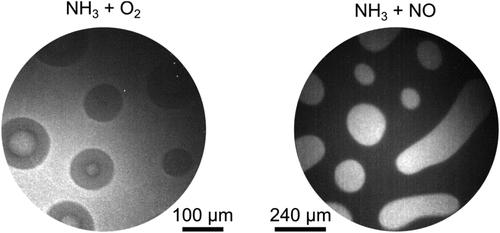
我们研究了θV < 0.5单层当量(MLE)的VOx/Rh(111)催化剂在10-4毫巴和10-6毫巴范围内的光电发射电子显微镜(PEEM)以及光谱光电发射和低能电子显微镜(SPELEEM)下与NO和O2的催化氨氧化反应。以 O2 作为氧化剂时,VOx 会凝结成具有宏观尺寸(即直径从几十微米到几百微米不等)的孤岛。使用 NO 时,在反应条件下 VOx 层会出现孔洞图案。在 NH3 + O2 反应中,微点-LEED(μLEED)可识别出 VOx 岛内部和周围金属表面的 (√3 × √3)-漩涡纹。在 NH3 氧化与 NO 反应中,微点 X 射线光电子能谱(μXPS)显示裸金属表面和 VOx 层上都存在氮物种。以 NO 为反应物时,VOx 覆盖层和裸金属表面区域之间的界面区域明显变宽,宽度约为 100 μm,而以 O2 为氧化剂时,宽度≈30 μm。我们的数据表明,在 VOx/Rh(111)上进行氨氧化时,用 NO 进行氧化的效果不如用 O2 进行氧化的效果好。
Ammonia Oxidation with O2 and NO on a VOx/Rh(111) Catalyst: A Comparison
We have studied catalytic ammonia oxidation with NO and O2 on a VOx/Rh(111) catalyst at θV < 0.5 monolayer equivalents (MLE) with photoemission electron microscopy (PEEM) at 10–4 mbar and with spectroscopic photoemission and low-energy electron microscopy (SPELEEM) in the 10–6 mbar range. With O2 as oxidant, VOx condenses into islands of macroscopic size, i.e., of diameters ranging from tens to several hundreds of microns. With NO a hole pattern in the VOx layer develops under reaction conditions. In the NH3 + O2 reaction microspot-LEED (μLEED) identifies a (√3 × √3)-moiré pattern inside the VOx islands and on the surrounding metal surface. In NH3 oxidation with NO reaction microspot X-ray photoelectron spectroscopy (μXPS) shows the presence of nitrogen species on the bare metal surface, as well as on the VOx layer. With NO as reactant, the interface region between the VOx covered and bare metal surface areas is strongly broadened with about 100 μm width as compared to ≈30 μm width with O2 as oxidant. Our data suggest that in ammonia oxidation over VOx/Rh(111), oxidation with NO is less effective than oxidation with O2.
期刊介绍:
The Journal of Physical Chemistry A/B/C is devoted to reporting new and original experimental and theoretical basic research of interest to physical chemists, biophysical chemists, and chemical physicists.




 京公网安备 11010802042870号
京ICP备2023020795号-1
京公网安备 11010802042870号
京ICP备2023020795号-1

 分享
分享
 求助内容:
求助内容: 应助结果提醒方式:
 扫码关注我们
