Li Wang, Yiping Liu, Xiangzheng Fu, Xiucai Ye, Junfeng Shi, Gary G. Yen, Quan Zou, Xiangxiang Zeng, Dongsheng Cao
{"title":"HMAMP:使用超容量驱动的多目标深度生成模型设计高效抗菌肽","authors":"Li Wang, Yiping Liu, Xiangzheng Fu, Xiucai Ye, Junfeng Shi, Gary G. Yen, Quan Zou, Xiangxiang Zeng, Dongsheng Cao","doi":"10.1021/acs.jmedchem.4c03073","DOIUrl":null,"url":null,"abstract":"Antimicrobial peptides (AMPs) have exhibited unprecedented potential as biomaterials in combating multidrug-resistant bacteria, prompting the proposal of many excellent generative models. However, the multiobjective nature of AMP discovery is often overlooked, contributing to the high attrition rate of drug candidates. Here, we propose a novel approach termed hypervolume-driven multiobjective AMP design (HMAMP), which prioritizes the simultaneous optimization of multiattribute AMPs. By synergizing reinforcement learning and a gradient descent algorithm rooted in the hypervolume maximization concept, HMAMP effectively biases generative processes and mitigates the pattern collapse issue. Comparative experiments show that HMAMP significantly outperforms state-of-the-art methods in effectiveness and diversity. A knee-based decision strategy is then employed to fast screen candidates with favorable physicochemical properties, aligning with the enhanced antimicrobial activity and reduced side effects. Molecular visualization further elucidates structural and functional properties of the AMPs. Overall, HMAMP is an effective approach to traverse large and complex exploration spaces to search for idealism-realism trade-off AMPs.","PeriodicalId":46,"journal":{"name":"Journal of Medicinal Chemistry","volume":"74 1","pages":""},"PeriodicalIF":6.8000,"publicationDate":"2025-04-15","publicationTypes":"Journal Article","fieldsOfStudy":null,"isOpenAccess":false,"openAccessPdf":"","citationCount":"0","resultStr":"{\"title\":\"HMAMP: Designing Highly Potent Antimicrobial Peptides Using a Hypervolume-Driven Multiobjective Deep Generative Model\",\"authors\":\"Li Wang, Yiping Liu, Xiangzheng Fu, Xiucai Ye, Junfeng Shi, Gary G. Yen, Quan Zou, Xiangxiang Zeng, Dongsheng Cao\",\"doi\":\"10.1021/acs.jmedchem.4c03073\",\"DOIUrl\":null,\"url\":null,\"abstract\":\"Antimicrobial peptides (AMPs) have exhibited unprecedented potential as biomaterials in combating multidrug-resistant bacteria, prompting the proposal of many excellent generative models. However, the multiobjective nature of AMP discovery is often overlooked, contributing to the high attrition rate of drug candidates. Here, we propose a novel approach termed hypervolume-driven multiobjective AMP design (HMAMP), which prioritizes the simultaneous optimization of multiattribute AMPs. By synergizing reinforcement learning and a gradient descent algorithm rooted in the hypervolume maximization concept, HMAMP effectively biases generative processes and mitigates the pattern collapse issue. Comparative experiments show that HMAMP significantly outperforms state-of-the-art methods in effectiveness and diversity. A knee-based decision strategy is then employed to fast screen candidates with favorable physicochemical properties, aligning with the enhanced antimicrobial activity and reduced side effects. Molecular visualization further elucidates structural and functional properties of the AMPs. Overall, HMAMP is an effective approach to traverse large and complex exploration spaces to search for idealism-realism trade-off AMPs.\",\"PeriodicalId\":46,\"journal\":{\"name\":\"Journal of Medicinal Chemistry\",\"volume\":\"74 1\",\"pages\":\"\"},\"PeriodicalIF\":6.8000,\"publicationDate\":\"2025-04-15\",\"publicationTypes\":\"Journal Article\",\"fieldsOfStudy\":null,\"isOpenAccess\":false,\"openAccessPdf\":\"\",\"citationCount\":\"0\",\"resultStr\":null,\"platform\":\"Semanticscholar\",\"paperid\":null,\"PeriodicalName\":\"Journal of Medicinal Chemistry\",\"FirstCategoryId\":\"3\",\"ListUrlMain\":\"https://doi.org/10.1021/acs.jmedchem.4c03073\",\"RegionNum\":1,\"RegionCategory\":\"医学\",\"ArticlePicture\":[],\"TitleCN\":null,\"AbstractTextCN\":null,\"PMCID\":null,\"EPubDate\":\"\",\"PubModel\":\"\",\"JCR\":\"Q1\",\"JCRName\":\"CHEMISTRY, MEDICINAL\",\"Score\":null,\"Total\":0}","platform":"Semanticscholar","paperid":null,"PeriodicalName":"Journal of Medicinal Chemistry","FirstCategoryId":"3","ListUrlMain":"https://doi.org/10.1021/acs.jmedchem.4c03073","RegionNum":1,"RegionCategory":"医学","ArticlePicture":[],"TitleCN":null,"AbstractTextCN":null,"PMCID":null,"EPubDate":"","PubModel":"","JCR":"Q1","JCRName":"CHEMISTRY, MEDICINAL","Score":null,"Total":0}
HMAMP: Designing Highly Potent Antimicrobial Peptides Using a Hypervolume-Driven Multiobjective Deep Generative Model
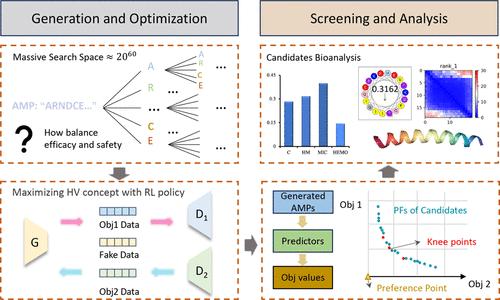
Antimicrobial peptides (AMPs) have exhibited unprecedented potential as biomaterials in combating multidrug-resistant bacteria, prompting the proposal of many excellent generative models. However, the multiobjective nature of AMP discovery is often overlooked, contributing to the high attrition rate of drug candidates. Here, we propose a novel approach termed hypervolume-driven multiobjective AMP design (HMAMP), which prioritizes the simultaneous optimization of multiattribute AMPs. By synergizing reinforcement learning and a gradient descent algorithm rooted in the hypervolume maximization concept, HMAMP effectively biases generative processes and mitigates the pattern collapse issue. Comparative experiments show that HMAMP significantly outperforms state-of-the-art methods in effectiveness and diversity. A knee-based decision strategy is then employed to fast screen candidates with favorable physicochemical properties, aligning with the enhanced antimicrobial activity and reduced side effects. Molecular visualization further elucidates structural and functional properties of the AMPs. Overall, HMAMP is an effective approach to traverse large and complex exploration spaces to search for idealism-realism trade-off AMPs.
期刊介绍:
The Journal of Medicinal Chemistry is a prestigious biweekly peer-reviewed publication that focuses on the multifaceted field of medicinal chemistry. Since its inception in 1959 as the Journal of Medicinal and Pharmaceutical Chemistry, it has evolved to become a cornerstone in the dissemination of research findings related to the design, synthesis, and development of therapeutic agents.
The Journal of Medicinal Chemistry is recognized for its significant impact in the scientific community, as evidenced by its 2022 impact factor of 7.3. This metric reflects the journal's influence and the importance of its content in shaping the future of drug discovery and development. The journal serves as a vital resource for chemists, pharmacologists, and other researchers interested in the molecular mechanisms of drug action and the optimization of therapeutic compounds.




 京公网安备 11010802042870号
京ICP备2023020795号-1
京公网安备 11010802042870号
京ICP备2023020795号-1

 分享
分享
 求助内容:
求助内容: 应助结果提醒方式:
 扫码关注我们
