Jaideep Mor, Kanaklata L. Pandey and Sandeep Kumar Sharma
{"title":"聚环氧乙烷和树枝状纤维纳米二氧化硅复合电解质的自由体积结构与离子电导率的关系:利用正电子湮灭和宽带介电光谱的研究","authors":"Jaideep Mor, Kanaklata L. Pandey and Sandeep Kumar Sharma","doi":"10.1039/D4CP04826A","DOIUrl":null,"url":null,"abstract":"<p >Passive and active filler-loaded poly(ethylene oxide) (PEO)-based solid-state polymer electrolytes (SPEs) are considered promising alternatives to currently used flammable liquid electrolytes in lithium metal batteries. The enhancement in the ionic conductivity of PEO-based composite electrolytes is attributed to additional ion conduction pathways available at the interphase region. Considering this aspect, in the present study, we prepared dendritic fibrous nanosilica (DFNS)-loaded PEO-based polymer composite (PEO–DNFS), and electrolytes (PEO–Li, PEO–Li–DFNS) with an EO : Li ratio of 20 : 1. DFNS was chosen as the filler due to its unique dendritic fibrous structure, which was expected to create a large interphase region in the composite. These composite and electrolytes were characterized using various techniques, including powder X-ray diffraction, attenuated total reflectance Fourier transform infrared spectroscopy, and differential scanning calorimetry, to determine modifications in chemical bonding and thermal properties. Positron annihilation lifetime spectroscopy and broadband dielectric spectroscopy (BDS) were employed to determine the modifications in the free volume structure/chain packing of PEO and the ion conduction mechanism, respectively. The relative free volume was observed to increase with DFNS loading due to modifications in the PEO chain packing. The higher number of free volume holes provided additional pathways for ionic diffusion, leading to an enhancement in ionic conductivity. The role of relative free volume in ionic conductivity enhancement was further supported by the strong coupling observed between ionic conduction and segmental relaxations of PEO electrolytes, as investigated using BDS.</p>","PeriodicalId":99,"journal":{"name":"Physical Chemistry Chemical Physics","volume":" 19","pages":" 10082-10090"},"PeriodicalIF":2.9000,"publicationDate":"2025-04-15","publicationTypes":"Journal Article","fieldsOfStudy":null,"isOpenAccess":false,"openAccessPdf":"","citationCount":"0","resultStr":"{\"title\":\"Correlation between free volume structure and ionic conductivity of a poly(ethylene oxide) and dendritic fibrous nanosilica composite-based electrolyte: an investigation using positron annihilation and broadband dielectric spectroscopy†\",\"authors\":\"Jaideep Mor, Kanaklata L. Pandey and Sandeep Kumar Sharma\",\"doi\":\"10.1039/D4CP04826A\",\"DOIUrl\":null,\"url\":null,\"abstract\":\"<p >Passive and active filler-loaded poly(ethylene oxide) (PEO)-based solid-state polymer electrolytes (SPEs) are considered promising alternatives to currently used flammable liquid electrolytes in lithium metal batteries. The enhancement in the ionic conductivity of PEO-based composite electrolytes is attributed to additional ion conduction pathways available at the interphase region. Considering this aspect, in the present study, we prepared dendritic fibrous nanosilica (DFNS)-loaded PEO-based polymer composite (PEO–DNFS), and electrolytes (PEO–Li, PEO–Li–DFNS) with an EO : Li ratio of 20 : 1. DFNS was chosen as the filler due to its unique dendritic fibrous structure, which was expected to create a large interphase region in the composite. These composite and electrolytes were characterized using various techniques, including powder X-ray diffraction, attenuated total reflectance Fourier transform infrared spectroscopy, and differential scanning calorimetry, to determine modifications in chemical bonding and thermal properties. Positron annihilation lifetime spectroscopy and broadband dielectric spectroscopy (BDS) were employed to determine the modifications in the free volume structure/chain packing of PEO and the ion conduction mechanism, respectively. The relative free volume was observed to increase with DFNS loading due to modifications in the PEO chain packing. The higher number of free volume holes provided additional pathways for ionic diffusion, leading to an enhancement in ionic conductivity. The role of relative free volume in ionic conductivity enhancement was further supported by the strong coupling observed between ionic conduction and segmental relaxations of PEO electrolytes, as investigated using BDS.</p>\",\"PeriodicalId\":99,\"journal\":{\"name\":\"Physical Chemistry Chemical Physics\",\"volume\":\" 19\",\"pages\":\" 10082-10090\"},\"PeriodicalIF\":2.9000,\"publicationDate\":\"2025-04-15\",\"publicationTypes\":\"Journal Article\",\"fieldsOfStudy\":null,\"isOpenAccess\":false,\"openAccessPdf\":\"\",\"citationCount\":\"0\",\"resultStr\":null,\"platform\":\"Semanticscholar\",\"paperid\":null,\"PeriodicalName\":\"Physical Chemistry Chemical Physics\",\"FirstCategoryId\":\"92\",\"ListUrlMain\":\"https://pubs.rsc.org/en/content/articlelanding/2025/cp/d4cp04826a\",\"RegionNum\":3,\"RegionCategory\":\"化学\",\"ArticlePicture\":[],\"TitleCN\":null,\"AbstractTextCN\":null,\"PMCID\":null,\"EPubDate\":\"\",\"PubModel\":\"\",\"JCR\":\"Q3\",\"JCRName\":\"CHEMISTRY, PHYSICAL\",\"Score\":null,\"Total\":0}","platform":"Semanticscholar","paperid":null,"PeriodicalName":"Physical Chemistry Chemical Physics","FirstCategoryId":"92","ListUrlMain":"https://pubs.rsc.org/en/content/articlelanding/2025/cp/d4cp04826a","RegionNum":3,"RegionCategory":"化学","ArticlePicture":[],"TitleCN":null,"AbstractTextCN":null,"PMCID":null,"EPubDate":"","PubModel":"","JCR":"Q3","JCRName":"CHEMISTRY, PHYSICAL","Score":null,"Total":0}
Correlation between free volume structure and ionic conductivity of a poly(ethylene oxide) and dendritic fibrous nanosilica composite-based electrolyte: an investigation using positron annihilation and broadband dielectric spectroscopy†
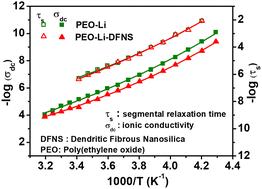
Passive and active filler-loaded poly(ethylene oxide) (PEO)-based solid-state polymer electrolytes (SPEs) are considered promising alternatives to currently used flammable liquid electrolytes in lithium metal batteries. The enhancement in the ionic conductivity of PEO-based composite electrolytes is attributed to additional ion conduction pathways available at the interphase region. Considering this aspect, in the present study, we prepared dendritic fibrous nanosilica (DFNS)-loaded PEO-based polymer composite (PEO–DNFS), and electrolytes (PEO–Li, PEO–Li–DFNS) with an EO : Li ratio of 20 : 1. DFNS was chosen as the filler due to its unique dendritic fibrous structure, which was expected to create a large interphase region in the composite. These composite and electrolytes were characterized using various techniques, including powder X-ray diffraction, attenuated total reflectance Fourier transform infrared spectroscopy, and differential scanning calorimetry, to determine modifications in chemical bonding and thermal properties. Positron annihilation lifetime spectroscopy and broadband dielectric spectroscopy (BDS) were employed to determine the modifications in the free volume structure/chain packing of PEO and the ion conduction mechanism, respectively. The relative free volume was observed to increase with DFNS loading due to modifications in the PEO chain packing. The higher number of free volume holes provided additional pathways for ionic diffusion, leading to an enhancement in ionic conductivity. The role of relative free volume in ionic conductivity enhancement was further supported by the strong coupling observed between ionic conduction and segmental relaxations of PEO electrolytes, as investigated using BDS.
期刊介绍:
Physical Chemistry Chemical Physics (PCCP) is an international journal co-owned by 19 physical chemistry and physics societies from around the world. This journal publishes original, cutting-edge research in physical chemistry, chemical physics and biophysical chemistry. To be suitable for publication in PCCP, articles must include significant innovation and/or insight into physical chemistry; this is the most important criterion that reviewers and Editors will judge against when evaluating submissions.
The journal has a broad scope and welcomes contributions spanning experiment, theory, computation and data science. Topical coverage includes spectroscopy, dynamics, kinetics, statistical mechanics, thermodynamics, electrochemistry, catalysis, surface science, quantum mechanics, quantum computing and machine learning. Interdisciplinary research areas such as polymers and soft matter, materials, nanoscience, energy, surfaces/interfaces, and biophysical chemistry are welcomed if they demonstrate significant innovation and/or insight into physical chemistry. Joined experimental/theoretical studies are particularly appreciated when complementary and based on up-to-date approaches.





 京公网安备 11010802042870号
京ICP备2023020795号-1
京公网安备 11010802042870号
京ICP备2023020795号-1

 分享
分享
 求助内容:
求助内容: 应助结果提醒方式:
 扫码关注我们
