Min Woo Kim, Jong Min Lee, Chi-Young Jung, Jung-Eun Cha, Kwang Shik Myung, Nam Jin Lee, Nam Dong Kim and Jae Young Jung
{"title":"氧还原反应中耐用Pt电催化剂的热驱动氧功能化","authors":"Min Woo Kim, Jong Min Lee, Chi-Young Jung, Jung-Eun Cha, Kwang Shik Myung, Nam Jin Lee, Nam Dong Kim and Jae Young Jung","doi":"10.1039/D5TA01939G","DOIUrl":null,"url":null,"abstract":"<p >Enhancing the durability of platinum catalysts in proton exchange membrane fuel cells (PEMFCs) remains a key challenge for long-haul truck applications. In this study, we employed a commercialized high-surface-area carbon support and performed thermal annealing under oxidizing/reducing conditions to precisely control the oxygen functional groups on its surface. Subsequently, platinum nanoparticles (Pt NPs) were uniformly dispersed on the carbon support <em>via</em> a polyol method. We systematically investigated the Pt NPs/carbon interface effect using advanced spectroscopic techniques combined with electrochemical surface analyses, while isolating the effects of Pt location and pore structure. Consequently, we significantly improved the durability of the platinum catalyst, with mass activity retention increasing from 40.9% to 78.6% of initial performance (0.393–0.403 A mg<small><sub>Pt</sub></small><small><sup>−1</sup></small>), and the electrochemical surface area (ECSA) rising from 57.9% to 84.2% of initial ECSA values (95–97 m<small><sup>2</sup></small> g<small><sub>Pt</sub></small><small><sup>−1</sup></small>). These improvements were achieved while maintaining highly precise initial parameters. Through extensive material characterization, we demonstrated that the improved durability of the platinum catalyst is attributed to the increased binding energy between the oxygen functional groups and Pt nanoparticles (NPs), as well as the suppression of Pt ionization. This study highlights the crucial role of carbon supports in fuel cells and provides guidelines for optimal design, paving the way for platinum catalysts intended for long-range fuel cell applications in areas such as ecofriendly hydrogen vehicles and distributed power generation.</p>","PeriodicalId":82,"journal":{"name":"Journal of Materials Chemistry A","volume":" 20","pages":" 14796-14808"},"PeriodicalIF":9.5000,"publicationDate":"2025-04-15","publicationTypes":"Journal Article","fieldsOfStudy":null,"isOpenAccess":false,"openAccessPdf":"","citationCount":"0","resultStr":"{\"title\":\"Thermally driven oxygen functionalization for durable Pt electrocatalysts in the oxygen reduction reaction†\",\"authors\":\"Min Woo Kim, Jong Min Lee, Chi-Young Jung, Jung-Eun Cha, Kwang Shik Myung, Nam Jin Lee, Nam Dong Kim and Jae Young Jung\",\"doi\":\"10.1039/D5TA01939G\",\"DOIUrl\":null,\"url\":null,\"abstract\":\"<p >Enhancing the durability of platinum catalysts in proton exchange membrane fuel cells (PEMFCs) remains a key challenge for long-haul truck applications. In this study, we employed a commercialized high-surface-area carbon support and performed thermal annealing under oxidizing/reducing conditions to precisely control the oxygen functional groups on its surface. Subsequently, platinum nanoparticles (Pt NPs) were uniformly dispersed on the carbon support <em>via</em> a polyol method. We systematically investigated the Pt NPs/carbon interface effect using advanced spectroscopic techniques combined with electrochemical surface analyses, while isolating the effects of Pt location and pore structure. Consequently, we significantly improved the durability of the platinum catalyst, with mass activity retention increasing from 40.9% to 78.6% of initial performance (0.393–0.403 A mg<small><sub>Pt</sub></small><small><sup>−1</sup></small>), and the electrochemical surface area (ECSA) rising from 57.9% to 84.2% of initial ECSA values (95–97 m<small><sup>2</sup></small> g<small><sub>Pt</sub></small><small><sup>−1</sup></small>). These improvements were achieved while maintaining highly precise initial parameters. Through extensive material characterization, we demonstrated that the improved durability of the platinum catalyst is attributed to the increased binding energy between the oxygen functional groups and Pt nanoparticles (NPs), as well as the suppression of Pt ionization. This study highlights the crucial role of carbon supports in fuel cells and provides guidelines for optimal design, paving the way for platinum catalysts intended for long-range fuel cell applications in areas such as ecofriendly hydrogen vehicles and distributed power generation.</p>\",\"PeriodicalId\":82,\"journal\":{\"name\":\"Journal of Materials Chemistry A\",\"volume\":\" 20\",\"pages\":\" 14796-14808\"},\"PeriodicalIF\":9.5000,\"publicationDate\":\"2025-04-15\",\"publicationTypes\":\"Journal Article\",\"fieldsOfStudy\":null,\"isOpenAccess\":false,\"openAccessPdf\":\"\",\"citationCount\":\"0\",\"resultStr\":null,\"platform\":\"Semanticscholar\",\"paperid\":null,\"PeriodicalName\":\"Journal of Materials Chemistry A\",\"FirstCategoryId\":\"88\",\"ListUrlMain\":\"https://pubs.rsc.org/en/content/articlelanding/2025/ta/d5ta01939g\",\"RegionNum\":2,\"RegionCategory\":\"材料科学\",\"ArticlePicture\":[],\"TitleCN\":null,\"AbstractTextCN\":null,\"PMCID\":null,\"EPubDate\":\"\",\"PubModel\":\"\",\"JCR\":\"Q1\",\"JCRName\":\"CHEMISTRY, PHYSICAL\",\"Score\":null,\"Total\":0}","platform":"Semanticscholar","paperid":null,"PeriodicalName":"Journal of Materials Chemistry A","FirstCategoryId":"88","ListUrlMain":"https://pubs.rsc.org/en/content/articlelanding/2025/ta/d5ta01939g","RegionNum":2,"RegionCategory":"材料科学","ArticlePicture":[],"TitleCN":null,"AbstractTextCN":null,"PMCID":null,"EPubDate":"","PubModel":"","JCR":"Q1","JCRName":"CHEMISTRY, PHYSICAL","Score":null,"Total":0}
引用次数: 0
摘要
提高质子交换膜燃料电池(pemfc)中铂催化剂的耐久性仍然是长途卡车应用的关键挑战。在本研究中,我们采用商业化的高表面积碳载体,并在氧化/还原条件下进行热退火,以精确控制其表面的氧官能团。随后,通过多元醇法将铂纳米粒子(Pt NPs)均匀分散在碳载体上。我们利用先进的光谱技术结合电化学表面分析系统地研究了Pt NPs/碳界面效应,同时分离了Pt位置和孔隙结构的影响。因此,我们显著提高了铂催化剂的耐久性,其质量活性保留率从初始性能的40.9%提高到78.6% (0.393-0.403 A mgPt−1),电化学表面积(ECSA)从初始ECSA值的57.9%提高到84.2% (95-97 m2 gPt−1)。这些改进是在保持高度精确的初始参数的情况下实现的。通过广泛的材料表征,我们证明了铂催化剂耐久性的提高是由于氧官能团和Pt纳米颗粒(NPs)之间的结合能增加,以及Pt电离的抑制。这项研究强调了碳支撑在燃料电池中的关键作用,并为优化设计提供了指导方针,为铂催化剂在环保氢燃料汽车和分布式发电等领域的远程燃料电池应用铺平了道路。
Thermally driven oxygen functionalization for durable Pt electrocatalysts in the oxygen reduction reaction†
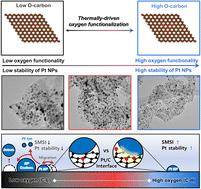
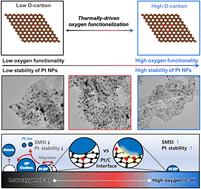
Enhancing the durability of platinum catalysts in proton exchange membrane fuel cells (PEMFCs) remains a key challenge for long-haul truck applications. In this study, we employed a commercialized high-surface-area carbon support and performed thermal annealing under oxidizing/reducing conditions to precisely control the oxygen functional groups on its surface. Subsequently, platinum nanoparticles (Pt NPs) were uniformly dispersed on the carbon support via a polyol method. We systematically investigated the Pt NPs/carbon interface effect using advanced spectroscopic techniques combined with electrochemical surface analyses, while isolating the effects of Pt location and pore structure. Consequently, we significantly improved the durability of the platinum catalyst, with mass activity retention increasing from 40.9% to 78.6% of initial performance (0.393–0.403 A mgPt−1), and the electrochemical surface area (ECSA) rising from 57.9% to 84.2% of initial ECSA values (95–97 m2 gPt−1). These improvements were achieved while maintaining highly precise initial parameters. Through extensive material characterization, we demonstrated that the improved durability of the platinum catalyst is attributed to the increased binding energy between the oxygen functional groups and Pt nanoparticles (NPs), as well as the suppression of Pt ionization. This study highlights the crucial role of carbon supports in fuel cells and provides guidelines for optimal design, paving the way for platinum catalysts intended for long-range fuel cell applications in areas such as ecofriendly hydrogen vehicles and distributed power generation.
期刊介绍:
The Journal of Materials Chemistry A, B & C covers a wide range of high-quality studies in the field of materials chemistry, with each section focusing on specific applications of the materials studied. Journal of Materials Chemistry A emphasizes applications in energy and sustainability, including topics such as artificial photosynthesis, batteries, and fuel cells. Journal of Materials Chemistry B focuses on applications in biology and medicine, while Journal of Materials Chemistry C covers applications in optical, magnetic, and electronic devices. Example topic areas within the scope of Journal of Materials Chemistry A include catalysis, green/sustainable materials, sensors, and water treatment, among others.




 京公网安备 11010802042870号
京ICP备2023020795号-1
京公网安备 11010802042870号
京ICP备2023020795号-1

 分享
分享
 求助内容:
求助内容: 应助结果提醒方式:
 扫码关注我们
