Anna Vidal-López, Joan Gassó-Capdevila, Miquel Solà, Albert Poater, Sergio Posada-Pérez
{"title":"过渡金属单原子修饰的石墨氮化碳的析氢和二氧化碳还原途径","authors":"Anna Vidal-López, Joan Gassó-Capdevila, Miquel Solà, Albert Poater, Sergio Posada-Pérez","doi":"10.1021/acs.jpcc.4c08038","DOIUrl":null,"url":null,"abstract":"The conversion of carbon dioxide (CO<sub>2</sub>) into valuable products represents a promising strategy to mitigate CO<sub>2</sub> emissions and enable sustainable energy storage. However, the development of efficient and selective catalysts for the electrocatalytic reduction of CO<sub>2</sub> (CO<sub>2</sub>RR) remains a significant challenge. In this study, we explore the performance of first-row transition metal single atoms anchored on g-C<sub>3</sub>N<sub>4</sub> monolayers as potential catalysts for the CO<sub>2</sub>RR. We employed density functional theory (DFT) calculations to investigate the hydrogen evolution reaction (HER) as a competing pathway to the CO<sub>2</sub>RR. Only the candidates that suppress the HER are promising candidates for the selective CO<sub>2</sub>RR. Our results indicate that Ni<sub>1</sub>/C<sub>3</sub>N<sub>4</sub> emerges as the most promising catalyst due to its relatively moderate-to-high overpotential for the HER and a favorable reaction pathway that favors CO production through the HCOO* intermediate. Despite some challenges, such as the strong Ni–CO interaction hindering CO desorption, Ni<sub>1</sub>/C<sub>3</sub>N<sub>4</sub> presents a viable route for CO<sub>2</sub>RR. Mn and Co single atoms exhibit slighly lower overpotential toward HER, overcoming one of the main limitations to be active and selective for CO<sub>2</sub>RR. Nevertheless, Co<sub>1</sub>/C<sub>3</sub>N<sub>4</sub> shows large energy barriers for CO hydrogenation and HCOOH production, while Mn<sub>1</sub>/C<sub>3</sub>N<sub>4</sub> opens the route for formic acid production. This work highlights the importance of evaluating the HER alongside the CO<sub>2</sub>RR to identify catalysts with optimal selectivity and efficiency.","PeriodicalId":61,"journal":{"name":"The Journal of Physical Chemistry C","volume":"238 1","pages":""},"PeriodicalIF":3.2000,"publicationDate":"2025-04-16","publicationTypes":"Journal Article","fieldsOfStudy":null,"isOpenAccess":false,"openAccessPdf":"","citationCount":"0","resultStr":"{\"title\":\"Hydrogen Evolution and Carbon Dioxide Reduction Pathways on Graphitic Carbon Nitride Decorated by Single Atoms of Transition Metals‡\",\"authors\":\"Anna Vidal-López, Joan Gassó-Capdevila, Miquel Solà, Albert Poater, Sergio Posada-Pérez\",\"doi\":\"10.1021/acs.jpcc.4c08038\",\"DOIUrl\":null,\"url\":null,\"abstract\":\"The conversion of carbon dioxide (CO<sub>2</sub>) into valuable products represents a promising strategy to mitigate CO<sub>2</sub> emissions and enable sustainable energy storage. However, the development of efficient and selective catalysts for the electrocatalytic reduction of CO<sub>2</sub> (CO<sub>2</sub>RR) remains a significant challenge. In this study, we explore the performance of first-row transition metal single atoms anchored on g-C<sub>3</sub>N<sub>4</sub> monolayers as potential catalysts for the CO<sub>2</sub>RR. We employed density functional theory (DFT) calculations to investigate the hydrogen evolution reaction (HER) as a competing pathway to the CO<sub>2</sub>RR. Only the candidates that suppress the HER are promising candidates for the selective CO<sub>2</sub>RR. Our results indicate that Ni<sub>1</sub>/C<sub>3</sub>N<sub>4</sub> emerges as the most promising catalyst due to its relatively moderate-to-high overpotential for the HER and a favorable reaction pathway that favors CO production through the HCOO* intermediate. Despite some challenges, such as the strong Ni–CO interaction hindering CO desorption, Ni<sub>1</sub>/C<sub>3</sub>N<sub>4</sub> presents a viable route for CO<sub>2</sub>RR. Mn and Co single atoms exhibit slighly lower overpotential toward HER, overcoming one of the main limitations to be active and selective for CO<sub>2</sub>RR. Nevertheless, Co<sub>1</sub>/C<sub>3</sub>N<sub>4</sub> shows large energy barriers for CO hydrogenation and HCOOH production, while Mn<sub>1</sub>/C<sub>3</sub>N<sub>4</sub> opens the route for formic acid production. This work highlights the importance of evaluating the HER alongside the CO<sub>2</sub>RR to identify catalysts with optimal selectivity and efficiency.\",\"PeriodicalId\":61,\"journal\":{\"name\":\"The Journal of Physical Chemistry C\",\"volume\":\"238 1\",\"pages\":\"\"},\"PeriodicalIF\":3.2000,\"publicationDate\":\"2025-04-16\",\"publicationTypes\":\"Journal Article\",\"fieldsOfStudy\":null,\"isOpenAccess\":false,\"openAccessPdf\":\"\",\"citationCount\":\"0\",\"resultStr\":null,\"platform\":\"Semanticscholar\",\"paperid\":null,\"PeriodicalName\":\"The Journal of Physical Chemistry C\",\"FirstCategoryId\":\"1\",\"ListUrlMain\":\"https://doi.org/10.1021/acs.jpcc.4c08038\",\"RegionNum\":3,\"RegionCategory\":\"化学\",\"ArticlePicture\":[],\"TitleCN\":null,\"AbstractTextCN\":null,\"PMCID\":null,\"EPubDate\":\"\",\"PubModel\":\"\",\"JCR\":\"Q2\",\"JCRName\":\"CHEMISTRY, PHYSICAL\",\"Score\":null,\"Total\":0}","platform":"Semanticscholar","paperid":null,"PeriodicalName":"The Journal of Physical Chemistry C","FirstCategoryId":"1","ListUrlMain":"https://doi.org/10.1021/acs.jpcc.4c08038","RegionNum":3,"RegionCategory":"化学","ArticlePicture":[],"TitleCN":null,"AbstractTextCN":null,"PMCID":null,"EPubDate":"","PubModel":"","JCR":"Q2","JCRName":"CHEMISTRY, PHYSICAL","Score":null,"Total":0}
Hydrogen Evolution and Carbon Dioxide Reduction Pathways on Graphitic Carbon Nitride Decorated by Single Atoms of Transition Metals‡
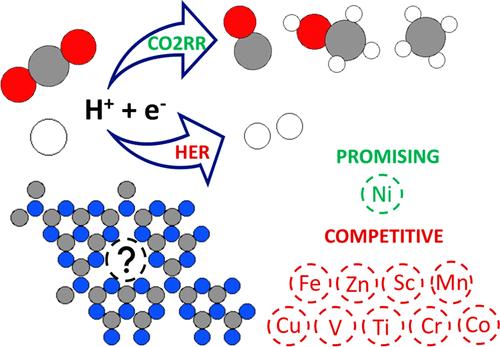
The conversion of carbon dioxide (CO2) into valuable products represents a promising strategy to mitigate CO2 emissions and enable sustainable energy storage. However, the development of efficient and selective catalysts for the electrocatalytic reduction of CO2 (CO2RR) remains a significant challenge. In this study, we explore the performance of first-row transition metal single atoms anchored on g-C3N4 monolayers as potential catalysts for the CO2RR. We employed density functional theory (DFT) calculations to investigate the hydrogen evolution reaction (HER) as a competing pathway to the CO2RR. Only the candidates that suppress the HER are promising candidates for the selective CO2RR. Our results indicate that Ni1/C3N4 emerges as the most promising catalyst due to its relatively moderate-to-high overpotential for the HER and a favorable reaction pathway that favors CO production through the HCOO* intermediate. Despite some challenges, such as the strong Ni–CO interaction hindering CO desorption, Ni1/C3N4 presents a viable route for CO2RR. Mn and Co single atoms exhibit slighly lower overpotential toward HER, overcoming one of the main limitations to be active and selective for CO2RR. Nevertheless, Co1/C3N4 shows large energy barriers for CO hydrogenation and HCOOH production, while Mn1/C3N4 opens the route for formic acid production. This work highlights the importance of evaluating the HER alongside the CO2RR to identify catalysts with optimal selectivity and efficiency.
期刊介绍:
The Journal of Physical Chemistry A/B/C is devoted to reporting new and original experimental and theoretical basic research of interest to physical chemists, biophysical chemists, and chemical physicists.




 京公网安备 11010802042870号
京ICP备2023020795号-1
京公网安备 11010802042870号
京ICP备2023020795号-1

 分享
分享
 求助内容:
求助内容: 应助结果提醒方式:
 扫码关注我们
