{"title":"发光四面体锰(II)五氟酚酸盐配合物作为高灵敏度分子温度计","authors":"Luca Labella, Gregorio Bottaro, Fabio Marchetti, Simona Samaritani, Lidia Armelao","doi":"10.1021/acs.inorgchem.4c05477","DOIUrl":null,"url":null,"abstract":"A mononuclear tetrahedral manganese complex containing all O-donor ligands has been prepared under mild conditions starting from a dialkylcarbamato manganese(II) precursor. Manganese(II) <i>N,N</i>-dibutylcarbamate [Mn(O<sub>2</sub>CNBu<sub>2</sub>)<sub>2</sub>]<sub><i>n</i></sub>, <b>1</b>, can be conveniently prepared by extraction from a deoxygenated water solution of manganese(II) sulfate using a CO<sub>2</sub>-saturated toluene solution of dibutylamine. Access to the <i>N</i>,<i>N</i>-dibenzylcarbamato manganese complex [Mn(O<sub>2</sub>CNBz<sub>2</sub>)<sub>2</sub>]<sub><i>n</i></sub>, <b>2</b>, occurs through metathesis by reaction with dibenzylamine and carbon dioxide. By reaction of <b>2</b> with pentafluorophenol, an almost quantitative reaction affords [Bz<sub>2</sub>NH<sub>2</sub>]<sub>2</sub>[Mn(OC<sub>6</sub>F<sub>5</sub>)<sub>4</sub>], <b>3</b>, that has been crystallographically characterized through single-crystal X-ray diffraction. Compound <b>3</b> exhibits absorption and emission spectral features characteristic of Mn<sup>2+</sup> ions in a tetrahedral coordination environment. Upon cooling, the emission intensity was observed to increase by approximately two orders of magnitude. The excited-state lifetimes exhibited significant temperature dependence, ranging from 12.7 ms at 80 K to 10 μs at 290 K. The temperature-dependent trends of both emission intensity and lifetimes showed nearly identical profiles. As a result, compound <b>3</b> functions as a dual-mode highly sensitive luminescent molecular thermometer, with a maximum relative thermal sensitivity (<i>S</i><sub>r</sub>) of 7.4% K<sup>–1</sup> at 220 K and <i>S</i><sub>r</sub> >1 over the temperature range 170–270 K. A distinctive feature of compound <b>3</b> is its capacity to yield equivalent luminescent molecular thermometers (LMT) using either the emission intensity or lifetime, thus enhancing its versatility in thermal sensing applications.","PeriodicalId":40,"journal":{"name":"Inorganic Chemistry","volume":"15 1","pages":""},"PeriodicalIF":4.7000,"publicationDate":"2025-04-16","publicationTypes":"Journal Article","fieldsOfStudy":null,"isOpenAccess":false,"openAccessPdf":"","citationCount":"0","resultStr":"{\"title\":\"Luminescent Tetrahedral Manganese(II) Pentaphluorophenolate Complex as a Highly Sensitive Molecular Thermometer\",\"authors\":\"Luca Labella, Gregorio Bottaro, Fabio Marchetti, Simona Samaritani, Lidia Armelao\",\"doi\":\"10.1021/acs.inorgchem.4c05477\",\"DOIUrl\":null,\"url\":null,\"abstract\":\"A mononuclear tetrahedral manganese complex containing all O-donor ligands has been prepared under mild conditions starting from a dialkylcarbamato manganese(II) precursor. Manganese(II) <i>N,N</i>-dibutylcarbamate [Mn(O<sub>2</sub>CNBu<sub>2</sub>)<sub>2</sub>]<sub><i>n</i></sub>, <b>1</b>, can be conveniently prepared by extraction from a deoxygenated water solution of manganese(II) sulfate using a CO<sub>2</sub>-saturated toluene solution of dibutylamine. Access to the <i>N</i>,<i>N</i>-dibenzylcarbamato manganese complex [Mn(O<sub>2</sub>CNBz<sub>2</sub>)<sub>2</sub>]<sub><i>n</i></sub>, <b>2</b>, occurs through metathesis by reaction with dibenzylamine and carbon dioxide. By reaction of <b>2</b> with pentafluorophenol, an almost quantitative reaction affords [Bz<sub>2</sub>NH<sub>2</sub>]<sub>2</sub>[Mn(OC<sub>6</sub>F<sub>5</sub>)<sub>4</sub>], <b>3</b>, that has been crystallographically characterized through single-crystal X-ray diffraction. Compound <b>3</b> exhibits absorption and emission spectral features characteristic of Mn<sup>2+</sup> ions in a tetrahedral coordination environment. Upon cooling, the emission intensity was observed to increase by approximately two orders of magnitude. The excited-state lifetimes exhibited significant temperature dependence, ranging from 12.7 ms at 80 K to 10 μs at 290 K. The temperature-dependent trends of both emission intensity and lifetimes showed nearly identical profiles. As a result, compound <b>3</b> functions as a dual-mode highly sensitive luminescent molecular thermometer, with a maximum relative thermal sensitivity (<i>S</i><sub>r</sub>) of 7.4% K<sup>–1</sup> at 220 K and <i>S</i><sub>r</sub> >1 over the temperature range 170–270 K. A distinctive feature of compound <b>3</b> is its capacity to yield equivalent luminescent molecular thermometers (LMT) using either the emission intensity or lifetime, thus enhancing its versatility in thermal sensing applications.\",\"PeriodicalId\":40,\"journal\":{\"name\":\"Inorganic Chemistry\",\"volume\":\"15 1\",\"pages\":\"\"},\"PeriodicalIF\":4.7000,\"publicationDate\":\"2025-04-16\",\"publicationTypes\":\"Journal Article\",\"fieldsOfStudy\":null,\"isOpenAccess\":false,\"openAccessPdf\":\"\",\"citationCount\":\"0\",\"resultStr\":null,\"platform\":\"Semanticscholar\",\"paperid\":null,\"PeriodicalName\":\"Inorganic Chemistry\",\"FirstCategoryId\":\"92\",\"ListUrlMain\":\"https://doi.org/10.1021/acs.inorgchem.4c05477\",\"RegionNum\":2,\"RegionCategory\":\"化学\",\"ArticlePicture\":[],\"TitleCN\":null,\"AbstractTextCN\":null,\"PMCID\":null,\"EPubDate\":\"\",\"PubModel\":\"\",\"JCR\":\"Q1\",\"JCRName\":\"CHEMISTRY, INORGANIC & NUCLEAR\",\"Score\":null,\"Total\":0}","platform":"Semanticscholar","paperid":null,"PeriodicalName":"Inorganic Chemistry","FirstCategoryId":"92","ListUrlMain":"https://doi.org/10.1021/acs.inorgchem.4c05477","RegionNum":2,"RegionCategory":"化学","ArticlePicture":[],"TitleCN":null,"AbstractTextCN":null,"PMCID":null,"EPubDate":"","PubModel":"","JCR":"Q1","JCRName":"CHEMISTRY, INORGANIC & NUCLEAR","Score":null,"Total":0}
引用次数: 0
摘要
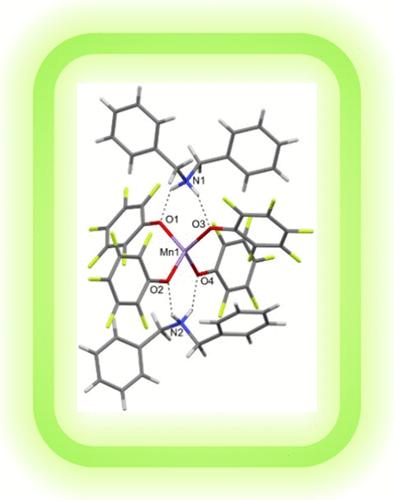
以二烷基氨基甲酸锰(II)前驱体为原料,在温和条件下制备了含有全部o给体配体的单核四面体锰配合物。锰(II) N,N-二丁基氨基甲酸酯[Mn(O2CNBu2)2] N, 1用饱和co2的二丁胺甲苯溶液从硫酸锰(II)的脱氧水溶液中萃取得到。N,N-二苄基氨基甲酸锰配合物[Mn(O2CNBz2)2] N, 2,通过与二苄胺和二氧化碳的反应发生复分解。通过2与五氟苯酚的反应,几乎可以定量得到[Bz2NH2]2[Mn(OC6F5)4], 3,并通过单晶x射线衍射对其进行了晶体学表征。化合物3在四面体配位环境中表现出Mn2+离子的吸收和发射光谱特征。在冷却后,观察到发射强度增加了大约两个数量级。激发态寿命表现出明显的温度依赖性,从80k时的12.7 ms到290 K时的10 μs不等。排放强度和寿命随温度的变化趋势几乎相同。结果表明,化合物3作为一种双模高灵敏度发光分子温度计,在220 K时最大相对热敏度Sr为7.4% K - 1,在170-270 K范围内Sr >;1。化合物3的一个显着特征是它能够使用发射强度或寿命产生等效发光分子温度计(LMT),从而增强其在热敏应用中的多功能性。
Luminescent Tetrahedral Manganese(II) Pentaphluorophenolate Complex as a Highly Sensitive Molecular Thermometer
A mononuclear tetrahedral manganese complex containing all O-donor ligands has been prepared under mild conditions starting from a dialkylcarbamato manganese(II) precursor. Manganese(II) N,N-dibutylcarbamate [Mn(O2CNBu2)2]n, 1, can be conveniently prepared by extraction from a deoxygenated water solution of manganese(II) sulfate using a CO2-saturated toluene solution of dibutylamine. Access to the N,N-dibenzylcarbamato manganese complex [Mn(O2CNBz2)2]n, 2, occurs through metathesis by reaction with dibenzylamine and carbon dioxide. By reaction of 2 with pentafluorophenol, an almost quantitative reaction affords [Bz2NH2]2[Mn(OC6F5)4], 3, that has been crystallographically characterized through single-crystal X-ray diffraction. Compound 3 exhibits absorption and emission spectral features characteristic of Mn2+ ions in a tetrahedral coordination environment. Upon cooling, the emission intensity was observed to increase by approximately two orders of magnitude. The excited-state lifetimes exhibited significant temperature dependence, ranging from 12.7 ms at 80 K to 10 μs at 290 K. The temperature-dependent trends of both emission intensity and lifetimes showed nearly identical profiles. As a result, compound 3 functions as a dual-mode highly sensitive luminescent molecular thermometer, with a maximum relative thermal sensitivity (Sr) of 7.4% K–1 at 220 K and Sr >1 over the temperature range 170–270 K. A distinctive feature of compound 3 is its capacity to yield equivalent luminescent molecular thermometers (LMT) using either the emission intensity or lifetime, thus enhancing its versatility in thermal sensing applications.
期刊介绍:
Inorganic Chemistry publishes fundamental studies in all phases of inorganic chemistry. Coverage includes experimental and theoretical reports on quantitative studies of structure and thermodynamics, kinetics, mechanisms of inorganic reactions, bioinorganic chemistry, and relevant aspects of organometallic chemistry, solid-state phenomena, and chemical bonding theory. Emphasis is placed on the synthesis, structure, thermodynamics, reactivity, spectroscopy, and bonding properties of significant new and known compounds.




 京公网安备 11010802042870号
京ICP备2023020795号-1
京公网安备 11010802042870号
京ICP备2023020795号-1

 分享
分享
 求助内容:
求助内容: 应助结果提醒方式:
 扫码关注我们
