J. Redondo , J. Subbian , M.A. Monclús , A. Pendashteh , D. Pérez , M. Mehdi , J. Ruiz-Hervías , J.M. Molina Aldareguia , J. LLorca
{"title":"弹性应变对Au薄膜析氢反应电催化活性的影响","authors":"J. Redondo , J. Subbian , M.A. Monclús , A. Pendashteh , D. Pérez , M. Mehdi , J. Ruiz-Hervías , J.M. Molina Aldareguia , J. LLorca","doi":"10.1016/j.jcat.2025.116151","DOIUrl":null,"url":null,"abstract":"<div><div>Platinum-group metals are currently the most efficient catalysts for hydrogen evolution reaction (HER), however their high cost and scarcity urge introduction and development of affordable alternatives. Herein, the effect of elastic strains on gold (Au) thin films is investigated to tune and enhance their catalytic activity towards HER. Tensile and compressive strains are introduced into Au films deposited via magnetron sputtering onto nitinol substrates using one-way shape memory effect of the alloy. The generated elastic strains are measured by X-ray diffraction, revealing maximum ∼ 0.43 % tension and ∼ 0.25 % compression. Electrochemical tests demonstrate that applying tensile strains to the Au thin film increases the HER catalytic activity, e.g., by reducing the overpotential at 50 mA/cm<sup>2</sup> by 24 %. On the contrary, compressive strains decrease the catalytic activity, resulting in an increased overpotential of 32 %. Such effect is further confirmed from the kinetics study through Tafel analysis and charge transfer resistance measurements. Accordingly, this study not only results in Au samples with improved HER activity but also paves the path towards better understanding and application of elastic strain engineering for metals with enhanced catalytic activity for sustainable hydrogen production.</div></div>","PeriodicalId":346,"journal":{"name":"Journal of Catalysis","volume":"447 ","pages":"Article 116151"},"PeriodicalIF":6.0000,"publicationDate":"2025-07-01","publicationTypes":"Journal Article","fieldsOfStudy":null,"isOpenAccess":false,"openAccessPdf":"","citationCount":"0","resultStr":"{\"title\":\"Effect of elastic strains on the electrocatalytic activity of Au thin films for the hydrogen evolution reaction\",\"authors\":\"J. Redondo , J. Subbian , M.A. Monclús , A. Pendashteh , D. Pérez , M. Mehdi , J. Ruiz-Hervías , J.M. Molina Aldareguia , J. LLorca\",\"doi\":\"10.1016/j.jcat.2025.116151\",\"DOIUrl\":null,\"url\":null,\"abstract\":\"<div><div>Platinum-group metals are currently the most efficient catalysts for hydrogen evolution reaction (HER), however their high cost and scarcity urge introduction and development of affordable alternatives. Herein, the effect of elastic strains on gold (Au) thin films is investigated to tune and enhance their catalytic activity towards HER. Tensile and compressive strains are introduced into Au films deposited via magnetron sputtering onto nitinol substrates using one-way shape memory effect of the alloy. The generated elastic strains are measured by X-ray diffraction, revealing maximum ∼ 0.43 % tension and ∼ 0.25 % compression. Electrochemical tests demonstrate that applying tensile strains to the Au thin film increases the HER catalytic activity, e.g., by reducing the overpotential at 50 mA/cm<sup>2</sup> by 24 %. On the contrary, compressive strains decrease the catalytic activity, resulting in an increased overpotential of 32 %. Such effect is further confirmed from the kinetics study through Tafel analysis and charge transfer resistance measurements. Accordingly, this study not only results in Au samples with improved HER activity but also paves the path towards better understanding and application of elastic strain engineering for metals with enhanced catalytic activity for sustainable hydrogen production.</div></div>\",\"PeriodicalId\":346,\"journal\":{\"name\":\"Journal of Catalysis\",\"volume\":\"447 \",\"pages\":\"Article 116151\"},\"PeriodicalIF\":6.0000,\"publicationDate\":\"2025-07-01\",\"publicationTypes\":\"Journal Article\",\"fieldsOfStudy\":null,\"isOpenAccess\":false,\"openAccessPdf\":\"\",\"citationCount\":\"0\",\"resultStr\":null,\"platform\":\"Semanticscholar\",\"paperid\":null,\"PeriodicalName\":\"Journal of Catalysis\",\"FirstCategoryId\":\"92\",\"ListUrlMain\":\"https://www.sciencedirect.com/science/article/pii/S0021951725002167\",\"RegionNum\":1,\"RegionCategory\":\"化学\",\"ArticlePicture\":[],\"TitleCN\":null,\"AbstractTextCN\":null,\"PMCID\":null,\"EPubDate\":\"2025/4/16 0:00:00\",\"PubModel\":\"Epub\",\"JCR\":\"Q2\",\"JCRName\":\"CHEMISTRY, PHYSICAL\",\"Score\":null,\"Total\":0}","platform":"Semanticscholar","paperid":null,"PeriodicalName":"Journal of Catalysis","FirstCategoryId":"92","ListUrlMain":"https://www.sciencedirect.com/science/article/pii/S0021951725002167","RegionNum":1,"RegionCategory":"化学","ArticlePicture":[],"TitleCN":null,"AbstractTextCN":null,"PMCID":null,"EPubDate":"2025/4/16 0:00:00","PubModel":"Epub","JCR":"Q2","JCRName":"CHEMISTRY, PHYSICAL","Score":null,"Total":0}
Effect of elastic strains on the electrocatalytic activity of Au thin films for the hydrogen evolution reaction
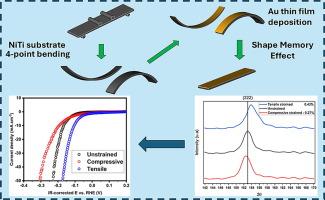
Platinum-group metals are currently the most efficient catalysts for hydrogen evolution reaction (HER), however their high cost and scarcity urge introduction and development of affordable alternatives. Herein, the effect of elastic strains on gold (Au) thin films is investigated to tune and enhance their catalytic activity towards HER. Tensile and compressive strains are introduced into Au films deposited via magnetron sputtering onto nitinol substrates using one-way shape memory effect of the alloy. The generated elastic strains are measured by X-ray diffraction, revealing maximum ∼ 0.43 % tension and ∼ 0.25 % compression. Electrochemical tests demonstrate that applying tensile strains to the Au thin film increases the HER catalytic activity, e.g., by reducing the overpotential at 50 mA/cm2 by 24 %. On the contrary, compressive strains decrease the catalytic activity, resulting in an increased overpotential of 32 %. Such effect is further confirmed from the kinetics study through Tafel analysis and charge transfer resistance measurements. Accordingly, this study not only results in Au samples with improved HER activity but also paves the path towards better understanding and application of elastic strain engineering for metals with enhanced catalytic activity for sustainable hydrogen production.
期刊介绍:
The Journal of Catalysis publishes scholarly articles on both heterogeneous and homogeneous catalysis, covering a wide range of chemical transformations. These include various types of catalysis, such as those mediated by photons, plasmons, and electrons. The focus of the studies is to understand the relationship between catalytic function and the underlying chemical properties of surfaces and metal complexes.
The articles in the journal offer innovative concepts and explore the synthesis and kinetics of inorganic solids and homogeneous complexes. Furthermore, they discuss spectroscopic techniques for characterizing catalysts, investigate the interaction of probes and reacting species with catalysts, and employ theoretical methods.
The research presented in the journal should have direct relevance to the field of catalytic processes, addressing either fundamental aspects or applications of catalysis.





 京公网安备 11010802042870号
京ICP备2023020795号-1
京公网安备 11010802042870号
京ICP备2023020795号-1

 分享
分享
 求助内容:
求助内容: 应助结果提醒方式:
 扫码关注我们
