{"title":"一种用于乳化过程中液滴破碎核可靠识别的系统方法","authors":"Kristy Touma , Noureddine Lebaz , Gürkan Sin , Nida Sheibat-Othman","doi":"10.1016/j.ces.2025.121699","DOIUrl":null,"url":null,"abstract":"<div><div>Accurate modeling of emulsification processes within Population Balance Models (PBMs) for the prediction of the droplet size distribution (DSD) requires reliable identification of the breakage frequency kernel. This study investigates the identifiability and sensitivity of PBM parameters, model selection and dataset selection for emulsification, under a wide range of operating conditions characterized by Reynolds of the dispersed phase number and the Weber number. Frequentist and Bayesian optimization approaches are employed to estimate the parameters. The Bayesian approach permits also to quantify uncertainty distributions. Sensitivity and identifiability analyses are then conducted. Using a dataset based on fractional factorial experimental design is found to be satisfactory to identify parameter subsets that are robust and widely generalizable. The methodology also allows discrimination between the available breakage kernels based on their description of the experimental observations. This work provides a systematic methodology for ensuring reliable PBM application for emulsification processes.</div></div>","PeriodicalId":271,"journal":{"name":"Chemical Engineering Science","volume":"312 ","pages":"Article 121699"},"PeriodicalIF":4.3000,"publicationDate":"2025-06-15","publicationTypes":"Journal Article","fieldsOfStudy":null,"isOpenAccess":false,"openAccessPdf":"","citationCount":"0","resultStr":"{\"title\":\"A systematic methodology for robust identification of droplet breakage kernels for emulsification processes\",\"authors\":\"Kristy Touma , Noureddine Lebaz , Gürkan Sin , Nida Sheibat-Othman\",\"doi\":\"10.1016/j.ces.2025.121699\",\"DOIUrl\":null,\"url\":null,\"abstract\":\"<div><div>Accurate modeling of emulsification processes within Population Balance Models (PBMs) for the prediction of the droplet size distribution (DSD) requires reliable identification of the breakage frequency kernel. This study investigates the identifiability and sensitivity of PBM parameters, model selection and dataset selection for emulsification, under a wide range of operating conditions characterized by Reynolds of the dispersed phase number and the Weber number. Frequentist and Bayesian optimization approaches are employed to estimate the parameters. The Bayesian approach permits also to quantify uncertainty distributions. Sensitivity and identifiability analyses are then conducted. Using a dataset based on fractional factorial experimental design is found to be satisfactory to identify parameter subsets that are robust and widely generalizable. The methodology also allows discrimination between the available breakage kernels based on their description of the experimental observations. This work provides a systematic methodology for ensuring reliable PBM application for emulsification processes.</div></div>\",\"PeriodicalId\":271,\"journal\":{\"name\":\"Chemical Engineering Science\",\"volume\":\"312 \",\"pages\":\"Article 121699\"},\"PeriodicalIF\":4.3000,\"publicationDate\":\"2025-06-15\",\"publicationTypes\":\"Journal Article\",\"fieldsOfStudy\":null,\"isOpenAccess\":false,\"openAccessPdf\":\"\",\"citationCount\":\"0\",\"resultStr\":null,\"platform\":\"Semanticscholar\",\"paperid\":null,\"PeriodicalName\":\"Chemical Engineering Science\",\"FirstCategoryId\":\"5\",\"ListUrlMain\":\"https://www.sciencedirect.com/science/article/pii/S0009250925005226\",\"RegionNum\":2,\"RegionCategory\":\"工程技术\",\"ArticlePicture\":[],\"TitleCN\":null,\"AbstractTextCN\":null,\"PMCID\":null,\"EPubDate\":\"2025/4/17 0:00:00\",\"PubModel\":\"Epub\",\"JCR\":\"Q2\",\"JCRName\":\"ENGINEERING, CHEMICAL\",\"Score\":null,\"Total\":0}","platform":"Semanticscholar","paperid":null,"PeriodicalName":"Chemical Engineering Science","FirstCategoryId":"5","ListUrlMain":"https://www.sciencedirect.com/science/article/pii/S0009250925005226","RegionNum":2,"RegionCategory":"工程技术","ArticlePicture":[],"TitleCN":null,"AbstractTextCN":null,"PMCID":null,"EPubDate":"2025/4/17 0:00:00","PubModel":"Epub","JCR":"Q2","JCRName":"ENGINEERING, CHEMICAL","Score":null,"Total":0}
A systematic methodology for robust identification of droplet breakage kernels for emulsification processes
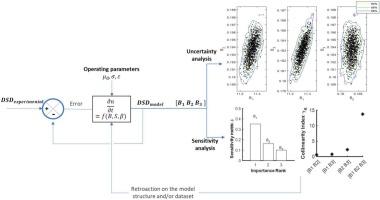
Accurate modeling of emulsification processes within Population Balance Models (PBMs) for the prediction of the droplet size distribution (DSD) requires reliable identification of the breakage frequency kernel. This study investigates the identifiability and sensitivity of PBM parameters, model selection and dataset selection for emulsification, under a wide range of operating conditions characterized by Reynolds of the dispersed phase number and the Weber number. Frequentist and Bayesian optimization approaches are employed to estimate the parameters. The Bayesian approach permits also to quantify uncertainty distributions. Sensitivity and identifiability analyses are then conducted. Using a dataset based on fractional factorial experimental design is found to be satisfactory to identify parameter subsets that are robust and widely generalizable. The methodology also allows discrimination between the available breakage kernels based on their description of the experimental observations. This work provides a systematic methodology for ensuring reliable PBM application for emulsification processes.
期刊介绍:
Chemical engineering enables the transformation of natural resources and energy into useful products for society. It draws on and applies natural sciences, mathematics and economics, and has developed fundamental engineering science that underpins the discipline.
Chemical Engineering Science (CES) has been publishing papers on the fundamentals of chemical engineering since 1951. CES is the platform where the most significant advances in the discipline have ever since been published. Chemical Engineering Science has accompanied and sustained chemical engineering through its development into the vibrant and broad scientific discipline it is today.




 京公网安备 11010802042870号
京ICP备2023020795号-1
京公网安备 11010802042870号
京ICP备2023020795号-1

 分享
分享
 求助内容:
求助内容: 应助结果提醒方式:
 扫码关注我们
