Russell G. Fritzemeier, Nicholas S. Akins, Paul J. Arcoria, Srinu Paladugu, Elijah Z. Ullman, James Allen, Rehan Sheikh, Kelsey A. Nocilla, Ellington D. McDaniels, Emanuel M. Coleman, Pantelis Antonoudiou, Michael P. D’Erasmo, Perry Bartsch, Savita K. Sharma, Jamie Maguire, Stephen F. Traynelis, Dennis C. Liotta
{"title":"噻吩嘧啶衍生物作为GluN2B/C/D偏置的n -甲基- D -天冬氨酸受体的正变构调节剂","authors":"Russell G. Fritzemeier, Nicholas S. Akins, Paul J. Arcoria, Srinu Paladugu, Elijah Z. Ullman, James Allen, Rehan Sheikh, Kelsey A. Nocilla, Ellington D. McDaniels, Emanuel M. Coleman, Pantelis Antonoudiou, Michael P. D’Erasmo, Perry Bartsch, Savita K. Sharma, Jamie Maguire, Stephen F. Traynelis, Dennis C. Liotta","doi":"10.1021/acs.jmedchem.4c02912","DOIUrl":null,"url":null,"abstract":"Positive allosteric modulators (PAMs) of the <i>N</i>-methyl-<span>d</span>-aspartate receptor (NMDAR) have been proposed as therapeutics in several neuropsychiatric indications, including schizophrenia, depression, cognitive dysfunction, and anxiety. In particular, GluN2D-containing NMDARs are highly expressed in inhibitory interneurons and are a target of interest for drug development. Toward that end, we describe our investigation into the GluN2-selective EU 1622 series of PAMs that enhance receptor efficacy, increase agonist potency, prolong deactivation time course, reduce single channel conductance, and limit calcium influx. Through SAR studies of the amide, aryl, and thiophene side chains, we identified analogues with submicromolar potency that preferentially potentiate GluN2B-, GluN2C-, and GluN2D-containing NMDARs. Elaboration of the thiophene side chain to block metabolism resulted in the discovery of <b>EU 1622-240</b> (<b>25b</b>) with improved metabolic stability, oral bioavailability, and CNS penetration in rodents. Consequently, we present data with <b>EU 1622-240</b> showing the promising properties of this series as a biased GluN2 potentiator.","PeriodicalId":46,"journal":{"name":"Journal of Medicinal Chemistry","volume":"47 1","pages":""},"PeriodicalIF":7.3000,"publicationDate":"2025-04-20","publicationTypes":"Journal Article","fieldsOfStudy":null,"isOpenAccess":false,"openAccessPdf":"","citationCount":"0","resultStr":"{\"title\":\"Thienopyrimidinone Derivatives as a GluN2B/C/D Biased, Positive Allosteric Modulator of the N-Methyl-d-Aspartate Receptor\",\"authors\":\"Russell G. Fritzemeier, Nicholas S. Akins, Paul J. Arcoria, Srinu Paladugu, Elijah Z. Ullman, James Allen, Rehan Sheikh, Kelsey A. Nocilla, Ellington D. McDaniels, Emanuel M. Coleman, Pantelis Antonoudiou, Michael P. D’Erasmo, Perry Bartsch, Savita K. Sharma, Jamie Maguire, Stephen F. Traynelis, Dennis C. Liotta\",\"doi\":\"10.1021/acs.jmedchem.4c02912\",\"DOIUrl\":null,\"url\":null,\"abstract\":\"Positive allosteric modulators (PAMs) of the <i>N</i>-methyl-<span>d</span>-aspartate receptor (NMDAR) have been proposed as therapeutics in several neuropsychiatric indications, including schizophrenia, depression, cognitive dysfunction, and anxiety. In particular, GluN2D-containing NMDARs are highly expressed in inhibitory interneurons and are a target of interest for drug development. Toward that end, we describe our investigation into the GluN2-selective EU 1622 series of PAMs that enhance receptor efficacy, increase agonist potency, prolong deactivation time course, reduce single channel conductance, and limit calcium influx. Through SAR studies of the amide, aryl, and thiophene side chains, we identified analogues with submicromolar potency that preferentially potentiate GluN2B-, GluN2C-, and GluN2D-containing NMDARs. Elaboration of the thiophene side chain to block metabolism resulted in the discovery of <b>EU 1622-240</b> (<b>25b</b>) with improved metabolic stability, oral bioavailability, and CNS penetration in rodents. Consequently, we present data with <b>EU 1622-240</b> showing the promising properties of this series as a biased GluN2 potentiator.\",\"PeriodicalId\":46,\"journal\":{\"name\":\"Journal of Medicinal Chemistry\",\"volume\":\"47 1\",\"pages\":\"\"},\"PeriodicalIF\":7.3000,\"publicationDate\":\"2025-04-20\",\"publicationTypes\":\"Journal Article\",\"fieldsOfStudy\":null,\"isOpenAccess\":false,\"openAccessPdf\":\"\",\"citationCount\":\"0\",\"resultStr\":null,\"platform\":\"Semanticscholar\",\"paperid\":null,\"PeriodicalName\":\"Journal of Medicinal Chemistry\",\"FirstCategoryId\":\"3\",\"ListUrlMain\":\"https://doi.org/10.1021/acs.jmedchem.4c02912\",\"RegionNum\":1,\"RegionCategory\":\"医学\",\"ArticlePicture\":[],\"TitleCN\":null,\"AbstractTextCN\":null,\"PMCID\":null,\"EPubDate\":\"\",\"PubModel\":\"\",\"JCR\":\"Q1\",\"JCRName\":\"CHEMISTRY, MEDICINAL\",\"Score\":null,\"Total\":0}","platform":"Semanticscholar","paperid":null,"PeriodicalName":"Journal of Medicinal Chemistry","FirstCategoryId":"3","ListUrlMain":"https://doi.org/10.1021/acs.jmedchem.4c02912","RegionNum":1,"RegionCategory":"医学","ArticlePicture":[],"TitleCN":null,"AbstractTextCN":null,"PMCID":null,"EPubDate":"","PubModel":"","JCR":"Q1","JCRName":"CHEMISTRY, MEDICINAL","Score":null,"Total":0}
引用次数: 0
摘要
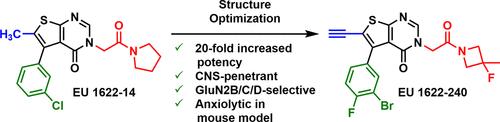
N-甲基-d-天冬氨酸受体(NMDAR)的正性异位调节剂(PAMs)已被提议作为治疗精神分裂症、抑郁症、认知功能障碍和焦虑症等多种神经精神疾病的药物。特别是,含 GluN2D 的 NMDAR 在抑制性中间神经元中高度表达,是药物开发的兴趣靶点。为此,我们介绍了我们对 GluN2 选择性 EU 1622 系列 PAM 的研究,这些 PAM 可增强受体功效、提高激动剂效力、延长失活时间过程、降低单通道电导和限制钙离子流入。通过对酰胺、芳基和噻吩侧链的 SAR 研究,我们发现了具有亚摩尔效力的类似物,它们能优先增效含 GluN2B、GluN2C 和 GluN2D 的 NMDAR。为了阻止代谢,我们对噻吩侧链进行了精心设计,最终发现了 EU 1622-240(25b),它在啮齿动物体内的代谢稳定性、口服生物利用度和中枢神经系统穿透性都得到了改善。因此,我们展示了 EU 1622-240 的数据,这些数据表明该系列药物作为一种偏向 GluN2 的增效剂具有良好的特性。
Thienopyrimidinone Derivatives as a GluN2B/C/D Biased, Positive Allosteric Modulator of the N-Methyl-d-Aspartate Receptor
Positive allosteric modulators (PAMs) of the N-methyl-d-aspartate receptor (NMDAR) have been proposed as therapeutics in several neuropsychiatric indications, including schizophrenia, depression, cognitive dysfunction, and anxiety. In particular, GluN2D-containing NMDARs are highly expressed in inhibitory interneurons and are a target of interest for drug development. Toward that end, we describe our investigation into the GluN2-selective EU 1622 series of PAMs that enhance receptor efficacy, increase agonist potency, prolong deactivation time course, reduce single channel conductance, and limit calcium influx. Through SAR studies of the amide, aryl, and thiophene side chains, we identified analogues with submicromolar potency that preferentially potentiate GluN2B-, GluN2C-, and GluN2D-containing NMDARs. Elaboration of the thiophene side chain to block metabolism resulted in the discovery of EU 1622-240 (25b) with improved metabolic stability, oral bioavailability, and CNS penetration in rodents. Consequently, we present data with EU 1622-240 showing the promising properties of this series as a biased GluN2 potentiator.
期刊介绍:
The Journal of Medicinal Chemistry is a prestigious biweekly peer-reviewed publication that focuses on the multifaceted field of medicinal chemistry. Since its inception in 1959 as the Journal of Medicinal and Pharmaceutical Chemistry, it has evolved to become a cornerstone in the dissemination of research findings related to the design, synthesis, and development of therapeutic agents.
The Journal of Medicinal Chemistry is recognized for its significant impact in the scientific community, as evidenced by its 2022 impact factor of 7.3. This metric reflects the journal's influence and the importance of its content in shaping the future of drug discovery and development. The journal serves as a vital resource for chemists, pharmacologists, and other researchers interested in the molecular mechanisms of drug action and the optimization of therapeutic compounds.




 京公网安备 11010802042870号
京ICP备2023020795号-1
京公网安备 11010802042870号
京ICP备2023020795号-1

 分享
分享
 求助内容:
求助内容: 应助结果提醒方式:
 扫码关注我们
