Xinli Yang, Hongwu Li, Dexing Li, Maoguo Luo, Renxiao Liu, Yinglu Ji, Chunhui Wang, Xiaochun Wu, Guanglu Ge
{"title":"单粒子 ICP-MS 混合泊松分布形式仪器响应函数的建模、验证和应用","authors":"Xinli Yang, Hongwu Li, Dexing Li, Maoguo Luo, Renxiao Liu, Yinglu Ji, Chunhui Wang, Xiaochun Wu, Guanglu Ge","doi":"10.1021/acs.analchem.5c00089","DOIUrl":null,"url":null,"abstract":"Single-particle inductively coupled plasma mass spectrometry (spICP-MS) is a sensitive and convenient technique for characterizing nanoparticles in suspension, enabling the determination of particle size, particle size distribution (PSD) and particle number concentration (PNC) from time-resolved signals of particle events. Accurate acquisition and modeling of event intensity distributions (EIDs) are critical steps in expanding functionality and improving measurement accuracy. In this work, we explored the broadening factors of EID, establishing and validating a robust instrument response function (IRF) in the form of a mixed Poisson distribution that reliably correlates PSD with EID across varying operating conditions. The EID tailing caused by particle coincidence is quantified and eliminated through Monte Carlo simulations grounded in the homogeneous Poisson process, and then the recovered EID is deconvoluted by IRF to yield high-fidelity PSD, improving the accuracy of PSD and PNC obtained by spICP-MS. For monodisperse gold nanoparticles (AuNPs) and AuNP mixtures, stable PSDs can be recovered from the broadened EIDs by IRF deconvolution, yielding results closely aligned with those obtained by transmission electron microscopy, thus increasing the size resolution to about 7 nm in both simulated and actual samples. The application of IRF to the measurement of nanoparticle agglomerates was also demonstrated, and the probability mass function of agglomeration numbers was successfully resolved. This technique is expected to leverage the high-throughput advantages of spICP-MS in the quantification of nanoparticle mixtures or agglomerates.","PeriodicalId":27,"journal":{"name":"Analytical Chemistry","volume":"41 1","pages":""},"PeriodicalIF":6.7000,"publicationDate":"2025-04-22","publicationTypes":"Journal Article","fieldsOfStudy":null,"isOpenAccess":false,"openAccessPdf":"","citationCount":"0","resultStr":"{\"title\":\"Modeling, Validation, and Application of Instrument Response Function in the Form of Mixed Poisson Distribution for Single-Particle ICP-MS\",\"authors\":\"Xinli Yang, Hongwu Li, Dexing Li, Maoguo Luo, Renxiao Liu, Yinglu Ji, Chunhui Wang, Xiaochun Wu, Guanglu Ge\",\"doi\":\"10.1021/acs.analchem.5c00089\",\"DOIUrl\":null,\"url\":null,\"abstract\":\"Single-particle inductively coupled plasma mass spectrometry (spICP-MS) is a sensitive and convenient technique for characterizing nanoparticles in suspension, enabling the determination of particle size, particle size distribution (PSD) and particle number concentration (PNC) from time-resolved signals of particle events. Accurate acquisition and modeling of event intensity distributions (EIDs) are critical steps in expanding functionality and improving measurement accuracy. In this work, we explored the broadening factors of EID, establishing and validating a robust instrument response function (IRF) in the form of a mixed Poisson distribution that reliably correlates PSD with EID across varying operating conditions. The EID tailing caused by particle coincidence is quantified and eliminated through Monte Carlo simulations grounded in the homogeneous Poisson process, and then the recovered EID is deconvoluted by IRF to yield high-fidelity PSD, improving the accuracy of PSD and PNC obtained by spICP-MS. For monodisperse gold nanoparticles (AuNPs) and AuNP mixtures, stable PSDs can be recovered from the broadened EIDs by IRF deconvolution, yielding results closely aligned with those obtained by transmission electron microscopy, thus increasing the size resolution to about 7 nm in both simulated and actual samples. The application of IRF to the measurement of nanoparticle agglomerates was also demonstrated, and the probability mass function of agglomeration numbers was successfully resolved. This technique is expected to leverage the high-throughput advantages of spICP-MS in the quantification of nanoparticle mixtures or agglomerates.\",\"PeriodicalId\":27,\"journal\":{\"name\":\"Analytical Chemistry\",\"volume\":\"41 1\",\"pages\":\"\"},\"PeriodicalIF\":6.7000,\"publicationDate\":\"2025-04-22\",\"publicationTypes\":\"Journal Article\",\"fieldsOfStudy\":null,\"isOpenAccess\":false,\"openAccessPdf\":\"\",\"citationCount\":\"0\",\"resultStr\":null,\"platform\":\"Semanticscholar\",\"paperid\":null,\"PeriodicalName\":\"Analytical Chemistry\",\"FirstCategoryId\":\"92\",\"ListUrlMain\":\"https://doi.org/10.1021/acs.analchem.5c00089\",\"RegionNum\":1,\"RegionCategory\":\"化学\",\"ArticlePicture\":[],\"TitleCN\":null,\"AbstractTextCN\":null,\"PMCID\":null,\"EPubDate\":\"\",\"PubModel\":\"\",\"JCR\":\"Q1\",\"JCRName\":\"CHEMISTRY, ANALYTICAL\",\"Score\":null,\"Total\":0}","platform":"Semanticscholar","paperid":null,"PeriodicalName":"Analytical Chemistry","FirstCategoryId":"92","ListUrlMain":"https://doi.org/10.1021/acs.analchem.5c00089","RegionNum":1,"RegionCategory":"化学","ArticlePicture":[],"TitleCN":null,"AbstractTextCN":null,"PMCID":null,"EPubDate":"","PubModel":"","JCR":"Q1","JCRName":"CHEMISTRY, ANALYTICAL","Score":null,"Total":0}
Modeling, Validation, and Application of Instrument Response Function in the Form of Mixed Poisson Distribution for Single-Particle ICP-MS
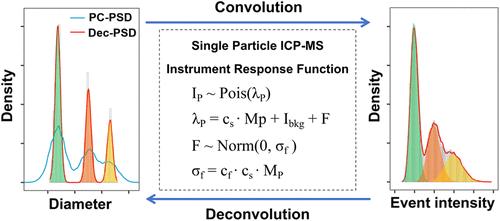
Single-particle inductively coupled plasma mass spectrometry (spICP-MS) is a sensitive and convenient technique for characterizing nanoparticles in suspension, enabling the determination of particle size, particle size distribution (PSD) and particle number concentration (PNC) from time-resolved signals of particle events. Accurate acquisition and modeling of event intensity distributions (EIDs) are critical steps in expanding functionality and improving measurement accuracy. In this work, we explored the broadening factors of EID, establishing and validating a robust instrument response function (IRF) in the form of a mixed Poisson distribution that reliably correlates PSD with EID across varying operating conditions. The EID tailing caused by particle coincidence is quantified and eliminated through Monte Carlo simulations grounded in the homogeneous Poisson process, and then the recovered EID is deconvoluted by IRF to yield high-fidelity PSD, improving the accuracy of PSD and PNC obtained by spICP-MS. For monodisperse gold nanoparticles (AuNPs) and AuNP mixtures, stable PSDs can be recovered from the broadened EIDs by IRF deconvolution, yielding results closely aligned with those obtained by transmission electron microscopy, thus increasing the size resolution to about 7 nm in both simulated and actual samples. The application of IRF to the measurement of nanoparticle agglomerates was also demonstrated, and the probability mass function of agglomeration numbers was successfully resolved. This technique is expected to leverage the high-throughput advantages of spICP-MS in the quantification of nanoparticle mixtures or agglomerates.
期刊介绍:
Analytical Chemistry, a peer-reviewed research journal, focuses on disseminating new and original knowledge across all branches of analytical chemistry. Fundamental articles may explore general principles of chemical measurement science and need not directly address existing or potential analytical methodology. They can be entirely theoretical or report experimental results. Contributions may cover various phases of analytical operations, including sampling, bioanalysis, electrochemistry, mass spectrometry, microscale and nanoscale systems, environmental analysis, separations, spectroscopy, chemical reactions and selectivity, instrumentation, imaging, surface analysis, and data processing. Papers discussing known analytical methods should present a significant, original application of the method, a notable improvement, or results on an important analyte.




 京公网安备 11010802042870号
京ICP备2023020795号-1
京公网安备 11010802042870号
京ICP备2023020795号-1

 分享
分享
 求助内容:
求助内容: 应助结果提醒方式:
 扫码关注我们
