Melinda Nolten, Kay T. Xia, Simone Pezzotti, Gerhard Schwaab, Robert G. Bergman, Kenneth N. Raymond, F. Dean Toste, Teresa Head-Gordon, Wan-Lu Li and Martina Havenith
{"title":"用助溶剂调节主客体包封的自由能","authors":"Melinda Nolten, Kay T. Xia, Simone Pezzotti, Gerhard Schwaab, Robert G. Bergman, Kenneth N. Raymond, F. Dean Toste, Teresa Head-Gordon, Wan-Lu Li and Martina Havenith","doi":"10.1039/D5CP00661A","DOIUrl":null,"url":null,"abstract":"<p >Supramolecular hosts create unique microenvironments which enable the tuning of reactions <em>via</em> steric confinement and electrostatics. It has been shown that “solvent shaping inside hydrophobic cavities” is an important thermodynamic driving force for guest encapsulation in the nanocage host. Here, we show that even small (5%) changes in the solvent composition can have a profound impact on the free energy of encapsulation. In a combined THz, NMR and <em>ab initio</em> MD study, we reveal that the preferential residing of a single DMSO molecule in the cavity upon addition of ≥5% DMSO results in a considerable change of Δ<em>S</em> from 63–76 cal mol<small><sup>−1</sup></small> K<small><sup>−1</sup></small> to 23–24 cal mol<small><sup>−1</sup></small> K<small><sup>−1</sup></small>. This can be rationalized by reduction of the cavity volume due to the DMSO molecule which resides preferentially in the cavity. These results provide novel insights into the guest–binding interactions, emphasizing that the entropic driving force is notably influenced by even small changes in the solvent composition, irrespective of changes in metal ligand vertices. Having demonstrated that the local solvent composition within the cage is essential for regulating catalytic efficiency, solvent tuning might enable novel applications in supramolecular chemistry in catalysis and chemical separation.</p>","PeriodicalId":99,"journal":{"name":"Physical Chemistry Chemical Physics","volume":" 19","pages":" 10120-10128"},"PeriodicalIF":3.0000,"publicationDate":"2025-04-22","publicationTypes":"Journal Article","fieldsOfStudy":null,"isOpenAccess":false,"openAccessPdf":"https://pubs.rsc.org/en/content/articlepdf/2025/cp/d5cp00661a?page=search","citationCount":"0","resultStr":"{\"title\":\"Tuning the free energy of host–guest encapsulation by cosolvent†\",\"authors\":\"Melinda Nolten, Kay T. Xia, Simone Pezzotti, Gerhard Schwaab, Robert G. Bergman, Kenneth N. Raymond, F. Dean Toste, Teresa Head-Gordon, Wan-Lu Li and Martina Havenith\",\"doi\":\"10.1039/D5CP00661A\",\"DOIUrl\":null,\"url\":null,\"abstract\":\"<p >Supramolecular hosts create unique microenvironments which enable the tuning of reactions <em>via</em> steric confinement and electrostatics. It has been shown that “solvent shaping inside hydrophobic cavities” is an important thermodynamic driving force for guest encapsulation in the nanocage host. Here, we show that even small (5%) changes in the solvent composition can have a profound impact on the free energy of encapsulation. In a combined THz, NMR and <em>ab initio</em> MD study, we reveal that the preferential residing of a single DMSO molecule in the cavity upon addition of ≥5% DMSO results in a considerable change of Δ<em>S</em> from 63–76 cal mol<small><sup>−1</sup></small> K<small><sup>−1</sup></small> to 23–24 cal mol<small><sup>−1</sup></small> K<small><sup>−1</sup></small>. This can be rationalized by reduction of the cavity volume due to the DMSO molecule which resides preferentially in the cavity. These results provide novel insights into the guest–binding interactions, emphasizing that the entropic driving force is notably influenced by even small changes in the solvent composition, irrespective of changes in metal ligand vertices. Having demonstrated that the local solvent composition within the cage is essential for regulating catalytic efficiency, solvent tuning might enable novel applications in supramolecular chemistry in catalysis and chemical separation.</p>\",\"PeriodicalId\":99,\"journal\":{\"name\":\"Physical Chemistry Chemical Physics\",\"volume\":\" 19\",\"pages\":\" 10120-10128\"},\"PeriodicalIF\":3.0000,\"publicationDate\":\"2025-04-22\",\"publicationTypes\":\"Journal Article\",\"fieldsOfStudy\":null,\"isOpenAccess\":false,\"openAccessPdf\":\"https://pubs.rsc.org/en/content/articlepdf/2025/cp/d5cp00661a?page=search\",\"citationCount\":\"0\",\"resultStr\":null,\"platform\":\"Semanticscholar\",\"paperid\":null,\"PeriodicalName\":\"Physical Chemistry Chemical Physics\",\"FirstCategoryId\":\"92\",\"ListUrlMain\":\"https://pubs.rsc.org/en/content/articlelanding/2025/cp/d5cp00661a\",\"RegionNum\":3,\"RegionCategory\":\"化学\",\"ArticlePicture\":[],\"TitleCN\":null,\"AbstractTextCN\":null,\"PMCID\":null,\"EPubDate\":\"\",\"PubModel\":\"\",\"JCR\":\"Q3\",\"JCRName\":\"CHEMISTRY, PHYSICAL\",\"Score\":null,\"Total\":0}","platform":"Semanticscholar","paperid":null,"PeriodicalName":"Physical Chemistry Chemical Physics","FirstCategoryId":"92","ListUrlMain":"https://pubs.rsc.org/en/content/articlelanding/2025/cp/d5cp00661a","RegionNum":3,"RegionCategory":"化学","ArticlePicture":[],"TitleCN":null,"AbstractTextCN":null,"PMCID":null,"EPubDate":"","PubModel":"","JCR":"Q3","JCRName":"CHEMISTRY, PHYSICAL","Score":null,"Total":0}
Tuning the free energy of host–guest encapsulation by cosolvent†
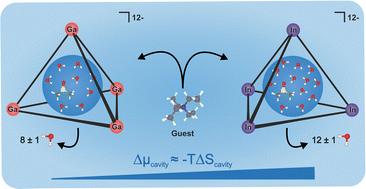
Supramolecular hosts create unique microenvironments which enable the tuning of reactions via steric confinement and electrostatics. It has been shown that “solvent shaping inside hydrophobic cavities” is an important thermodynamic driving force for guest encapsulation in the nanocage host. Here, we show that even small (5%) changes in the solvent composition can have a profound impact on the free energy of encapsulation. In a combined THz, NMR and ab initio MD study, we reveal that the preferential residing of a single DMSO molecule in the cavity upon addition of ≥5% DMSO results in a considerable change of ΔS from 63–76 cal mol−1 K−1 to 23–24 cal mol−1 K−1. This can be rationalized by reduction of the cavity volume due to the DMSO molecule which resides preferentially in the cavity. These results provide novel insights into the guest–binding interactions, emphasizing that the entropic driving force is notably influenced by even small changes in the solvent composition, irrespective of changes in metal ligand vertices. Having demonstrated that the local solvent composition within the cage is essential for regulating catalytic efficiency, solvent tuning might enable novel applications in supramolecular chemistry in catalysis and chemical separation.
期刊介绍:
Physical Chemistry Chemical Physics (PCCP) is an international journal co-owned by 19 physical chemistry and physics societies from around the world. This journal publishes original, cutting-edge research in physical chemistry, chemical physics and biophysical chemistry. To be suitable for publication in PCCP, articles must include significant innovation and/or insight into physical chemistry; this is the most important criterion that reviewers and Editors will judge against when evaluating submissions.
The journal has a broad scope and welcomes contributions spanning experiment, theory, computation and data science. Topical coverage includes spectroscopy, dynamics, kinetics, statistical mechanics, thermodynamics, electrochemistry, catalysis, surface science, quantum mechanics, quantum computing and machine learning. Interdisciplinary research areas such as polymers and soft matter, materials, nanoscience, energy, surfaces/interfaces, and biophysical chemistry are welcomed if they demonstrate significant innovation and/or insight into physical chemistry. Joined experimental/theoretical studies are particularly appreciated when complementary and based on up-to-date approaches.





 京公网安备 11010802042870号
京ICP备2023020795号-1
京公网安备 11010802042870号
京ICP备2023020795号-1

 分享
分享
 求助内容:
求助内容: 应助结果提醒方式:
 扫码关注我们
