{"title":"通过含有苯胺三聚体的界面邻苯二酚-环氧底漆增强钢材在湿热条件下的附着力和耐腐蚀性能","authors":"Yu Xie , Yeping Wu , Xiuli Zhao , Hanbing Ma , Ping Zhang , Yinyu Zhang","doi":"10.1016/j.ces.2025.121715","DOIUrl":null,"url":null,"abstract":"<div><h3>Abstract</h3><div>As the non-covalent interfacial interactions of adhesive-metal bonds are inherently susceptible to disruption by water molecules, bonding structures often culminate in failure under hydrothermal conditions. Herein, we designed a novel primer composed of catechol-based epoxy adhesive containing the aniline trimer, which enhances both the adhesion properties and anti-corrosive performance for ordinary epoxy adhesive. The lap shear strength of Q235 steel coated with EP-AT-CMB increased from 8.36 MPa to 22.07 MPa compared to untreated substrates. Notably, the adhesion strength of Q235 steel coated with EP-AT-CMB remained robust at 14.16 MPa after being immersed in water for 4 days, whereas the untreated samples experienced a near-total loss of adhesion strength. The superior anti-corrosion capability of EP-AT-CMB specimens is attributed to two factors: (1) the high density of hydrogen bonds of the primer/metal interface exhibit a barrier property for water molecules; (2) the electroactivity aniline trimer, which facilitates the formation of a passive film composed of Fe<sub>2</sub>O<sub>3</sub> and Fe<sub>3</sub>O<sub>4</sub>. The synergism between the catechol structure of the primer and the electrochemical behavior of the aniline trimer enhances the durability of the adhesive structure, offering a practical and durable primer material for a wide range of applications.</div></div>","PeriodicalId":271,"journal":{"name":"Chemical Engineering Science","volume":"313 ","pages":"Article 121715"},"PeriodicalIF":5.1000,"publicationDate":"2025-07-01","publicationTypes":"Journal Article","fieldsOfStudy":null,"isOpenAccess":false,"openAccessPdf":"","citationCount":"0","resultStr":"{\"title\":\"Enhanced adhesion and corrosion resistance of steel under hygrothermal conditions through an interfacial catechol-epoxy primer containing aniline trimer\",\"authors\":\"Yu Xie , Yeping Wu , Xiuli Zhao , Hanbing Ma , Ping Zhang , Yinyu Zhang\",\"doi\":\"10.1016/j.ces.2025.121715\",\"DOIUrl\":null,\"url\":null,\"abstract\":\"<div><h3>Abstract</h3><div>As the non-covalent interfacial interactions of adhesive-metal bonds are inherently susceptible to disruption by water molecules, bonding structures often culminate in failure under hydrothermal conditions. Herein, we designed a novel primer composed of catechol-based epoxy adhesive containing the aniline trimer, which enhances both the adhesion properties and anti-corrosive performance for ordinary epoxy adhesive. The lap shear strength of Q235 steel coated with EP-AT-CMB increased from 8.36 MPa to 22.07 MPa compared to untreated substrates. Notably, the adhesion strength of Q235 steel coated with EP-AT-CMB remained robust at 14.16 MPa after being immersed in water for 4 days, whereas the untreated samples experienced a near-total loss of adhesion strength. The superior anti-corrosion capability of EP-AT-CMB specimens is attributed to two factors: (1) the high density of hydrogen bonds of the primer/metal interface exhibit a barrier property for water molecules; (2) the electroactivity aniline trimer, which facilitates the formation of a passive film composed of Fe<sub>2</sub>O<sub>3</sub> and Fe<sub>3</sub>O<sub>4</sub>. The synergism between the catechol structure of the primer and the electrochemical behavior of the aniline trimer enhances the durability of the adhesive structure, offering a practical and durable primer material for a wide range of applications.</div></div>\",\"PeriodicalId\":271,\"journal\":{\"name\":\"Chemical Engineering Science\",\"volume\":\"313 \",\"pages\":\"Article 121715\"},\"PeriodicalIF\":5.1000,\"publicationDate\":\"2025-07-01\",\"publicationTypes\":\"Journal Article\",\"fieldsOfStudy\":null,\"isOpenAccess\":false,\"openAccessPdf\":\"\",\"citationCount\":\"0\",\"resultStr\":null,\"platform\":\"Semanticscholar\",\"paperid\":null,\"PeriodicalName\":\"Chemical Engineering Science\",\"FirstCategoryId\":\"5\",\"ListUrlMain\":\"https://www.sciencedirect.com/science/article/pii/S000925092500538X\",\"RegionNum\":2,\"RegionCategory\":\"工程技术\",\"ArticlePicture\":[],\"TitleCN\":null,\"AbstractTextCN\":null,\"PMCID\":null,\"EPubDate\":\"2025/4/21 0:00:00\",\"PubModel\":\"Epub\",\"JCR\":\"Q2\",\"JCRName\":\"ENGINEERING, CHEMICAL\",\"Score\":null,\"Total\":0}","platform":"Semanticscholar","paperid":null,"PeriodicalName":"Chemical Engineering Science","FirstCategoryId":"5","ListUrlMain":"https://www.sciencedirect.com/science/article/pii/S000925092500538X","RegionNum":2,"RegionCategory":"工程技术","ArticlePicture":[],"TitleCN":null,"AbstractTextCN":null,"PMCID":null,"EPubDate":"2025/4/21 0:00:00","PubModel":"Epub","JCR":"Q2","JCRName":"ENGINEERING, CHEMICAL","Score":null,"Total":0}
Enhanced adhesion and corrosion resistance of steel under hygrothermal conditions through an interfacial catechol-epoxy primer containing aniline trimer
Abstract
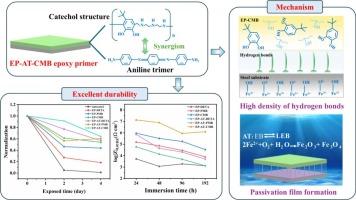
As the non-covalent interfacial interactions of adhesive-metal bonds are inherently susceptible to disruption by water molecules, bonding structures often culminate in failure under hydrothermal conditions. Herein, we designed a novel primer composed of catechol-based epoxy adhesive containing the aniline trimer, which enhances both the adhesion properties and anti-corrosive performance for ordinary epoxy adhesive. The lap shear strength of Q235 steel coated with EP-AT-CMB increased from 8.36 MPa to 22.07 MPa compared to untreated substrates. Notably, the adhesion strength of Q235 steel coated with EP-AT-CMB remained robust at 14.16 MPa after being immersed in water for 4 days, whereas the untreated samples experienced a near-total loss of adhesion strength. The superior anti-corrosion capability of EP-AT-CMB specimens is attributed to two factors: (1) the high density of hydrogen bonds of the primer/metal interface exhibit a barrier property for water molecules; (2) the electroactivity aniline trimer, which facilitates the formation of a passive film composed of Fe2O3 and Fe3O4. The synergism between the catechol structure of the primer and the electrochemical behavior of the aniline trimer enhances the durability of the adhesive structure, offering a practical and durable primer material for a wide range of applications.
期刊介绍:
Chemical engineering enables the transformation of natural resources and energy into useful products for society. It draws on and applies natural sciences, mathematics and economics, and has developed fundamental engineering science that underpins the discipline.
Chemical Engineering Science (CES) has been publishing papers on the fundamentals of chemical engineering since 1951. CES is the platform where the most significant advances in the discipline have ever since been published. Chemical Engineering Science has accompanied and sustained chemical engineering through its development into the vibrant and broad scientific discipline it is today.





 京公网安备 11010802042870号
京ICP备2023020795号-1
京公网安备 11010802042870号
京ICP备2023020795号-1

 分享
分享
 求助内容:
求助内容: 应助结果提醒方式:
 扫码关注我们
