{"title":"烯二炔的c - α - c6热环化","authors":"Haonan Cheng, Wenbo Wang, Yun Zeng, Houjun Zhang, Xiaohua Huang, Fangxu Pu, Xiaofan Zhang, Aiguo Hu, Yun Ding","doi":"10.1021/acs.joc.4c03124","DOIUrl":null,"url":null,"abstract":"Canonical thermal cycloaromatizations (Bergman, C<sup>1</sup>–C<sup>6</sup>; Myers-Saito, C<sup>2</sup>–C<sup>7</sup>; Schmittel, C<sup>2</sup>–C<sup>6</sup>; Schreiner-Pascal, C<sup>1</sup>–C<sup>5</sup>) are limited to the formation of five- or six-membered rings, while the formation of larger rings from enediyne (or enyne-allenes) has no precedent experimental exploration. Herein, we present a novel thermal cyclization of enediyne, leading to the formation of a stable seven-membered cyclization product. The structure of this product was elucidated by using NMR and single-crystal X-ray diffraction techniques. The presence of a maleic hydrazide moiety is postulated to facilitate the proton transfer, resulting in the rearrangement of enediyne to enyne-allene, culminating in ring closure through C<sup>α</sup>–C<sup>6</sup> cyclization. The reaction mechanism was further explored by using density functional theory (DFT), revealing a low activation barrier for the C<sup>α</sup>–C<sup>6</sup> cyclization at 19.6 kcal/mol. The newly formed seven-membered ring exhibits strong Möbius aromaticity, as confirmed by calculations of the nucleus-independent chemical shift (NICS) and anisotropy of the induced current density (ACID). In the subsequent reaction, the fusion of the oxazolidin-2-one ring and the elimination of the isobutene molecule release a significant amount of energy, further driving the formation of the final product.","PeriodicalId":57,"journal":{"name":"Journal of Organic Chemistry","volume":"47 1","pages":""},"PeriodicalIF":3.3000,"publicationDate":"2025-04-22","publicationTypes":"Journal Article","fieldsOfStudy":null,"isOpenAccess":false,"openAccessPdf":"","citationCount":"0","resultStr":"{\"title\":\"Thermal Cα–C6 Cyclization of Enediynes\",\"authors\":\"Haonan Cheng, Wenbo Wang, Yun Zeng, Houjun Zhang, Xiaohua Huang, Fangxu Pu, Xiaofan Zhang, Aiguo Hu, Yun Ding\",\"doi\":\"10.1021/acs.joc.4c03124\",\"DOIUrl\":null,\"url\":null,\"abstract\":\"Canonical thermal cycloaromatizations (Bergman, C<sup>1</sup>–C<sup>6</sup>; Myers-Saito, C<sup>2</sup>–C<sup>7</sup>; Schmittel, C<sup>2</sup>–C<sup>6</sup>; Schreiner-Pascal, C<sup>1</sup>–C<sup>5</sup>) are limited to the formation of five- or six-membered rings, while the formation of larger rings from enediyne (or enyne-allenes) has no precedent experimental exploration. Herein, we present a novel thermal cyclization of enediyne, leading to the formation of a stable seven-membered cyclization product. The structure of this product was elucidated by using NMR and single-crystal X-ray diffraction techniques. The presence of a maleic hydrazide moiety is postulated to facilitate the proton transfer, resulting in the rearrangement of enediyne to enyne-allene, culminating in ring closure through C<sup>α</sup>–C<sup>6</sup> cyclization. The reaction mechanism was further explored by using density functional theory (DFT), revealing a low activation barrier for the C<sup>α</sup>–C<sup>6</sup> cyclization at 19.6 kcal/mol. The newly formed seven-membered ring exhibits strong Möbius aromaticity, as confirmed by calculations of the nucleus-independent chemical shift (NICS) and anisotropy of the induced current density (ACID). In the subsequent reaction, the fusion of the oxazolidin-2-one ring and the elimination of the isobutene molecule release a significant amount of energy, further driving the formation of the final product.\",\"PeriodicalId\":57,\"journal\":{\"name\":\"Journal of Organic Chemistry\",\"volume\":\"47 1\",\"pages\":\"\"},\"PeriodicalIF\":3.3000,\"publicationDate\":\"2025-04-22\",\"publicationTypes\":\"Journal Article\",\"fieldsOfStudy\":null,\"isOpenAccess\":false,\"openAccessPdf\":\"\",\"citationCount\":\"0\",\"resultStr\":null,\"platform\":\"Semanticscholar\",\"paperid\":null,\"PeriodicalName\":\"Journal of Organic Chemistry\",\"FirstCategoryId\":\"1\",\"ListUrlMain\":\"https://doi.org/10.1021/acs.joc.4c03124\",\"RegionNum\":2,\"RegionCategory\":\"化学\",\"ArticlePicture\":[],\"TitleCN\":null,\"AbstractTextCN\":null,\"PMCID\":null,\"EPubDate\":\"\",\"PubModel\":\"\",\"JCR\":\"Q1\",\"JCRName\":\"CHEMISTRY, ORGANIC\",\"Score\":null,\"Total\":0}","platform":"Semanticscholar","paperid":null,"PeriodicalName":"Journal of Organic Chemistry","FirstCategoryId":"1","ListUrlMain":"https://doi.org/10.1021/acs.joc.4c03124","RegionNum":2,"RegionCategory":"化学","ArticlePicture":[],"TitleCN":null,"AbstractTextCN":null,"PMCID":null,"EPubDate":"","PubModel":"","JCR":"Q1","JCRName":"CHEMISTRY, ORGANIC","Score":null,"Total":0}
引用次数: 0
摘要
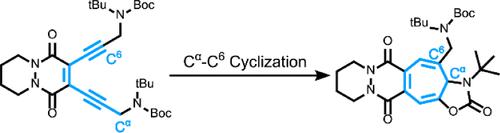
经典的热环芳构化(Bergman,C1-C6;Myers-Saito,C2-C7;Schmittel,C2-C6;Schreiner-Pascal,C1-C5)仅限于形成五元或六元环,而从烯二炔(或烯炔-烯)形成更大的环还没有实验探索的先例。在本文中,我们介绍了一种新型的烯二炔热环化方法,该方法可形成稳定的七元环化产物。利用核磁共振和单晶 X 射线衍射技术阐明了该产物的结构。据推测,马来酰肼分子的存在促进了质子转移,导致烯二炔重排为烯三炔,并最终通过 Cα-C6 环化实现闭环。利用密度泛函理论(DFT)对反应机理进行了进一步探索,发现 Cα-C6 环化的活化势垒很低,仅为 19.6 kcal/mol。核无关化学位移(NICS)和诱导电流密度(ACID)的各向异性计算证实,新形成的七元环具有很强的莫比乌斯芳香性。在随后的反应中,噁唑烷-2-酮环的融合和异丁烯分子的消除释放出大量能量,进一步推动了最终产物的形成。
Canonical thermal cycloaromatizations (Bergman, C1–C6; Myers-Saito, C2–C7; Schmittel, C2–C6; Schreiner-Pascal, C1–C5) are limited to the formation of five- or six-membered rings, while the formation of larger rings from enediyne (or enyne-allenes) has no precedent experimental exploration. Herein, we present a novel thermal cyclization of enediyne, leading to the formation of a stable seven-membered cyclization product. The structure of this product was elucidated by using NMR and single-crystal X-ray diffraction techniques. The presence of a maleic hydrazide moiety is postulated to facilitate the proton transfer, resulting in the rearrangement of enediyne to enyne-allene, culminating in ring closure through Cα–C6 cyclization. The reaction mechanism was further explored by using density functional theory (DFT), revealing a low activation barrier for the Cα–C6 cyclization at 19.6 kcal/mol. The newly formed seven-membered ring exhibits strong Möbius aromaticity, as confirmed by calculations of the nucleus-independent chemical shift (NICS) and anisotropy of the induced current density (ACID). In the subsequent reaction, the fusion of the oxazolidin-2-one ring and the elimination of the isobutene molecule release a significant amount of energy, further driving the formation of the final product.
期刊介绍:
Journal of Organic Chemistry welcomes original contributions of fundamental research in all branches of the theory and practice of organic chemistry. In selecting manuscripts for publication, the editors place emphasis on the quality and novelty of the work, as well as the breadth of interest to the organic chemistry community.




 京公网安备 11010802042870号
京ICP备2023020795号-1
京公网安备 11010802042870号
京ICP备2023020795号-1

 分享
分享
 求助内容:
求助内容: 应助结果提醒方式:
 扫码关注我们
