Syamasrit Dash, Arnaud Fihey, Ludovic Favereau, Corinne Lagrost, Rajaa Benchouaia, Sébastien Blanchard, Mickaël Ménand, Stéphane Le Gac
{"title":"在图腾结构中编码和表达莫比乌斯 π 系统的手性","authors":"Syamasrit Dash, Arnaud Fihey, Ludovic Favereau, Corinne Lagrost, Rajaa Benchouaia, Sébastien Blanchard, Mickaël Ménand, Stéphane Le Gac","doi":"10.1021/jacs.5c00524","DOIUrl":null,"url":null,"abstract":"The efficient control of the chirality of Möbius π systems remains a challenging task that hinders the development of such molecules into information processing systems. Achieving such control through a redox process would thus open new opportunities. In this context, redox behaviors of Ni(II) and Pd(II) complexes of a Möbius aromatic [28]hexaphyrin doubly linked to an α-cyclodextrin have been investigated. This totemic architecture embedding three types of chirality elements generates two pseudoenantiomers after coordination with either metal. These isomeric pairs possess marked and opposite chiroptical signatures resulting from the <i>P</i> and <i>M</i> configurations of the Möbius π systems. Chemical oxidation to 26-π systems led to behaviors reminiscent to <i>The Oak and the Reeds</i> fable, due to a N3C coordination sphere of Ni(II) being more robust than that of Pd(II). Oxidized Ni(II) complexes (<i>the Oak</i>) maintain a Möbius-type conformation at the expense of the π-systems, which undergo an interruption due to inevitable water insertion. In contrast, oxidation of Pd(II) complexes (<i>the Reeds</i>) converts the Möbius aromatic systems into Hückel (rectangular) aromatic ones that are maintained in the chiral environment provided by the linking pattern with the cyclodextrin. This constitutes an effective chiral instructing site, as reduction back to their original Möbius configuration occurs with high stereoselectivity. Such a reversible shape-shifting process corresponds to a chiral memory phenomenon where the handedness of a cyclic π system is encoded in a scaffold and expressed upon changing an electronic state. For both metals, spectroelectrochemical studies ultimately revealed robust ON-OFF chiroptical switches, which is unprecedented with Möbius π-systems.","PeriodicalId":49,"journal":{"name":"Journal of the American Chemical Society","volume":"38 1","pages":""},"PeriodicalIF":16.6000,"publicationDate":"2025-04-22","publicationTypes":"Journal Article","fieldsOfStudy":null,"isOpenAccess":false,"openAccessPdf":"","citationCount":"0","resultStr":"{\"title\":\"Encoding and Expressing the Handedness of a Möbius π System in a Totemic Architecture\",\"authors\":\"Syamasrit Dash, Arnaud Fihey, Ludovic Favereau, Corinne Lagrost, Rajaa Benchouaia, Sébastien Blanchard, Mickaël Ménand, Stéphane Le Gac\",\"doi\":\"10.1021/jacs.5c00524\",\"DOIUrl\":null,\"url\":null,\"abstract\":\"The efficient control of the chirality of Möbius π systems remains a challenging task that hinders the development of such molecules into information processing systems. Achieving such control through a redox process would thus open new opportunities. In this context, redox behaviors of Ni(II) and Pd(II) complexes of a Möbius aromatic [28]hexaphyrin doubly linked to an α-cyclodextrin have been investigated. This totemic architecture embedding three types of chirality elements generates two pseudoenantiomers after coordination with either metal. These isomeric pairs possess marked and opposite chiroptical signatures resulting from the <i>P</i> and <i>M</i> configurations of the Möbius π systems. Chemical oxidation to 26-π systems led to behaviors reminiscent to <i>The Oak and the Reeds</i> fable, due to a N3C coordination sphere of Ni(II) being more robust than that of Pd(II). Oxidized Ni(II) complexes (<i>the Oak</i>) maintain a Möbius-type conformation at the expense of the π-systems, which undergo an interruption due to inevitable water insertion. In contrast, oxidation of Pd(II) complexes (<i>the Reeds</i>) converts the Möbius aromatic systems into Hückel (rectangular) aromatic ones that are maintained in the chiral environment provided by the linking pattern with the cyclodextrin. This constitutes an effective chiral instructing site, as reduction back to their original Möbius configuration occurs with high stereoselectivity. Such a reversible shape-shifting process corresponds to a chiral memory phenomenon where the handedness of a cyclic π system is encoded in a scaffold and expressed upon changing an electronic state. For both metals, spectroelectrochemical studies ultimately revealed robust ON-OFF chiroptical switches, which is unprecedented with Möbius π-systems.\",\"PeriodicalId\":49,\"journal\":{\"name\":\"Journal of the American Chemical Society\",\"volume\":\"38 1\",\"pages\":\"\"},\"PeriodicalIF\":16.6000,\"publicationDate\":\"2025-04-22\",\"publicationTypes\":\"Journal Article\",\"fieldsOfStudy\":null,\"isOpenAccess\":false,\"openAccessPdf\":\"\",\"citationCount\":\"0\",\"resultStr\":null,\"platform\":\"Semanticscholar\",\"paperid\":null,\"PeriodicalName\":\"Journal of the American Chemical Society\",\"FirstCategoryId\":\"92\",\"ListUrlMain\":\"https://doi.org/10.1021/jacs.5c00524\",\"RegionNum\":1,\"RegionCategory\":\"化学\",\"ArticlePicture\":[],\"TitleCN\":null,\"AbstractTextCN\":null,\"PMCID\":null,\"EPubDate\":\"\",\"PubModel\":\"\",\"JCR\":\"Q1\",\"JCRName\":\"CHEMISTRY, MULTIDISCIPLINARY\",\"Score\":null,\"Total\":0}","platform":"Semanticscholar","paperid":null,"PeriodicalName":"Journal of the American Chemical Society","FirstCategoryId":"92","ListUrlMain":"https://doi.org/10.1021/jacs.5c00524","RegionNum":1,"RegionCategory":"化学","ArticlePicture":[],"TitleCN":null,"AbstractTextCN":null,"PMCID":null,"EPubDate":"","PubModel":"","JCR":"Q1","JCRName":"CHEMISTRY, MULTIDISCIPLINARY","Score":null,"Total":0}
Encoding and Expressing the Handedness of a Möbius π System in a Totemic Architecture
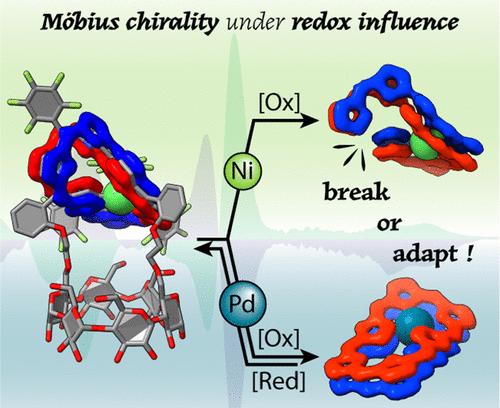
The efficient control of the chirality of Möbius π systems remains a challenging task that hinders the development of such molecules into information processing systems. Achieving such control through a redox process would thus open new opportunities. In this context, redox behaviors of Ni(II) and Pd(II) complexes of a Möbius aromatic [28]hexaphyrin doubly linked to an α-cyclodextrin have been investigated. This totemic architecture embedding three types of chirality elements generates two pseudoenantiomers after coordination with either metal. These isomeric pairs possess marked and opposite chiroptical signatures resulting from the P and M configurations of the Möbius π systems. Chemical oxidation to 26-π systems led to behaviors reminiscent to The Oak and the Reeds fable, due to a N3C coordination sphere of Ni(II) being more robust than that of Pd(II). Oxidized Ni(II) complexes (the Oak) maintain a Möbius-type conformation at the expense of the π-systems, which undergo an interruption due to inevitable water insertion. In contrast, oxidation of Pd(II) complexes (the Reeds) converts the Möbius aromatic systems into Hückel (rectangular) aromatic ones that are maintained in the chiral environment provided by the linking pattern with the cyclodextrin. This constitutes an effective chiral instructing site, as reduction back to their original Möbius configuration occurs with high stereoselectivity. Such a reversible shape-shifting process corresponds to a chiral memory phenomenon where the handedness of a cyclic π system is encoded in a scaffold and expressed upon changing an electronic state. For both metals, spectroelectrochemical studies ultimately revealed robust ON-OFF chiroptical switches, which is unprecedented with Möbius π-systems.
期刊介绍:
The flagship journal of the American Chemical Society, known as the Journal of the American Chemical Society (JACS), has been a prestigious publication since its establishment in 1879. It holds a preeminent position in the field of chemistry and related interdisciplinary sciences. JACS is committed to disseminating cutting-edge research papers, covering a wide range of topics, and encompasses approximately 19,000 pages of Articles, Communications, and Perspectives annually. With a weekly publication frequency, JACS plays a vital role in advancing the field of chemistry by providing essential research.




 京公网安备 11010802042870号
京ICP备2023020795号-1
京公网安备 11010802042870号
京ICP备2023020795号-1

 分享
分享
 求助内容:
求助内容: 应助结果提醒方式:
 扫码关注我们
