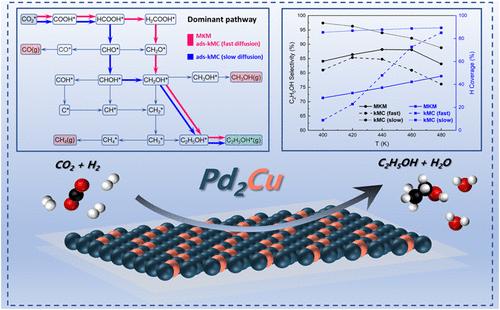
{"title":"Pd2Cu(110)上CO2加氢制乙醇的动力学模拟","authors":"Yongjie Jiang, Hui Guo, Feng Cheng, Zhao-Xu Chen","doi":"10.1021/acs.jpcc.4c08652","DOIUrl":null,"url":null,"abstract":"Conversion of CO<sub>2</sub> to ethanol is a potential method for carbon capture and utilization. Among various catalysts for this reaction, Pd<sub>2</sub>Cu is found to have high activity and selectivity. In this paper, we investigated the reaction mechanism using mean-field microkinetic modeling (MF-MKM) and kinetic Monte Carlo (kMC) simulations. To overcome the stiffness problem caused by the significant difference in time scales of different events in kMC simulation, we employed the ads-kMC algorithm proposed in our previous work, in which the adsorption/desorption/reaction rate constants were reduced under certain requirements and the diffusion process was treated by redistributing surface species each time an event occurs. Both methods show similar surface coverage, i.e., the surface is fully covered by H and CO and exhibits high selectivity for ethanol. This study also compares the effect of species diffusion rates on the kMC simulations. The results show that the diffusion rate changes the reaction mechanism and coverage, and under slow diffusion case the kMC predicted selectivity is higher than that under fast diffusion. The present study sheds light on the mechanism of CO<sub>2</sub> hydrogenation to ethanol on Pd<sub>2</sub>Cu catalyst, deepens the understanding of kMC and MF-MKM simulations, and examines the influence of species diffusion on reaction kinetics.","PeriodicalId":61,"journal":{"name":"The Journal of Physical Chemistry C","volume":"43 1","pages":""},"PeriodicalIF":3.4000,"publicationDate":"2025-04-22","publicationTypes":"Journal Article","fieldsOfStudy":null,"isOpenAccess":false,"openAccessPdf":"","citationCount":"0","resultStr":"{\"title\":\"Kinetic Simulations of CO2 Hydrogenation to Ethanol on Pd2Cu (110)\",\"authors\":\"Yongjie Jiang, Hui Guo, Feng Cheng, Zhao-Xu Chen\",\"doi\":\"10.1021/acs.jpcc.4c08652\",\"DOIUrl\":null,\"url\":null,\"abstract\":\"Conversion of CO<sub>2</sub> to ethanol is a potential method for carbon capture and utilization. Among various catalysts for this reaction, Pd<sub>2</sub>Cu is found to have high activity and selectivity. In this paper, we investigated the reaction mechanism using mean-field microkinetic modeling (MF-MKM) and kinetic Monte Carlo (kMC) simulations. To overcome the stiffness problem caused by the significant difference in time scales of different events in kMC simulation, we employed the ads-kMC algorithm proposed in our previous work, in which the adsorption/desorption/reaction rate constants were reduced under certain requirements and the diffusion process was treated by redistributing surface species each time an event occurs. Both methods show similar surface coverage, i.e., the surface is fully covered by H and CO and exhibits high selectivity for ethanol. This study also compares the effect of species diffusion rates on the kMC simulations. The results show that the diffusion rate changes the reaction mechanism and coverage, and under slow diffusion case the kMC predicted selectivity is higher than that under fast diffusion. The present study sheds light on the mechanism of CO<sub>2</sub> hydrogenation to ethanol on Pd<sub>2</sub>Cu catalyst, deepens the understanding of kMC and MF-MKM simulations, and examines the influence of species diffusion on reaction kinetics.\",\"PeriodicalId\":61,\"journal\":{\"name\":\"The Journal of Physical Chemistry C\",\"volume\":\"43 1\",\"pages\":\"\"},\"PeriodicalIF\":3.4000,\"publicationDate\":\"2025-04-22\",\"publicationTypes\":\"Journal Article\",\"fieldsOfStudy\":null,\"isOpenAccess\":false,\"openAccessPdf\":\"\",\"citationCount\":\"0\",\"resultStr\":null,\"platform\":\"Semanticscholar\",\"paperid\":null,\"PeriodicalName\":\"The Journal of Physical Chemistry C\",\"FirstCategoryId\":\"1\",\"ListUrlMain\":\"https://doi.org/10.1021/acs.jpcc.4c08652\",\"RegionNum\":3,\"RegionCategory\":\"化学\",\"ArticlePicture\":[],\"TitleCN\":null,\"AbstractTextCN\":null,\"PMCID\":null,\"EPubDate\":\"\",\"PubModel\":\"\",\"JCR\":\"Q2\",\"JCRName\":\"CHEMISTRY, PHYSICAL\",\"Score\":null,\"Total\":0}","platform":"Semanticscholar","paperid":null,"PeriodicalName":"The Journal of Physical Chemistry C","FirstCategoryId":"1","ListUrlMain":"https://doi.org/10.1021/acs.jpcc.4c08652","RegionNum":3,"RegionCategory":"化学","ArticlePicture":[],"TitleCN":null,"AbstractTextCN":null,"PMCID":null,"EPubDate":"","PubModel":"","JCR":"Q2","JCRName":"CHEMISTRY, PHYSICAL","Score":null,"Total":0}
引用次数: 0
摘要
将二氧化碳转化为乙醇是一种潜在的碳捕获和利用方法。在该反应的各种催化剂中,Pd2Cu 被认为具有较高的活性和选择性。本文采用均场微动力学建模(MF-MKM)和动力学蒙特卡罗(kMC)模拟研究了反应机理。为了克服 kMC 模拟中不同事件的时间尺度差异较大所导致的僵化问题,我们采用了之前工作中提出的 ads-kMC 算法,即在一定要求下降低吸附/解吸/反应速率常数,并在每次事件发生时通过重新分配表面物种来处理扩散过程。两种方法都显示出相似的表面覆盖率,即表面被 H 和 CO 完全覆盖,并对乙醇表现出高选择性。本研究还比较了物种扩散率对 kMC 模拟的影响。结果表明,扩散速率会改变反应机制和覆盖率,在慢扩散情况下,kMC 预测的选择性高于快扩散情况下的选择性。本研究揭示了 Pd2Cu 催化剂上 CO2 加氢制乙醇的机理,加深了对 kMC 和 MF-MKM 模拟的理解,并考察了物种扩散对反应动力学的影响。
Kinetic Simulations of CO2 Hydrogenation to Ethanol on Pd2Cu (110)
Conversion of CO2 to ethanol is a potential method for carbon capture and utilization. Among various catalysts for this reaction, Pd2Cu is found to have high activity and selectivity. In this paper, we investigated the reaction mechanism using mean-field microkinetic modeling (MF-MKM) and kinetic Monte Carlo (kMC) simulations. To overcome the stiffness problem caused by the significant difference in time scales of different events in kMC simulation, we employed the ads-kMC algorithm proposed in our previous work, in which the adsorption/desorption/reaction rate constants were reduced under certain requirements and the diffusion process was treated by redistributing surface species each time an event occurs. Both methods show similar surface coverage, i.e., the surface is fully covered by H and CO and exhibits high selectivity for ethanol. This study also compares the effect of species diffusion rates on the kMC simulations. The results show that the diffusion rate changes the reaction mechanism and coverage, and under slow diffusion case the kMC predicted selectivity is higher than that under fast diffusion. The present study sheds light on the mechanism of CO2 hydrogenation to ethanol on Pd2Cu catalyst, deepens the understanding of kMC and MF-MKM simulations, and examines the influence of species diffusion on reaction kinetics.
期刊介绍:
The Journal of Physical Chemistry A/B/C is devoted to reporting new and original experimental and theoretical basic research of interest to physical chemists, biophysical chemists, and chemical physicists.




 京公网安备 11010802042870号
京ICP备2023020795号-1
京公网安备 11010802042870号
京ICP备2023020795号-1

 分享
分享
 求助内容:
求助内容: 应助结果提醒方式:
 扫码关注我们
