Chunlei Xuan , Xihang Yan , Jun Xiong , Yao Wu , Gazi Hao , Wei Jiang , Jun Di
{"title":"改善NO3−到nh3光还原†的界面极化不对称tis101n2位点","authors":"Chunlei Xuan , Xihang Yan , Jun Xiong , Yao Wu , Gazi Hao , Wei Jiang , Jun Di","doi":"10.1039/d5gc00516g","DOIUrl":null,"url":null,"abstract":"<div><div>The efficiency of photocatalytic ammonia production is limited by insufficient active sites and sluggish interfacial charge transfer in photocatalysts. To address this, a titano-oxide phthalocyanine monatomic layer (TiOPc) is modified onto the face-centered cubic structured CdIn<sub>2</sub>S<sub>4</sub><em>via</em> a hydrothermal process, significantly increasing the number of active sites. The close proximity of CdIn<sub>2</sub>S<sub>4</sub> and TiOPc creates a local interface with an asymmetric configuration, resulting in a pronounced potential difference and an electron-rich TiS<sub>1</sub>O<sub>1</sub>N<sub>2</sub> polarization site. This configuration facilitates rapid charge transport between the two materials through the interfacial Ti–S bond. Profiting from these properties, TiOPc/CdIn<sub>2</sub>S<sub>4</sub> delivers an impressive NH<sub>3</sub> formation rate of 2572.8 μmol g<sup>−1</sup> h<sup>−1</sup> and an apparent quantum efficiency achieving 7.16%, 6.86%, 4.12%, 2.13%, 1.86% and 1.15% at 400, 450, 500, 550, 650 and 700 nm, respectively. This study offers a practical method for designing symmetry breaking structures and establishing strongly coupled interfaces to enhance photocatalytic performance.</div></div>","PeriodicalId":78,"journal":{"name":"Green Chemistry","volume":"27 17","pages":"Pages 4742-4749"},"PeriodicalIF":9.2000,"publicationDate":"2025-03-20","publicationTypes":"Journal Article","fieldsOfStudy":null,"isOpenAccess":false,"openAccessPdf":"","citationCount":"0","resultStr":"{\"title\":\"Asymmetric TiS1O1N2 site for interfacial polarization with improved NO3−-to-NH3 photoreduction†\",\"authors\":\"Chunlei Xuan , Xihang Yan , Jun Xiong , Yao Wu , Gazi Hao , Wei Jiang , Jun Di\",\"doi\":\"10.1039/d5gc00516g\",\"DOIUrl\":null,\"url\":null,\"abstract\":\"<div><div>The efficiency of photocatalytic ammonia production is limited by insufficient active sites and sluggish interfacial charge transfer in photocatalysts. To address this, a titano-oxide phthalocyanine monatomic layer (TiOPc) is modified onto the face-centered cubic structured CdIn<sub>2</sub>S<sub>4</sub><em>via</em> a hydrothermal process, significantly increasing the number of active sites. The close proximity of CdIn<sub>2</sub>S<sub>4</sub> and TiOPc creates a local interface with an asymmetric configuration, resulting in a pronounced potential difference and an electron-rich TiS<sub>1</sub>O<sub>1</sub>N<sub>2</sub> polarization site. This configuration facilitates rapid charge transport between the two materials through the interfacial Ti–S bond. Profiting from these properties, TiOPc/CdIn<sub>2</sub>S<sub>4</sub> delivers an impressive NH<sub>3</sub> formation rate of 2572.8 μmol g<sup>−1</sup> h<sup>−1</sup> and an apparent quantum efficiency achieving 7.16%, 6.86%, 4.12%, 2.13%, 1.86% and 1.15% at 400, 450, 500, 550, 650 and 700 nm, respectively. This study offers a practical method for designing symmetry breaking structures and establishing strongly coupled interfaces to enhance photocatalytic performance.</div></div>\",\"PeriodicalId\":78,\"journal\":{\"name\":\"Green Chemistry\",\"volume\":\"27 17\",\"pages\":\"Pages 4742-4749\"},\"PeriodicalIF\":9.2000,\"publicationDate\":\"2025-03-20\",\"publicationTypes\":\"Journal Article\",\"fieldsOfStudy\":null,\"isOpenAccess\":false,\"openAccessPdf\":\"\",\"citationCount\":\"0\",\"resultStr\":null,\"platform\":\"Semanticscholar\",\"paperid\":null,\"PeriodicalName\":\"Green Chemistry\",\"FirstCategoryId\":\"92\",\"ListUrlMain\":\"https://www.sciencedirect.com/org/science/article/pii/S146392622500233X\",\"RegionNum\":1,\"RegionCategory\":\"化学\",\"ArticlePicture\":[],\"TitleCN\":null,\"AbstractTextCN\":null,\"PMCID\":null,\"EPubDate\":\"2025/3/25 0:00:00\",\"PubModel\":\"Epub\",\"JCR\":\"Q1\",\"JCRName\":\"CHEMISTRY, MULTIDISCIPLINARY\",\"Score\":null,\"Total\":0}","platform":"Semanticscholar","paperid":null,"PeriodicalName":"Green Chemistry","FirstCategoryId":"92","ListUrlMain":"https://www.sciencedirect.com/org/science/article/pii/S146392622500233X","RegionNum":1,"RegionCategory":"化学","ArticlePicture":[],"TitleCN":null,"AbstractTextCN":null,"PMCID":null,"EPubDate":"2025/3/25 0:00:00","PubModel":"Epub","JCR":"Q1","JCRName":"CHEMISTRY, MULTIDISCIPLINARY","Score":null,"Total":0}
Asymmetric TiS1O1N2 site for interfacial polarization with improved NO3−-to-NH3 photoreduction†
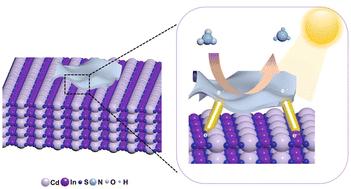
The efficiency of photocatalytic ammonia production is limited by insufficient active sites and sluggish interfacial charge transfer in photocatalysts. To address this, a titano-oxide phthalocyanine monatomic layer (TiOPc) is modified onto the face-centered cubic structured CdIn2S4via a hydrothermal process, significantly increasing the number of active sites. The close proximity of CdIn2S4 and TiOPc creates a local interface with an asymmetric configuration, resulting in a pronounced potential difference and an electron-rich TiS1O1N2 polarization site. This configuration facilitates rapid charge transport between the two materials through the interfacial Ti–S bond. Profiting from these properties, TiOPc/CdIn2S4 delivers an impressive NH3 formation rate of 2572.8 μmol g−1 h−1 and an apparent quantum efficiency achieving 7.16%, 6.86%, 4.12%, 2.13%, 1.86% and 1.15% at 400, 450, 500, 550, 650 and 700 nm, respectively. This study offers a practical method for designing symmetry breaking structures and establishing strongly coupled interfaces to enhance photocatalytic performance.
期刊介绍:
Green Chemistry is a journal that provides a unique forum for the publication of innovative research on the development of alternative green and sustainable technologies. The scope of Green Chemistry is based on the definition proposed by Anastas and Warner (Green Chemistry: Theory and Practice, P T Anastas and J C Warner, Oxford University Press, Oxford, 1998), which defines green chemistry as the utilisation of a set of principles that reduces or eliminates the use or generation of hazardous substances in the design, manufacture and application of chemical products. Green Chemistry aims to reduce the environmental impact of the chemical enterprise by developing a technology base that is inherently non-toxic to living things and the environment. The journal welcomes submissions on all aspects of research relating to this endeavor and publishes original and significant cutting-edge research that is likely to be of wide general appeal. For a work to be published, it must present a significant advance in green chemistry, including a comparison with existing methods and a demonstration of advantages over those methods.




 京公网安备 11010802042870号
京ICP备2023020795号-1
京公网安备 11010802042870号
京ICP备2023020795号-1

 分享
分享
 求助内容:
求助内容: 应助结果提醒方式:
 扫码关注我们
