Sijun Lu, Fengyi Zhang, Hongliang Xu, Xiang Huang, Kun Zhang, Yaxin Wang, Yongjun Zhang and Xiaoyu Zhao
{"title":"拓扑效应对二甲基二氢芘/环苯二烯光开关非线性光学性质的理论研究","authors":"Sijun Lu, Fengyi Zhang, Hongliang Xu, Xiang Huang, Kun Zhang, Yaxin Wang, Yongjun Zhang and Xiaoyu Zhao","doi":"10.1039/D5NJ00798D","DOIUrl":null,"url":null,"abstract":"<p >The isomerization between dimethyldihydropyrene (DHP) and cyclophanediene (CPD) generates a potential molecular switch, while topological regulation can provide an effective strategy to tune its optical response and switching efficiency. In this work, we twisted a fused pyridine structure into three topological configurations, namely, Hückel, Möbius and twisted-Hückel (<em>t</em>-Hückel), and integrated them at both ends of a DHP/CPD switch. By theoretical calculation, we determined the effect of topological characteristics on the molecular structure, electronic state and optical properties of these configurations. Especially for Hückel and Möbius molecules, CPD was in a closed-shell state, and DHP showed a diradical property. However, for <em>t</em>-Hückel molecules, CPD and DHP were both in open-shell singlet states. The topological effect was significant on absorption intensity in the 200–500 nm range for both the open- and closed-ring structures. Within the framework of Hückel, <em>β</em><small><sub>tot</sub></small> gradually decreased from Möbius to <em>t</em>-Hückel for closed-ring structures as the degree of twisting of the pyridine ring increased, but an opposite tendency was noted in open-ring systems. Consequently, the Hückel-type switches demonstrated high efficiency, with a <em>β</em>(C)/<em>β</em>(O) ratio of 12.6. The DHP derivative with Hückel-type molecules exhibited the best nonlinear optical response due to the highly conjugated structure with the largest first-order hyperpolarizability of the closed-ring structure (<em>β</em><small><sub>tot</sub></small> = 3.17 × 10<small><sup>4</sup></small> a.u.). This work highlights the crucial role of the topological structure in regulating the performance of switch molecules and provides insights for the design of switch molecules with unique topological structures.</p>","PeriodicalId":95,"journal":{"name":"New Journal of Chemistry","volume":" 17","pages":" 7073-7080"},"PeriodicalIF":2.5000,"publicationDate":"2025-03-24","publicationTypes":"Journal Article","fieldsOfStudy":null,"isOpenAccess":false,"openAccessPdf":"","citationCount":"0","resultStr":"{\"title\":\"Theoretical study of the topological effect on the nonlinear optical properties of a dimethyldihydropyrene/cyclophanediene photoswitch†\",\"authors\":\"Sijun Lu, Fengyi Zhang, Hongliang Xu, Xiang Huang, Kun Zhang, Yaxin Wang, Yongjun Zhang and Xiaoyu Zhao\",\"doi\":\"10.1039/D5NJ00798D\",\"DOIUrl\":null,\"url\":null,\"abstract\":\"<p >The isomerization between dimethyldihydropyrene (DHP) and cyclophanediene (CPD) generates a potential molecular switch, while topological regulation can provide an effective strategy to tune its optical response and switching efficiency. In this work, we twisted a fused pyridine structure into three topological configurations, namely, Hückel, Möbius and twisted-Hückel (<em>t</em>-Hückel), and integrated them at both ends of a DHP/CPD switch. By theoretical calculation, we determined the effect of topological characteristics on the molecular structure, electronic state and optical properties of these configurations. Especially for Hückel and Möbius molecules, CPD was in a closed-shell state, and DHP showed a diradical property. However, for <em>t</em>-Hückel molecules, CPD and DHP were both in open-shell singlet states. The topological effect was significant on absorption intensity in the 200–500 nm range for both the open- and closed-ring structures. Within the framework of Hückel, <em>β</em><small><sub>tot</sub></small> gradually decreased from Möbius to <em>t</em>-Hückel for closed-ring structures as the degree of twisting of the pyridine ring increased, but an opposite tendency was noted in open-ring systems. Consequently, the Hückel-type switches demonstrated high efficiency, with a <em>β</em>(C)/<em>β</em>(O) ratio of 12.6. The DHP derivative with Hückel-type molecules exhibited the best nonlinear optical response due to the highly conjugated structure with the largest first-order hyperpolarizability of the closed-ring structure (<em>β</em><small><sub>tot</sub></small> = 3.17 × 10<small><sup>4</sup></small> a.u.). This work highlights the crucial role of the topological structure in regulating the performance of switch molecules and provides insights for the design of switch molecules with unique topological structures.</p>\",\"PeriodicalId\":95,\"journal\":{\"name\":\"New Journal of Chemistry\",\"volume\":\" 17\",\"pages\":\" 7073-7080\"},\"PeriodicalIF\":2.5000,\"publicationDate\":\"2025-03-24\",\"publicationTypes\":\"Journal Article\",\"fieldsOfStudy\":null,\"isOpenAccess\":false,\"openAccessPdf\":\"\",\"citationCount\":\"0\",\"resultStr\":null,\"platform\":\"Semanticscholar\",\"paperid\":null,\"PeriodicalName\":\"New Journal of Chemistry\",\"FirstCategoryId\":\"92\",\"ListUrlMain\":\"https://pubs.rsc.org/en/content/articlelanding/2025/nj/d5nj00798d\",\"RegionNum\":3,\"RegionCategory\":\"化学\",\"ArticlePicture\":[],\"TitleCN\":null,\"AbstractTextCN\":null,\"PMCID\":null,\"EPubDate\":\"\",\"PubModel\":\"\",\"JCR\":\"Q2\",\"JCRName\":\"CHEMISTRY, MULTIDISCIPLINARY\",\"Score\":null,\"Total\":0}","platform":"Semanticscholar","paperid":null,"PeriodicalName":"New Journal of Chemistry","FirstCategoryId":"92","ListUrlMain":"https://pubs.rsc.org/en/content/articlelanding/2025/nj/d5nj00798d","RegionNum":3,"RegionCategory":"化学","ArticlePicture":[],"TitleCN":null,"AbstractTextCN":null,"PMCID":null,"EPubDate":"","PubModel":"","JCR":"Q2","JCRName":"CHEMISTRY, MULTIDISCIPLINARY","Score":null,"Total":0}
引用次数: 0
摘要
二甲基二氢芘(DHP)和环phanediene (CPD)之间的异构化产生了潜在的分子开关,而拓扑调节可以提供有效的策略来调节其光响应和开关效率。在这项工作中,我们将一个熔融吡啶结构扭曲成三种拓扑构型,即h ckel, Möbius和扭曲的h ckel (t- h ckel),并将它们集成在DHP/CPD开关的两端。通过理论计算,我们确定了拓扑特征对这些构型的分子结构、电子态和光学性质的影响。特别是h ckel和Möbius分子,CPD处于闭壳态,DHP表现为双自由基性质。而对于t- h ckel分子,CPD和DHP都处于开壳单重态。拓扑效应对开环和闭环结构在200 ~ 500 nm范围内的吸收强度有显著影响。在h ckel框架内,随着吡啶环扭转程度的增加,闭环结构的βtot从Möbius逐渐减小到t- h ckel,而开环结构的βtot则相反。因此,h kkel型开关显示出高效率,β(C)/β(O)比为12.6。具有h kkel型分子的DHP衍生物由于其高共轭结构和最大的一阶超极化率(βtot = 3.17 × 10⁴ a.u)而表现出最好的非线性光学响应。这项工作强调了拓扑结构在调节开关分子性能中的关键作用,并为具有独特拓扑结构的开关分子的设计提供了见解。
Theoretical study of the topological effect on the nonlinear optical properties of a dimethyldihydropyrene/cyclophanediene photoswitch†
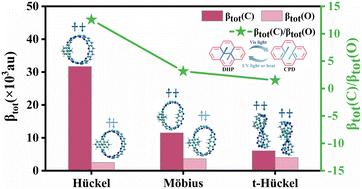
The isomerization between dimethyldihydropyrene (DHP) and cyclophanediene (CPD) generates a potential molecular switch, while topological regulation can provide an effective strategy to tune its optical response and switching efficiency. In this work, we twisted a fused pyridine structure into three topological configurations, namely, Hückel, Möbius and twisted-Hückel (t-Hückel), and integrated them at both ends of a DHP/CPD switch. By theoretical calculation, we determined the effect of topological characteristics on the molecular structure, electronic state and optical properties of these configurations. Especially for Hückel and Möbius molecules, CPD was in a closed-shell state, and DHP showed a diradical property. However, for t-Hückel molecules, CPD and DHP were both in open-shell singlet states. The topological effect was significant on absorption intensity in the 200–500 nm range for both the open- and closed-ring structures. Within the framework of Hückel, βtot gradually decreased from Möbius to t-Hückel for closed-ring structures as the degree of twisting of the pyridine ring increased, but an opposite tendency was noted in open-ring systems. Consequently, the Hückel-type switches demonstrated high efficiency, with a β(C)/β(O) ratio of 12.6. The DHP derivative with Hückel-type molecules exhibited the best nonlinear optical response due to the highly conjugated structure with the largest first-order hyperpolarizability of the closed-ring structure (βtot = 3.17 × 10⁴ a.u.). This work highlights the crucial role of the topological structure in regulating the performance of switch molecules and provides insights for the design of switch molecules with unique topological structures.




 京公网安备 11010802042870号
京ICP备2023020795号-1
京公网安备 11010802042870号
京ICP备2023020795号-1

 分享
分享
 求助内容:
求助内容: 应助结果提醒方式:
 扫码关注我们
