Yuanting Dai , Qiang Xia , Zijun Mao , Junjie Mu , Feng Peng , Xiang Hao
{"title":"可持续的生物塑料建立在d-木糖核心:从备份到中心舞台","authors":"Yuanting Dai , Qiang Xia , Zijun Mao , Junjie Mu , Feng Peng , Xiang Hao","doi":"10.1039/d4gc06578f","DOIUrl":null,"url":null,"abstract":"<div><div>The widespread use of petroleum-based plastics has led to severe environmental pollution due to their poor biodegradability and the accumulation of plastic waste. As a promising alternative, bioplastics derived from renewable and biodegradable polysaccharides have attracted growing attention. In recent years, more researchers have begun to explore the development of high-performance bioplastics while preserving the sugar ring structure. This review aims to provide recent progress in the preparation and application of bioplastics that build on <span>d</span>-xylose cores. Modification strategies of xylan, such as esterification, etherification, oxidization, graft polymerization, and chemical crosslinking, and synthetic routes of xylose-core polymers, like ring-opening polymerization, polycondensation, acyclic diene metathesis (ADMET) polymerization, and click polymerization, have been emphasized. The potential applications of these bioplastics in agriculture, packaging, 2D/3D printing, solid polymer electrolytes, and luminescence materials are also presented. Finally, the challenges and future directions of xylose-derived bioplastics are presented, stimulating further efforts in utilizing natural and synthetic biopolymers based on biomass, ultimately contributing to realising a more sustainable and eco-friendly society.</div></div>","PeriodicalId":78,"journal":{"name":"Green Chemistry","volume":"27 17","pages":"Pages 4464-4488"},"PeriodicalIF":10.6000,"publicationDate":"2025-03-20","publicationTypes":"Journal Article","fieldsOfStudy":null,"isOpenAccess":false,"openAccessPdf":"","citationCount":"0","resultStr":"{\"title\":\"Sustainable bioplastics build on d-xylose cores: from backup to the center stage\",\"authors\":\"Yuanting Dai , Qiang Xia , Zijun Mao , Junjie Mu , Feng Peng , Xiang Hao\",\"doi\":\"10.1039/d4gc06578f\",\"DOIUrl\":null,\"url\":null,\"abstract\":\"<div><div>The widespread use of petroleum-based plastics has led to severe environmental pollution due to their poor biodegradability and the accumulation of plastic waste. As a promising alternative, bioplastics derived from renewable and biodegradable polysaccharides have attracted growing attention. In recent years, more researchers have begun to explore the development of high-performance bioplastics while preserving the sugar ring structure. This review aims to provide recent progress in the preparation and application of bioplastics that build on <span>d</span>-xylose cores. Modification strategies of xylan, such as esterification, etherification, oxidization, graft polymerization, and chemical crosslinking, and synthetic routes of xylose-core polymers, like ring-opening polymerization, polycondensation, acyclic diene metathesis (ADMET) polymerization, and click polymerization, have been emphasized. The potential applications of these bioplastics in agriculture, packaging, 2D/3D printing, solid polymer electrolytes, and luminescence materials are also presented. Finally, the challenges and future directions of xylose-derived bioplastics are presented, stimulating further efforts in utilizing natural and synthetic biopolymers based on biomass, ultimately contributing to realising a more sustainable and eco-friendly society.</div></div>\",\"PeriodicalId\":78,\"journal\":{\"name\":\"Green Chemistry\",\"volume\":\"27 17\",\"pages\":\"Pages 4464-4488\"},\"PeriodicalIF\":10.6000,\"publicationDate\":\"2025-03-20\",\"publicationTypes\":\"Journal Article\",\"fieldsOfStudy\":null,\"isOpenAccess\":false,\"openAccessPdf\":\"\",\"citationCount\":\"0\",\"resultStr\":null,\"platform\":\"Semanticscholar\",\"paperid\":null,\"PeriodicalName\":\"Green Chemistry\",\"FirstCategoryId\":\"92\",\"ListUrlMain\":\"https://www.sciencedirect.com/org/science/article/pii/S1463926225002572\",\"RegionNum\":1,\"RegionCategory\":\"化学\",\"ArticlePicture\":[],\"TitleCN\":null,\"AbstractTextCN\":null,\"PMCID\":null,\"EPubDate\":\"2025/3/4 0:00:00\",\"PubModel\":\"Epub\",\"JCR\":\"Q1\",\"JCRName\":\"CHEMISTRY, MULTIDISCIPLINARY\",\"Score\":null,\"Total\":0}","platform":"Semanticscholar","paperid":null,"PeriodicalName":"Green Chemistry","FirstCategoryId":"92","ListUrlMain":"https://www.sciencedirect.com/org/science/article/pii/S1463926225002572","RegionNum":1,"RegionCategory":"化学","ArticlePicture":[],"TitleCN":null,"AbstractTextCN":null,"PMCID":null,"EPubDate":"2025/3/4 0:00:00","PubModel":"Epub","JCR":"Q1","JCRName":"CHEMISTRY, MULTIDISCIPLINARY","Score":null,"Total":0}
Sustainable bioplastics build on d-xylose cores: from backup to the center stage
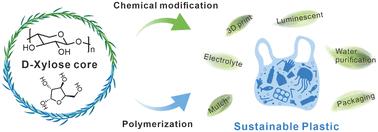
The widespread use of petroleum-based plastics has led to severe environmental pollution due to their poor biodegradability and the accumulation of plastic waste. As a promising alternative, bioplastics derived from renewable and biodegradable polysaccharides have attracted growing attention. In recent years, more researchers have begun to explore the development of high-performance bioplastics while preserving the sugar ring structure. This review aims to provide recent progress in the preparation and application of bioplastics that build on d-xylose cores. Modification strategies of xylan, such as esterification, etherification, oxidization, graft polymerization, and chemical crosslinking, and synthetic routes of xylose-core polymers, like ring-opening polymerization, polycondensation, acyclic diene metathesis (ADMET) polymerization, and click polymerization, have been emphasized. The potential applications of these bioplastics in agriculture, packaging, 2D/3D printing, solid polymer electrolytes, and luminescence materials are also presented. Finally, the challenges and future directions of xylose-derived bioplastics are presented, stimulating further efforts in utilizing natural and synthetic biopolymers based on biomass, ultimately contributing to realising a more sustainable and eco-friendly society.
期刊介绍:
Green Chemistry is a journal that provides a unique forum for the publication of innovative research on the development of alternative green and sustainable technologies. The scope of Green Chemistry is based on the definition proposed by Anastas and Warner (Green Chemistry: Theory and Practice, P T Anastas and J C Warner, Oxford University Press, Oxford, 1998), which defines green chemistry as the utilisation of a set of principles that reduces or eliminates the use or generation of hazardous substances in the design, manufacture and application of chemical products. Green Chemistry aims to reduce the environmental impact of the chemical enterprise by developing a technology base that is inherently non-toxic to living things and the environment. The journal welcomes submissions on all aspects of research relating to this endeavor and publishes original and significant cutting-edge research that is likely to be of wide general appeal. For a work to be published, it must present a significant advance in green chemistry, including a comparison with existing methods and a demonstration of advantages over those methods.




 京公网安备 11010802042870号
京ICP备2023020795号-1
京公网安备 11010802042870号
京ICP备2023020795号-1

 分享
分享
 求助内容:
求助内容: 应助结果提醒方式:
 扫码关注我们
