Genetic mutations and insecticide resistance in Diaphorina citri: a comparative study across Chinese citrus regions
BACKGROUND
Diaphorina citri, a serious pest of citrus, causes significant economic losses due to its role in spreading Huanglongbing. Chemical treatment is the primary method for controlling D. citri. In recent years, D. citri has demonstrated varying resistance levels to a number of pesticides. Combination bioassay and amplicon sequencing approaches can provide a more accurate assessment of resistance in D. citri.
RESULTS
Field populations of D. citri exhibited significant variability in pesticide susceptibility depending on geographic location. The Guilin population showed the highest imidacloprid sensitivity, with a median lethal concentration (LC50) of 1.14 mg L−1, indicating a comparatively high susceptibility to this pesticide. In contrast, the Chongzuo population exhibited the lowest sensitivity, with an LC50 exceeding 2000 mg L−1, reflecting a significant resistance level. Molecular analysis showed that resistance levels were associated with specific genetic mutations in two key areas: VGSC_L925M, VGSC_M918T, and the acetylcholine receptor α (nAChRα_N88S). Furthermore, there was a correlation between the rate of these mutations and the resistance level. Interestingly, the VGSC_L925M mutation was prevalent in the Chongzuo population, exhibiting a significant frequency of 42.08%. The nAChRα_N88S mutation, found at a low frequency of 0.24%, was unique to the Chongzuo population.
期刊介绍:
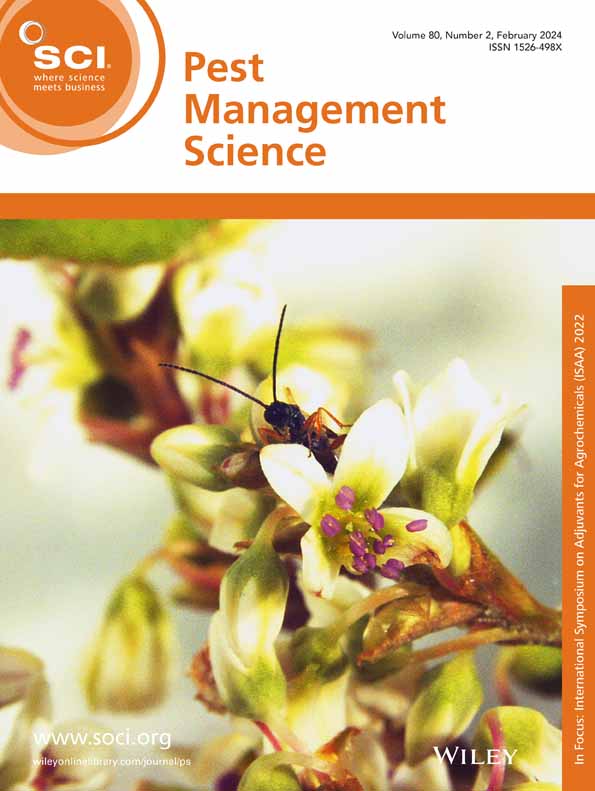
Pest Management Science is the international journal of research and development in crop protection and pest control. Since its launch in 1970, the journal has become the premier forum for papers on the discovery, application, and impact on the environment of products and strategies designed for pest management.
Published for SCI by John Wiley & Sons Ltd.






 京公网安备 11010802042870号
京ICP备2023020795号-1
京公网安备 11010802042870号
京ICP备2023020795号-1

 分享
分享
 求助内容:
求助内容: 应助结果提醒方式:
 扫码关注我们
