Andrew B. Kleist, Martyna Szpakowska, Lindsay J. Talbot, Greg Slodkowicz, Duccio Malinverni, Monica A. Thomas, Kyler S. Crawford, Daniel J. McGrail, Acacia F. Dishman, Michael J. Wedemeyer, Madison Sluter, S. Stephen Yi, Nidhi Sahni, Francis C. Peterson, Andy Chevigné, Brian F. Volkman, M. Madan Babu
{"title":"人类趋化因子- gpcr相互作用网络的编码和解码选择性和滥交","authors":"Andrew B. Kleist, Martyna Szpakowska, Lindsay J. Talbot, Greg Slodkowicz, Duccio Malinverni, Monica A. Thomas, Kyler S. Crawford, Daniel J. McGrail, Acacia F. Dishman, Michael J. Wedemeyer, Madison Sluter, S. Stephen Yi, Nidhi Sahni, Francis C. Peterson, Andy Chevigné, Brian F. Volkman, M. Madan Babu","doi":"10.1016/j.cell.2025.03.046","DOIUrl":null,"url":null,"abstract":"In humans, selective and promiscuous interactions between 46 secreted chemokine ligands and 23 cell surface chemokine receptors of the G-protein-coupled receptor (GPCR) family form a complex network to coordinate cell migration. While chemokines and their GPCRs each share common structural scaffolds, the molecular principles driving selectivity and promiscuity remain elusive. Here, we identify conserved, semi-conserved, and variable determinants (i.e., recognition elements) that are encoded and decoded by chemokines and their receptors to mediate interactions. Selectivity and promiscuity emerge from an ensemble of generalized (“public/conserved”) and specific (“private/variable”) determinants distributed among structured and unstructured protein regions, with ligands and receptors recognizing these determinants combinatorially. We employ these principles to engineer a viral chemokine with altered GPCR coupling preferences and provide a web resource to facilitate sequence-structure-function studies and protein design efforts for developing immuno-therapeutics and cell therapies.","PeriodicalId":9656,"journal":{"name":"Cell","volume":"18 1","pages":""},"PeriodicalIF":42.5000,"publicationDate":"2025-04-23","publicationTypes":"Journal Article","fieldsOfStudy":null,"isOpenAccess":false,"openAccessPdf":"","citationCount":"0","resultStr":"{\"title\":\"Encoding and decoding selectivity and promiscuity in the human chemokine-GPCR interaction network\",\"authors\":\"Andrew B. Kleist, Martyna Szpakowska, Lindsay J. Talbot, Greg Slodkowicz, Duccio Malinverni, Monica A. Thomas, Kyler S. Crawford, Daniel J. McGrail, Acacia F. Dishman, Michael J. Wedemeyer, Madison Sluter, S. Stephen Yi, Nidhi Sahni, Francis C. Peterson, Andy Chevigné, Brian F. Volkman, M. Madan Babu\",\"doi\":\"10.1016/j.cell.2025.03.046\",\"DOIUrl\":null,\"url\":null,\"abstract\":\"In humans, selective and promiscuous interactions between 46 secreted chemokine ligands and 23 cell surface chemokine receptors of the G-protein-coupled receptor (GPCR) family form a complex network to coordinate cell migration. While chemokines and their GPCRs each share common structural scaffolds, the molecular principles driving selectivity and promiscuity remain elusive. Here, we identify conserved, semi-conserved, and variable determinants (i.e., recognition elements) that are encoded and decoded by chemokines and their receptors to mediate interactions. Selectivity and promiscuity emerge from an ensemble of generalized (“public/conserved”) and specific (“private/variable”) determinants distributed among structured and unstructured protein regions, with ligands and receptors recognizing these determinants combinatorially. We employ these principles to engineer a viral chemokine with altered GPCR coupling preferences and provide a web resource to facilitate sequence-structure-function studies and protein design efforts for developing immuno-therapeutics and cell therapies.\",\"PeriodicalId\":9656,\"journal\":{\"name\":\"Cell\",\"volume\":\"18 1\",\"pages\":\"\"},\"PeriodicalIF\":42.5000,\"publicationDate\":\"2025-04-23\",\"publicationTypes\":\"Journal Article\",\"fieldsOfStudy\":null,\"isOpenAccess\":false,\"openAccessPdf\":\"\",\"citationCount\":\"0\",\"resultStr\":null,\"platform\":\"Semanticscholar\",\"paperid\":null,\"PeriodicalName\":\"Cell\",\"FirstCategoryId\":\"99\",\"ListUrlMain\":\"https://doi.org/10.1016/j.cell.2025.03.046\",\"RegionNum\":1,\"RegionCategory\":\"生物学\",\"ArticlePicture\":[],\"TitleCN\":null,\"AbstractTextCN\":null,\"PMCID\":null,\"EPubDate\":\"\",\"PubModel\":\"\",\"JCR\":\"Q1\",\"JCRName\":\"BIOCHEMISTRY & MOLECULAR BIOLOGY\",\"Score\":null,\"Total\":0}","platform":"Semanticscholar","paperid":null,"PeriodicalName":"Cell","FirstCategoryId":"99","ListUrlMain":"https://doi.org/10.1016/j.cell.2025.03.046","RegionNum":1,"RegionCategory":"生物学","ArticlePicture":[],"TitleCN":null,"AbstractTextCN":null,"PMCID":null,"EPubDate":"","PubModel":"","JCR":"Q1","JCRName":"BIOCHEMISTRY & MOLECULAR BIOLOGY","Score":null,"Total":0}
引用次数: 0
摘要
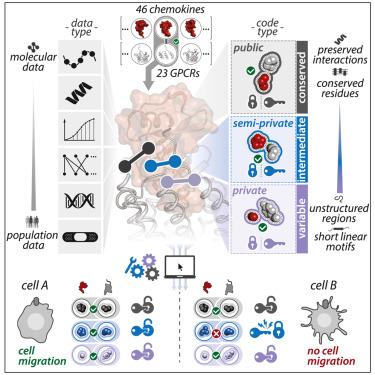
在人体中,46 种分泌型趋化因子配体与 23 种 G 蛋白偶联受体(GPCR)家族的细胞表面趋化因子受体之间的选择性和杂合性相互作用形成了一个复杂的网络,以协调细胞迁移。虽然趋化因子及其 GPCR 都有共同的结构支架,但驱动选择性和杂交性的分子原理仍然难以捉摸。在这里,我们确定了由趋化因子及其受体编码和解码以介导相互作用的保守、半保守和可变决定因素(即识别元件)。选择性和杂交性产生于分布在结构化和非结构化蛋白质区域的通用("公共/保守")和特异("私有/可变")决定因子的组合,配体和受体组合识别这些决定因子。我们利用这些原理设计了一种具有改变的 GPCR 偶联偏好的病毒趋化因子,并提供了一种网络资源,以促进序列-结构-功能研究和蛋白质设计工作,从而开发免疫疗法和细胞疗法。
Encoding and decoding selectivity and promiscuity in the human chemokine-GPCR interaction network
In humans, selective and promiscuous interactions between 46 secreted chemokine ligands and 23 cell surface chemokine receptors of the G-protein-coupled receptor (GPCR) family form a complex network to coordinate cell migration. While chemokines and their GPCRs each share common structural scaffolds, the molecular principles driving selectivity and promiscuity remain elusive. Here, we identify conserved, semi-conserved, and variable determinants (i.e., recognition elements) that are encoded and decoded by chemokines and their receptors to mediate interactions. Selectivity and promiscuity emerge from an ensemble of generalized (“public/conserved”) and specific (“private/variable”) determinants distributed among structured and unstructured protein regions, with ligands and receptors recognizing these determinants combinatorially. We employ these principles to engineer a viral chemokine with altered GPCR coupling preferences and provide a web resource to facilitate sequence-structure-function studies and protein design efforts for developing immuno-therapeutics and cell therapies.
期刊介绍:
Cells is an international, peer-reviewed, open access journal that focuses on cell biology, molecular biology, and biophysics. It is affiliated with several societies, including the Spanish Society for Biochemistry and Molecular Biology (SEBBM), Nordic Autophagy Society (NAS), Spanish Society of Hematology and Hemotherapy (SEHH), and Society for Regenerative Medicine (Russian Federation) (RPO).
The journal publishes research findings of significant importance in various areas of experimental biology, such as cell biology, molecular biology, neuroscience, immunology, virology, microbiology, cancer, human genetics, systems biology, signaling, and disease mechanisms and therapeutics. The primary criterion for considering papers is whether the results contribute to significant conceptual advances or raise thought-provoking questions and hypotheses related to interesting and important biological inquiries.
In addition to primary research articles presented in four formats, Cells also features review and opinion articles in its "leading edge" section, discussing recent research advancements and topics of interest to its wide readership.





 京公网安备 11010802042870号
京ICP备2023020795号-1
京公网安备 11010802042870号
京ICP备2023020795号-1

 分享
分享
 求助内容:
求助内容: 应助结果提醒方式:
 扫码关注我们
